.png)
.avif)
Manufacturing resilience rarely breaks because of one major event.
It weakens quietly—across disconnected assets, incomplete financial relationships, and fragmented compliance data.
An asset record without ownership visibility.
A supplier tied to the wrong facility.
A maintenance dependency hidden across disconnected systems.
A financial entity that isn’t connected to the operational assets it impacts.
Individually, these issues seem manageable.
But over time, they compound into operational disruption, compliance gaps, inaccurate reporting, and financial risk.
The issue isn’t always poor data quality.
It’s the inability to trust the relationships between that data.
Manufacturers don’t just need trusted records.
They need trusted relationships.
Where Operational Risk Actually Comes From
Manufacturers depend on connected operations across:
ERP systems
EAM platforms
MES environments
Procurement tools
Compliance systems
Financial systems
Asset management platforms
Supplier ecosystems
Most organizations have visibility into records.
But risk often exists between them.
This creates blind spots like:
- Assets disconnected from maintenance, warranty, or ownership history
- Supplier relationships that don’t reflect real operational dependencies
- Financial entities that aren’t tied to production impact
- Compliance workflows disconnected from physical asset relationships
- Hidden dependencies between suppliers, plants, materials, and operational assets
The result isn’t just inefficiency.
It’s resilience risk.
Teams are left trying to:
- Investigate disruptions without full operational context
- Trace supplier dependencies manually
- Reconcile asset relationships across multiple systems
- Identify risk exposure after problems have already spread downstream
Operational failures often begin in disconnected relationships—not disconnected systems.
Why Compliance and Resilience Fail Without Relationship Visibility
Manufacturers are investing in resilience strategies across:
Supply continuity
Regulatory compliance
Asset reliability
Financial controls
Operational governance
But resilience depends on understanding how entities interact.
When relationships are fragmented:
- Root-cause analysis slows down
- Supplier dependencies remain hidden
- Financial exposure becomes harder to trace
- Compliance reviews require manual investigation
- Cross-functional risks go undetected
The issue isn’t lack of governance.
It’s lack of relationship intelligence.
Without trusted relationship visibility, manufacturers react to risk instead of anticipating it.
The Hidden Cost of Disconnected Operational Networks
When assets, suppliers, and financial entities are disconnected, risk spreads across the business.
Hidden Dependency Risk
Organizations cannot easily identify upstream and downstream impacts.
Slower Incident Response
Teams investigate issues without full connected context.
Compliance Gaps
Relationships between assets, suppliers, and regulated workflows are harder to validate.
Financial Inaccuracy
Operational issues become disconnected from cost, revenue, and financial exposure.
Weak Resilience Planning
Organizations cannot model disruption impact effectively.
These are not isolated issues.
They are symptoms of the same root problem:
There is no governed network of trusted relationships across the enterprise.
A Different Approach: Govern Relationships, Not Just Records
Traditional MDM solves for entity consistency.
But operational resilience requires more than clean records.
It requires connected context.
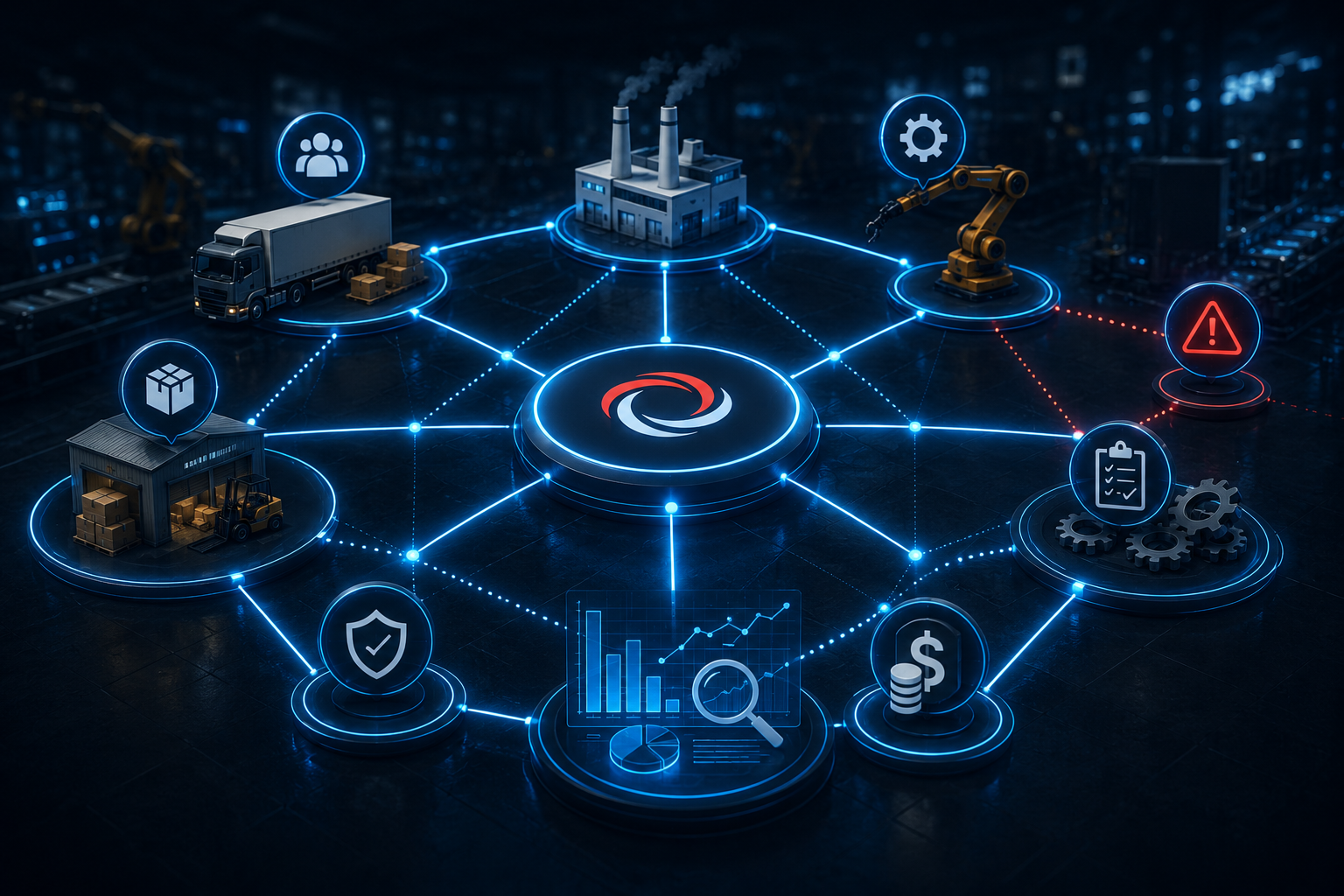
With LakeFusion’s LakeGraph-powered trusted network architecture, manufacturers can:
- Govern relationships between suppliers, assets, plants, products, and financial entities
- Surface hidden dependencies across operational systems
- Create multi-hop visibility across connected business entities
- Improve traceability during audits, incidents, and disruptions
- Detect downstream risk earlier with contextual relationship intelligence
- Support resilience planning with trusted network visibility
Instead of asking “What record is wrong?”
Teams can answer:
“What connected relationship is creating risk?”
That is where resilience improves.
From Reactive Risk Management to Network-Level Visibility
When relationships are governed at the foundation level, operations become more resilient.
Instead of reacting to disconnected issues:
- Asset ownership and dependencies remain visible
- Supplier relationships align with real operational impact
- Financial entities connect to production and compliance workflows
- Teams trace root cause faster
- Cross-system disruptions surface earlier
The impact is measurable:
- Faster incident response
- Stronger compliance visibility
- Improved operational resilience
- Better financial accuracy
- Reduced disruption impact
- Greater trust in enterprise decision-making
Resilience doesn’t come from more systems.
It comes from understanding connected risk.
Aligning Relationship Intelligence with the Lakehouse
The Databricks Lakehouse scales analytics and AI.
But it doesn’t define relationships across business entities.
Without a trusted relationship layer:
- Bronze captures raw records
- Silver transforms data
- Gold delivers analytics outputs
But dependencies across suppliers, assets, plants, and financial systems remain fragmented.
By introducing Master Data + Graph directly within Databricks:
- Assets become connected to ownership and lifecycle history
- Suppliers map to facilities and downstream products
- Financial entities align with operational exposure
- Compliance lineage becomes traceable
- Multi-hop dependencies become visible
This enables resilience based on trusted operational networks—not isolated records.
Why AI Can’t Detect Risk Without Relationship Intelligence
Manufacturers are using AI for:
Predictive maintenance
Operational risk modeling
Supply disruption analysis
Compliance monitoring
Financial forecasting
But AI can’t model what it cannot see.
When relationships are fragmented:
- Models miss hidden dependencies
- Alerts lack business context
- Risk signals become incomplete
- Root cause analysis slows
With a governed relationship layer:
- AI understands entity connections
- Risks are more explainable
- Operational impacts become traceable
- Decisions improve with contextual intelligence
AI doesn’t eliminate operational risk.
It exposes it faster when relationships are trusted.
From Records to Resilience
Manufacturers don’t strengthen resilience by governing records alone.
They strengthen it by governing the relationships between them.
LakeFusion helps manufacturers unify and govern asset, supplier, financial, and compliance relationships directly within Databricks—creating trusted networks that improve resilience, financial accuracy, and operational visibility.
Because operational risk doesn’t start in systems.
It starts in broken relationships.

Accelerate your edge with LakeFusion insights
Get practical perspectives on master data, governance, and building scalable, AI-ready data foundations.