
.avif)
Duplicate records are easy to spot when the same information appears twice. Things get less clear when records look different but point to the same customer, supplier, company, or product. One system may have "ABC Corporation," another may use "ABC Corp.," and a third may list a regional subsidiary with another address or identifier.
Understanding the difference between entity resolution vs data deduplication matters when an enterprise is trying to clean and manage its data. Deduplication targets duplicate records; entity resolution determines whether different records refer to the same real-world entity.
This difference matters for companies considering Master Data Management Software because trusted master data requires more than removing repeated rows.
Both approaches can improve data quality. However, they solve different problems.
What Is Data Deduplication?
Data deduplication identifies duplicate records in a data set. Depending on the circumstances, those records may be deleted, merged, or flagged for review. The simplest approach is to compare records using exact values.
For example:
| Customer ID | Company | |
|---|---|---|
| 101 | ABC Ltd | sales@abc.com |
| 101 | ABC Ltd | sales@abc.com |
Here, there is little doubt that the two records are duplicates. Enterprise data is not always this clean. Deduplication can also use normalization and fuzzy comparisons when records are very similar but not completely identical.
Why Duplicate Data Appears
Duplicate records can get into business systems in several ways:
- Users create the same customer more than once
- Data is migrated between applications
- Regional systems maintain separate copies
- Integrations generate repeated records
- Naming conventions differ between teams
- Acquisitions introduce overlapping datasets.
Deduplication reduces repeated data and makes the dataset easier to manage.
What Deduplication Does Well
Data deduplication works well when the main issue is repeated information inside a dataset or application. It can help organizations:
- Remove identical records
- Reduce storage redundancy
- Improve mailing or contact lists
- Simplify reporting
- Prevent repeated transactions or outreach.
There is a limit, though. Finding duplicate records does not always tell an enterprise whether different records belong to the same real-world entity. That is the problem entity resolution is designed to address.
What Is an Entity Resolution?
Entity resolution looks at different records and tries to determine whether they refer to the same real-world entity.
The records do not have to contain matching text.
Consider:
ABC Manufacturing LLC
125 Main Street
Chicago, IL
and:
ABC Mfg.
125 Main St.
Chicago, Illinois
The wording is different, but the two records may still describe the same company. An AI-powered MDM platform can review several fields together before deciding whether to connect those records to one entity.
Entity Resolution Uses Multiple Signals
Entity resolution can look at information such as:
- Names
- Addresses
- Phone Numbers
- Emails
- Tax Identifiers
- Company Identifiers
- Account Numbers
- Product Attributes
- Relationships
- Source-System Context.
The matching process may use deterministic rules, probabilistic methods, machine learning, or AI-assisted matching.
The point is not just to find rows that look repeated. The real question is, which records belong to the same underlying business entity?
Entity Resolution vs Data Deduplication
The main difference between entity resolution vs data deduplication is how deeply each approach looks at identity.
| Area | Data Deduplication | Entity Resolution |
|---|---|---|
| Primary goal | Remove redundant records | Identify real-world entities |
| Typical comparison | Exact or highly similar records | Multiple attributes and contextual signals |
| Complexity | Lower | Higher |
| Cross-system use | Possible but limited | Core use case |
| Ambiguous records | Often difficult | Designed to evaluate ambiguity |
| Matching methods | Exact/fuzzy comparison | Deterministic, probabilistic, ML, AI |
| Typical output | Deduplicated dataset | Unified entity identity |
Put simply:
Deduplication asks, "Are these records duplicates?"
Entity resolution asks, "Do these records represent the same entity?"
That difference matters more as a business adds more applications and data sources.
Deduplication vs Entity Resolution in Real Enterprise Data
The difference between entity resolution vs data deduplication is easier to see with real business examples.
Customer Records Across CRM and ERP
A CRM record may contain:
Robert Thompson
rthompson@company.com
The ERP may contain:
Bob Thompson
Robert.Thompson@company.com
A basic deduplication process may leave these records separate because the values are not identical.
Entity resolution can compare available fields and decide that both records likely refer to the same person.
For organizations building Master Data Management on Databricks, this type of identity matching across systems can be an important part of creating a consistent customer master.
Supplier Records Across Regions
A supplier could appear as:
Global ABC Holdings Ltd.
in one region and:
Global ABC Holdings Europe
in another.
This doesn't necessarily mean that the two records are copies of each other. These may be the same business, related businesses, subsidiaries, or legal entities. The primary criteria for entity resolution should be identifiers, addresses, ownership information, and business relationships before deciding whether to master the records together.
Product Records Across Systems
Product data can be even harder to match. Different ERP systems may use different part numbers, descriptions, languages, or classifications for the same physical product.
Why Record Matching Is Central to Entity Resolution
Record matching compares two or more records and estimates the probability that they come from the same entity. Simple rules can be enough when you have a reliable identifier.
For example:
- Exact tax ID,
- Exact company registration number,
- Exact email address.
Real company numbers can be more complicated. Values can be incomplete, missing, incorrect, or inconsistent between systems. That is when more advanced matching methods become useful.
Deterministic Matching
Deterministic matching follows predefined rules. For example: Match when the tax ID is identical. This method can be quick and easy to explain. When the identifier is reliable, it can also give a very strong match.
Probabilistic Matching
Probabilistic matching analyzes multiple fields and determines the probability that two records refer to the same entity. The company name may be slightly different, and the address, phone number and domain name are all identical. This provides a solution for when a record fails a very specific "exact-match" criterion.
AI-Assisted Matching
AI can help when record data is more complex or lacks a defined format. A Databricks-native MDM platform can integrate deterministic, probabilistic, and AI-driven approaches. Simple records can be processed quickly, while more complex records can be examined in depth.
Why Deduplication Alone Is Not Enough for MDM
Deduplication has a clear role in data quality, but enterprise Master Data Management needs to understand identity at a wider level.
Similar Records May Not Be Duplicates
Two records may look almost identical but still represent two different entities. For example:
- XYZ Holdings LLC
- XYZ Holdings Europe LLC
Merging them only because their names are similar could put incorrect information into the master record.
Different Records May Represent One Entity
The reverse can occur as well. Records can differ even if they come from the same organization. These differences can occur as a result of abbreviations, acquisitions, regional names or old information.
Unlike entity resolution, which focuses on similarities among records, entity resolution considers the identity behind them.
Relationships Matter
Enterprise entities do not always exist on their own. A company may have subsidiaries, a parent organization, supplier relationships, or customer affiliations.
A Graph Intelligence Platform can add this relationship information to mastered entities. This helps enterprises determine whether similar records are duplicates, connected organizations, or separate legal entities.
How Entity Resolution Supports MDM
Entity resolution is a key part of a mature MDM program. After the matching process identifies records that belong to the same entity, the MDM platform can take several other steps.
Match and Merge
Source records that belong together can be brought under one identity while the original source information remains available.
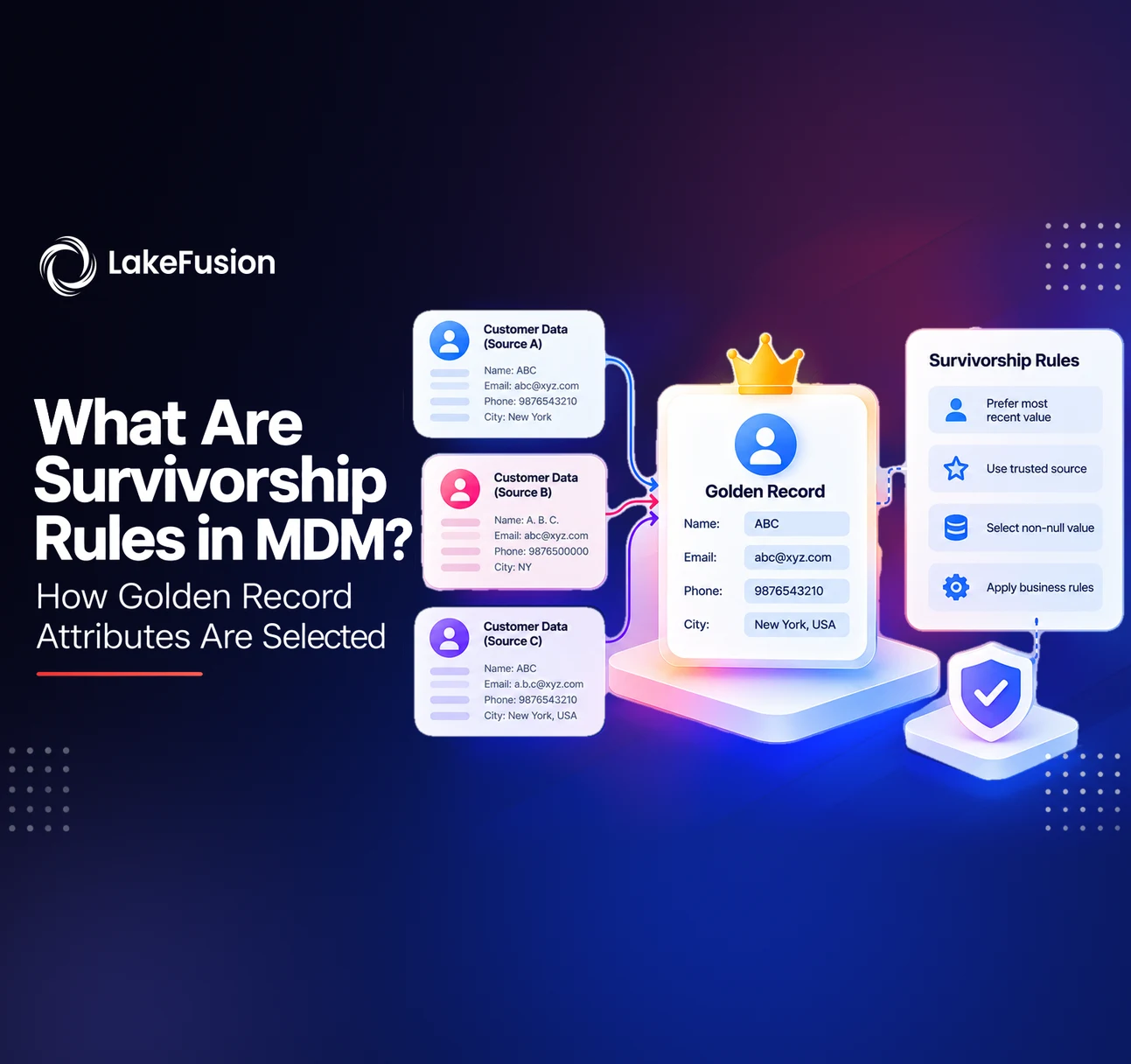
Survivorship
When two systems contain different values, business rules can decide which value becomes the authoritative one. CRM might contain the latest customer email, while ERP may have the verified billing address.
Stewardship
When the match is unclear, send cases to business users for review instead of merging automatically.
Ongoing Mastering
New records can continue to be checked against existing entities. This helps stop duplicate identities from building up again over time.
A Multidomain MDM Platform can use these processes across customers, suppliers, companies, products, locations, and other enterprise domains.
When Should Enterprises Use Deduplication?
Deduplication can be enough when the task is fairly simple, and the records follow a standard format. Common examples include:
- Removing repeated rows from a file,
- Cleaning contact lists,
- Eliminating exact transactional duplicates,
- Reducing duplicated storage,
- Preparing simple datasets.
If the aim is simply to clean one dataset, deduplication can do the job. The situation changes when an organization needs to understand identities across different systems, data domains, or inconsistent records. In that case, entity resolution becomes more important.
When Should Enterprises Use Entity Resolution?
Entity resolution is useful for more complex enterprise needs, including:
- customer mastering,
- supplier mastering,
- company mastering,
- product identity,
- fraud analysis,
- account consolidation,
- cross-system analytics,
- AI-ready enterprise data.
Organizations building an Enterprise Data Management Platform should look at whether their matching setup can do more than find simple duplicates. As more applications create and exchange records, identity becomes an ongoing business issue rather than something you can fix once and forget.
Entity Resolution on Databricks
For businesses that already keep their data in Databricks, adding another external MDM environment can mean more data copies, pipelines, and governance boundaries. A lakehouse-oriented setup allows entity matching and mastering to sit closer to the existing enterprise data foundation.
This can be useful when customer, supplier, product, and company information already exists across governed lakehouse tables. A modern MDM architecture can handle matching, survivorship, stewardship, and identity management while keeping mastered data connected to analytics and AI workloads.
For organizations that want trusted enterprise entities without adding another disconnected data stack, MDM software for Databricks can therefore be a relevant option.
Conclusion
The difference between deduplication vs entity resolution is mainly about the problem being solved.
Data deduplication deals with repeated information.
Entity resolution goes deeper and determines whether different records actually represent the same customer, supplier, product, or company.
If the dataset is simple, deduplicating the data may be enough. In a larger enterprise environment, identity can require record matching, context, governance, and ongoing mastering.
LakeFusion brings entity resolution, multidomain MDM, and graph intelligence together on Databricks. This helps enterprises move from basic duplicate cleanup to trusted, governed business identities.
Ready to resolve fragmented enterprise data at the identity level? Explore LakeFusion's Master Data Management platform and see how entity resolution can work around your Databricks environment.
Frequently Asked Questions
What is the difference between entity resolution and data deduplication?
Data deduplication finds and removes redundant records. Entity resolution goes further by checking whether different records refer to the same real-world entity, even when the information in those records is different.
Is deduplication part of entity resolution?
Deduplication can be used as one part of an entity-resolution process. Entity resolution covers a wider identity problem and can match inconsistent records across different systems.
What is entity matching?
Entity matching compares information from different records to determine whether they refer to the same customer, supplier, company, product, or other business entity.
Can entity resolution work across multiple systems?
Yes. Entity resolution can connect identities across CRM, ERP, billing, procurement, and other enterprise systems.
Why does MDM need entity resolution?
MDM needs entity resolution to identify which fragmented source records belong to the same entity. Once it establishes that identity, the platform can apply survivorship, governance, stewardship, and other mastering processes.

Accelerate your edge with LakeFusion insights
Get practical perspectives on master data, governance, and building scalable, AI-ready data foundations.