

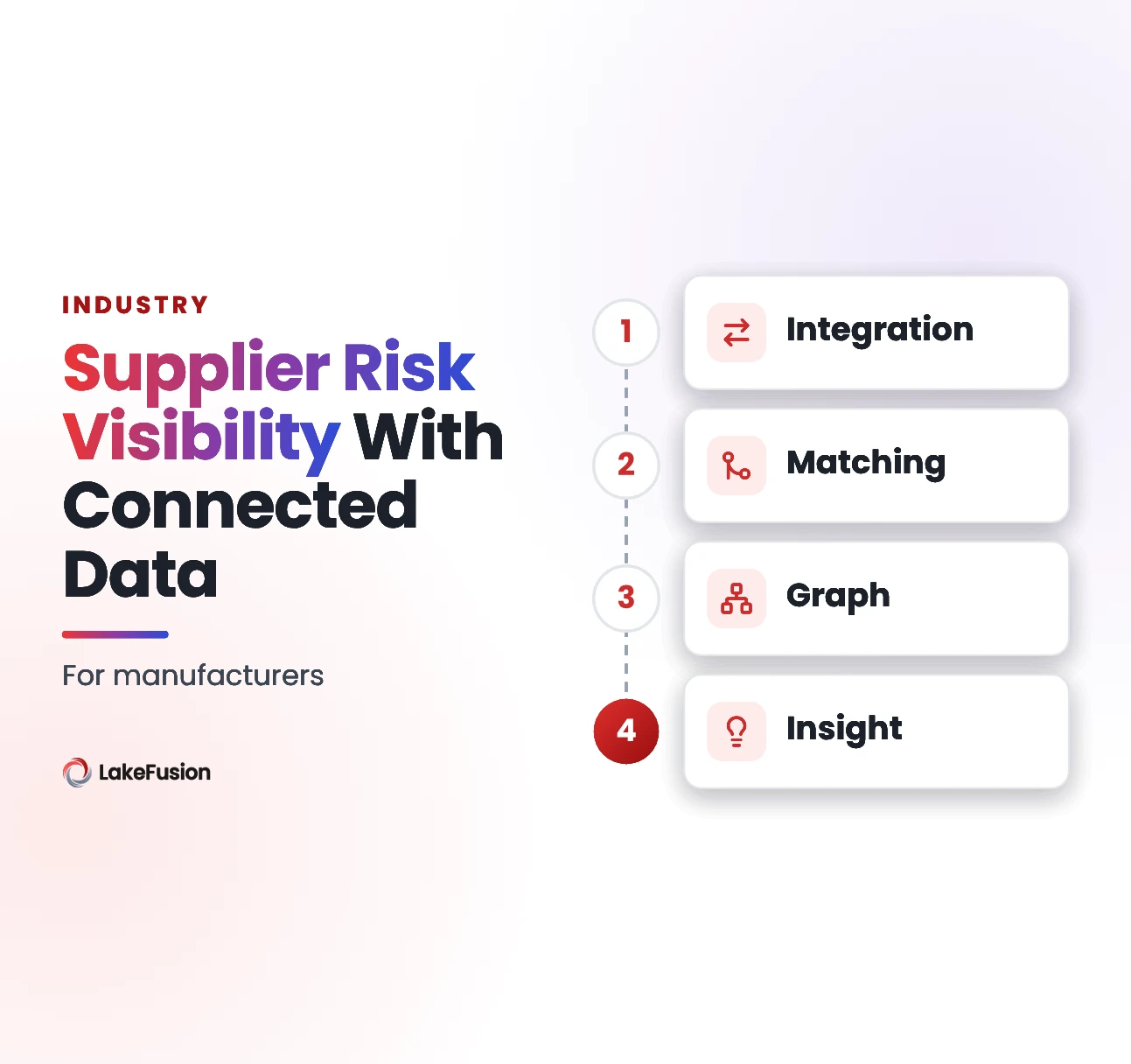

Manufacturers rely on networks of suppliers, distributors, contractors and logistics partners to keep things running. Supplier information often sits scattered across ERP systems, procurement platforms, finance applications and spreadsheets. That makes it hard to spot duplicate suppliers, understand corporate relationships and judge exposure across the supply chain.
Good manufacturing supplier risk management starts with reliable supplier information. You also need a clear view of how business entities connect.
With manufacturing data management solutions, manufacturers can pull scattered records together and build trusted supplier identities. Graph intelligence then shows relationships across the enterprise.
Why Manufacturers Struggle to Get a Clear View of Supplier Risk
Supplier risk isn't just about one vendor's performance. A manufacturer may work with several suppliers that belong to the same parent company. Some operate through different subsidiaries. Others share important business ties. When these facts sit in different enterprise systems, teams may never see the links.
Common data problems include:
- Duplicate supplier records: The same supplier shows up under different names or identifiers in procurement and ERP systems.
- Incomplete supplier information: Addresses, legal names, ownership details and other attributes are missing or old.
- Disconnected corporate relationships: Parent companies and subsidiaries sit in separate records with no clear link.
- Inconsistent supplier data: Different departments use different formats, naming habits and data standards.
- Limited enterprise visibility: Procurement teams can't easily pull supplier information together across plants and business units.
These gaps make supplier exposure hard to see. A procurement team may review each vendor account on its own. It may never realize that several accounts belong to related organizations.
That's why manufacturing supplier risk management needs a connected view. It covers supplier identities, business relationships and the risk information that matters.
Best Practices to Improve Supplier Risk Visibility With Connected Enterprise Data
Manufacturers need more than one central vendor list. They need a steady way to identify suppliers and keep records accurate. They also need to link related organizations and give business teams data they can trust. These practices help you build that base.
1. Consolidate Supplier Records Across Enterprise Systems
Supplier information usually comes from several systems. Those include ERP platforms, procurement applications, finance systems and supplier management tools. Each one may keep its own supplier identifier and its own version of an organization's details.
Supplier master data management helps pull these records together. It identifies records that describe the same business entity and builds a trusted master identity.
A consolidated supplier record can bring together:
- Legal and trading names
- Business addresses and contact information
- Supplier identifiers
- Source-system references
- Parent organization details
- Relevant supplier attributes
Procurement and finance teams get one consistent view of suppliers across systems. The manual work of reconciling duplicates before reporting or analysis also shrinks.
2. Improve Supplier Data Quality and Standardization
Duplicates are only part of the problem. Supplier information may also include inconsistent names, outdated addresses, missing identifiers, and conflicting attributes.
Better vendor data quality requires clear standards for how you collect, maintain, and update supplier information.
Manufacturers should set up processes to:
- Standardize supplier names and address formats.
- Spot missing or inconsistent attributes.
- Validate important supplier identifiers.
- Keep references to the original source records.
- Name an owner to review data exceptions.
A steady data quality process makes supplier information more dependable for procurement reports and risk analysis.
Without these standards, merging records may just bring inconsistent information into one place. Better manufacturing supplier risk management depends on keeping data quality up after the first consolidation, too.
3. Use Entity Resolution to Identify Duplicate Suppliers
One organization can look different across enterprise systems. One application holds its registered legal name. Another uses a short name. A third stores a local business name.
Entity resolution helps decide whether these records belong to the same organization. Manufacturers can use different matching methods:
- Deterministic matching: Compares records using set rules and identifiers.
- Probabilistic matching: Weighs similarities across names, addresses and other attributes.
- LLM matching: Uses meaning and context to judge harder-to-match records.
- Stewardship review: Sends uncertain matches to data stewards to confirm.
An enterprise entity resolution solution can help find duplicate supplier identities. It builds trusted records across source systems.
That gives supplier analysis a better base. But finding duplicate records doesn't tell you whether a supplier is risky. It makes sure teams are looking at the right organization. They aren't looking at scattered pieces.
4. Connect Suppliers With Parent Companies and Subsidiaries
A supplier's business identity can reach past its single vendor record. It may work through regional subsidiaries, manufacturing entities or other related organizations.
Without corporate hierarchy information, procurement teams may treat these entities as strangers.
Supplier relationship mapping links suppliers to their parent organizations, subsidiaries and other relevant business entities.
Say a manufacturer keeps separate supplier records for three regional companies. Once their link to a common parent organization is clear, procurement teams can view the broader relationship. They don't have to review each account separately.
That matters for manufacturing supply chain risk. Supplier exposure may be spread across several related entities.
5. Use Graph Intelligence to Understand Connected Supplier Data
Tables work well for keeping supplier records. But they make complex relationships hard to explore. Graph intelligence presents enterprise data differently. It connects entities through their relationships.
A manufacturer can use graph-based views to explore:
- Suppliers tied to a common parent company.
- Relationships between suppliers and distributors.
- Links between contractors and manufacturing facilities.
- Several supplier accounts tied to one organization.
- Business relationships kept across different plants.
Graph intelligence for manufacturing helps organizations explore these connections. They see how supplier entities relate to the wider enterprise.
Procurement and data teams get more context when they investigate supplier exposure. Graph intelligence doesn't check whether a supplier is stable on its own. It doesn't predict disruptions either. It makes relevant relationships easier to find and analyze.
6. Establish Data Governance and Stewardship
Connected supplier data has to stay accurate and controlled. Without clear owners, matching rules and update processes, duplicate and inconsistent records can creep back in. Manufacturers should set governance practices for:
- Data ownership: Name who's responsible for supplier information across procurement, finance and data teams.
- Matching policies: Set the rules for finding and resolving duplicate records.
- Survivorship: Decide which source attributes stay in the trusted master records.
- Stewardship: Give people a way to review uncertain matches and data exceptions.
- Access controls: Make sure users can view and change information based on their roles.
- Data lineage: Keep sight of the source records that feed the mastered supplier information.
LakeFusion master data management built on Databricks supports governed supplier data management inside your existing Databricks environment. These practices turn manufacturing supplier risk management into an ongoing data management process. It stops being a one-time supplier cleanup.
How LakeFusion Helps Manufacturers Build Connected Supplier Data
LakeFusion combines master data management and graph intelligence on Databricks so manufacturers can build trusted enterprise data. Its capabilities support supplier data management through:
- Supplier data consolidation: Resolve duplicate supplier and organization records across enterprise source systems.
- AI matching: Find records that may represent the same organization using deterministic, probabilistic, and LLM matching.
- Golden record management: Build trusted supplier identities with matching, merging and survivorship rules.
- Corporate hierarchy management: Link parent organizations, subsidiaries and related business entities.
- LakeGraph: Show and explore relationships between trusted entities using a property graph model on the Databricks and Delta Lake foundation.
- Governed data management: Support stewardship, role-based access and controlled management of master data.
The enterprise graph intelligence platform capabilities help connect trusted entities. Their relationships become easier to explore. MDM and graph intelligence together provide a foundation for more consistent supplier information and connected enterprise analysis.
Manufacturers can also combine trusted supplier records with internal and external indicators that matter. Examples include delivery performance, financial information, quality incidents and geographic exposure. These indicators support risk assessment. The quality and freshness of the underlying information still count.
Explore manufacturing data management capabilities and learn more about LakeFusion Trust and Security.
Conclusion
Better supplier visibility starts with fixing scattered records and understanding the relationships behind them. Manufacturing Supplier Risk Management works better when procurement, finance and data teams use consistent supplier identities and connected enterprise information.
LakeFusion brings Databricks-native MDM and graph intelligence together so manufacturers can build that trusted foundation.
Ready to see your supplier data more clearly across your manufacturing enterprise? Explore LakeFusion Product Capabilities and request a demo.
Frequently Asked Questions
What is Manufacturing Supplier Risk Management?
It's the work of spotting, assessing and monitoring risks tied to suppliers. The aim is to determine whether suppliers can continue supporting manufacturing operations.
How does supplier data quality affect risk visibility?
Inconsistent or duplicate supplier records can hide organizational links and skew supplier analysis. Reliable data gives risk assessment a stronger base.
What is supplier relationship mapping?
Supplier relationship mapping links suppliers to parent companies, subsidiaries, distributors and other related organizations. You get a wider view of business relationships.
How does graph intelligence support manufacturing supply chains?
Graph intelligence shows relationships between suppliers and other enterprise entities. Connected organizational information becomes easier to explore and analyze.
Can Master Data Management help manufacturers improve supplier risk visibility?
Yes. MDM helps combine duplicate supplier records and build trusted identities. It also keeps supplier information consistent, which supports risk analysis.

Accelerate your edge with LakeFusion insights
Get practical perspectives on master data, governance, and building scalable, AI-ready data foundations.


