

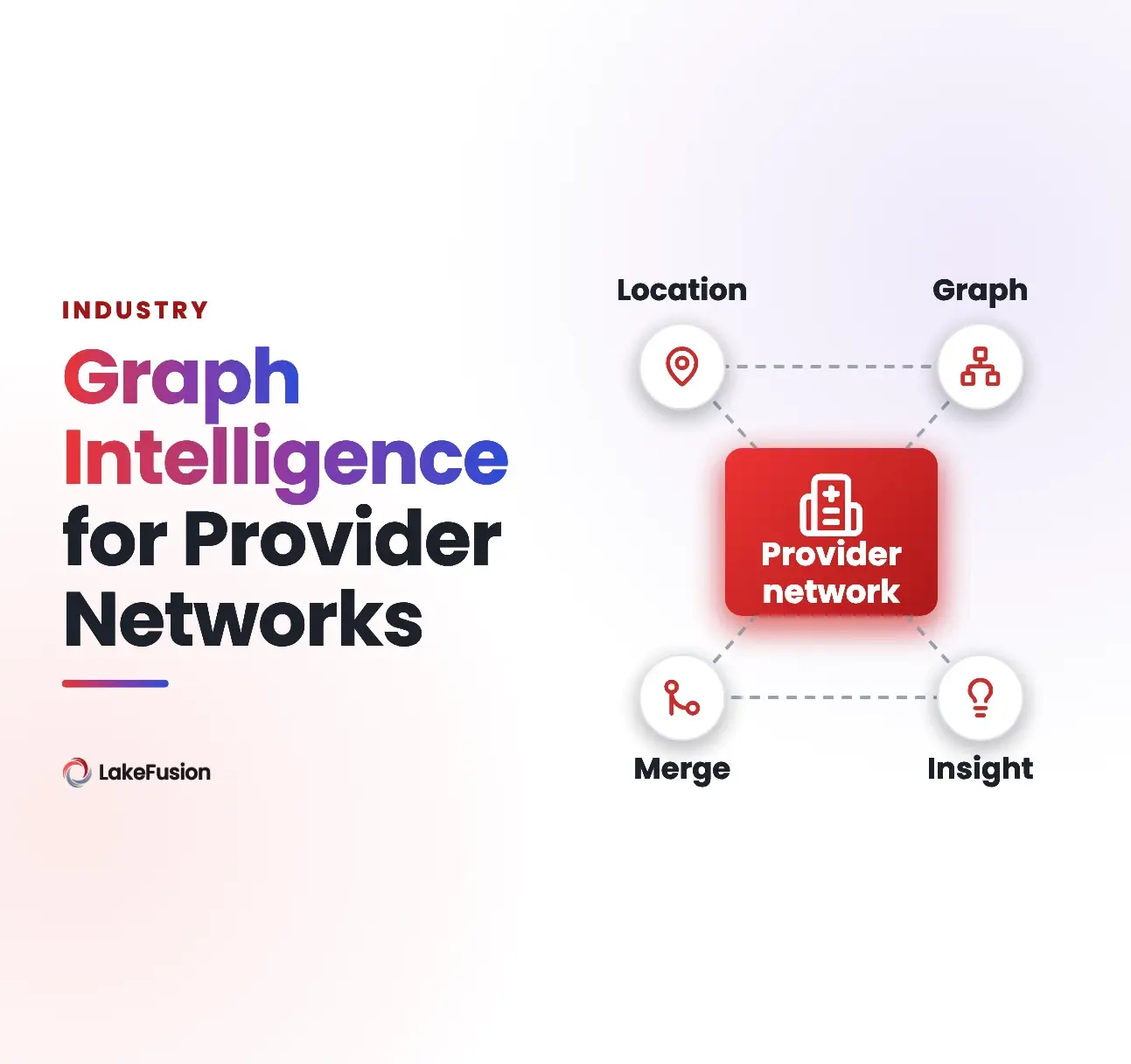

A healthcare provider network is bigger than a list of doctors, hospitals, and clinics. It includes medical groups, health systems, specialty practices, affiliated facilities, referral relationships, and other organizational ties. Healthcare organizations that manage provider directories, network operations, referrals, and analytics need to know how all these entities fit together.
The trouble is that this information sits in disconnected systems. Provider records get duplicated. Facility details don't match. Affiliation data can lag behind organizational changes. Traditional data management can store the records. It often can't represent complex, multi-level relationships.
Healthcare provider network intelligence brings these pieces together by pairing Master Data Management (MDM) with graph intelligence. MDM resolves trusted provider and facility records, and the graph links them so relationships are easier to explore, analyze, and put to use.
What Is Healthcare Provider Network Intelligence?
Healthcare provider network intelligence means understanding, managing, and analyzing how providers, facilities, organizations, and other network entities relate to each other.
A healthcare provider network may include:
- Individual physicians and other clinicians
- Hospitals and healthcare facilities
- Medical groups and independent practices
- Health systems and parent organizations
- Specialty departments and service locations
- Provider-to-facility affiliations
- Referral and professional relationships
Different kinds of relationships tie these entities together. One physician may practice at several facilities, belong to a medical group, and hold affiliations with more than one health system. A hospital may run several locations and work with independent specialty practices.
A regular database can hold these records in separate tables. Understanding how they connect across multiple levels often requires complex queries and repeated joins.
Graph intelligence shows entities as nodes and relationships as edges. You can explore direct and indirect connections, see how the network is structured, and use relationship context in operational and analytical workflows.
Why Healthcare Provider and Facility Relationships Are Difficult to Manage
Healthcare organizations often keep provider, facility, and affiliation information across credentialing systems, provider directories, claims platforms, electronic health record environments, and other applications.
Each system collects data for its own purpose. With no consistent way to identify entities and connect relationships, one provider or facility can look different across the organization.
1. Provider Records Are Duplicated Across Systems
A physician might appear under different name formats, identifiers, or practice addresses. One system could key on the National Provider Identifier (NPI), while another relies on an internal provider ID or a credentialing record number.
These mismatches make it hard to settle on one trusted provider identity. Duplicates can also hurt directory accuracy, network reporting, and downstream workflows.
2. Provider Affiliation Data Is Disconnected
Providers often work across several facilities, medical groups, and health systems. Affiliations change as clinicians join organizations, switch practices, or form new professional relationships.
When different systems maintain affiliation data on their own, organizations can struggle to see a provider's current network connections. When affiliation information is maintained separately across systems, organizations may struggle to identify the provider's current network connection.
3. Facility Relationships Are Complex
A facility may belong to a bigger health system. It may run under a parent organization or share services and departments with other locations.
Managing those ties takes more than a flat facility directory. Organizations need to understand parent-child structures, ownership, operational relationships, and provider affiliations.
4. Network Analytics Lack Relationship Context
Reports built only on individual provider or facility records can miss key connections. Teams may know which physicians appear in a directory. They may still struggle to see how those providers link to facilities, specialties, medical groups, and health systems.
That limits healthcare network analytics, especially when analysis depends on multiple relationship levels.
7 Ways Graph Intelligence Connects Healthcare Providers, Facilities, and Affiliations
Graph intelligence helps organizations move from disconnected records to connected network information. These practices show how healthcare organizations can use it alongside master data management and governance.
1. Establish Trusted Provider and Facility Records
Graph intelligence only helps when the underlying entities are identified correctly. Before you connect providers and facilities, you need a dependable way to resolve duplicate and inconsistent records.
Master Data Management (MDM) gives you that base. It matches records that describe the same real-world entity and keeps trusted golden records.
With LakeFusion, this runs natively on Databricks, where AI matching combines rules, deterministic identifiers like NPI, and LLM matching to resolve records that differ in name, address, or format.
Key practices include:
- Standardize provider and facility attributes.
- Match records using available identifiers and descriptive information.
- Spot potential duplicates across source systems.
- Apply approved match and merge rules.
- Define survivorship rules for conflicting attributes.
- Send uncertain matches to data stewards for review.
2. Represent Providers, Facilities, and Organizations as Connected Entities
Once entities are resolved, graph intelligence can show them as nodes and their relationships as edges.
A healthcare provider network graph may include:
- Provider nodes
- Facility nodes
- Medical group nodes
- Health system nodes
- Specialty nodes
- Organizational nodes
Relationships can capture connections such as:
- Provider practices at facility
- Provider affiliated with medical group
- Facility belongs to health system
- Medical group operates at facility
- Provider associated with specialty
- Facility operates under parent organization
This structure makes relationships explicit instead of leaving them buried across disconnected records.
A user can start with a physician and explore the practices, facilities, medical groups, and health systems tied to them, or start with a facility and find its providers and organizations.
3. Manage Provider Affiliations Across Multiple Locations
Provider affiliation data seldom stays still. A physician may practice at several facilities, join a new medical group, or end a tie with an old one.
A graph model handles this naturally, since a provider can hold as many organizational connections as the data supports.
ABC Health Network, for example, may include a physician who practices at two clinics and one hospital. You can connect that physician to all three facilities. You can also link them to a medical group.
Good affiliation management should track:
- Multiple provider-to-facility relationships
- Medical group memberships
- Parent health system connections
- Changes in affiliation status
- Effective dates, where available
- Source and provenance of relationship information
This supports stronger provider affiliation data management and gives teams a connected view of how providers take part in the network.
4. Connect Facility Hierarchies and Organizational Structures
Healthcare facilities often stay within bigger organizational structures. A hospital may run several departments, outpatient centers, and specialty clinics under one health system. A graph model can show these relationships across multiple levels.
For example:
- ABC Health System owns or operates ABC General Hospital.
- ABC General Hospital is associated with multiple specialty departments.
- Each department is connected to relevant providers.
- Some providers also practice at affiliated outpatient clinics.
That makes facility relationship management more complete. Teams stop treating facilities as isolated directory entries. They can see how locations connect to parent organizations, departments, and providers.
Graph-based exploration can also reveal facilities that share a parent organization. It can show providers who work across several locations too.
5. Improve Healthcare Network Analytics With Connected Context
Healthcare network analytics gets more useful when organizations can analyze relationships, not just individual records.
Graph intelligence can help answer questions such as:
- Which providers are affiliated with a particular health system?
- Which facilities are connected to a medical group?
- Which physicians practice across multiple locations?
- How are specialty providers distributed across a network?
- Which facilities share providers or organizational affiliations?
- How does a provider connect to a larger healthcare organization?
These questions can feed network analysis, directory management, operational planning, and relationship exploration.
The value comes from pairing trusted entity records with connected relationship information. Graph intelligence doesn't validate every relationship on its own. Organizations still need reliable source data, governance rules, and proper validation processes.
6. Maintain Relationship Accuracy Through Governance
Provider and facility relationships keep changing. New practices open. Providers move between organizations. Health systems restructure. Without governance, graph relationships can go stale even when each entity record stays accurate.
A practical governance approach should define:
- Who owns provider and facility information
- Which systems are authoritative for specific attributes
- Who can create or update affiliations
- How conflicting relationship information is reviewed
- How changes are approved and published
- How relationship history and provenance are maintained
Data stewards should be able to review uncertain records and settle exceptions. Role-based access controls help ensure users change only what falls under their responsibilities.
Governance keeps graph relationships in step with trusted master data. Unverified connections don't spread across the network.
7. Make Connected Healthcare Data Available to Applications and AI
Connected provider and facility information does more than power visuals. It can give approved applications, analytics workflows, and AI-enabled processes relationship context.
A provider network application, for instance, may need to pull a physician's trusted record. It may also need associated facilities, the medical group, and health system connections. A graph-based approach can serve those relationships as connected information. Every application doesn't have to rebuild them alone.
Organizations should think about:
- Governed access to provider and facility records
- APIs and approved data access patterns
- Scheduled relationship update pipelines
- Monitoring for failed or outdated updates
- Appropriate access controls for downstream applications
- Provenance and confidence information where available
Healthcare data becomes more useful while you keep control over how it is accessed and consumed. Because LakeFusion is deployed in your own cloud alongside Databricks, connected provider data stays within your existing governance.
Build a More Connected View of Healthcare Networks
Healthcare provider networks are complicated. Providers, facilities, medical groups, and health systems hold many relationships that change over time. Managing those ties through disconnected records makes the full network hard to see.
Graph intelligence for Healthcare lets you show and explore those relationships. Master Data Management keeps the underlying entities accurate and governed.
Together they give healthcare organizations a practical base. You get better visibility into provider affiliations, facility relationships, and network analytics.
Ready to connect trusted healthcare entities and relationships? Explore the LakeFusion healthcare graph intelligence platform, or contact our team to see how Master Data Management on Databricks can support your provider network strategy.
Frequently Asked Questions
1. What is healthcare provider network intelligence?
It means understanding and analyzing relationships among providers, facilities, medical groups, and health systems. It relies on connected entity and relationship data. You get network visibility and operational analysis.
2. How does graph intelligence help map healthcare provider relationships?
Graph intelligence shows providers, facilities, and organizations as nodes linked by relationships. Users can explore affiliations, facility connections, organizational hierarchies, and other network structures.
3. What is provider affiliation data?
It describes how healthcare professionals relate to organizations such as hospitals, medical groups, clinics, and health systems. It may include the facilities where a provider practices. It may also list the organizations the provider is associated with.
4. Why is Master Data Management important for healthcare network intelligence?
MDM finds duplicate provider and facility records. It standardizes information and keeps trusted entity records. Graph intelligence then builds on those trusted entities to show relationships more reliably.
5. What is the difference between healthcare data management and graph intelligence?
Healthcare data management is the broader discipline of integrating, governing, and maintaining healthcare information, and healthcare data management solutions often include MDM, data quality, and governance tools. Graph intelligence focuses on representing and analyzing how entities relate. The two work together: data management keeps entities accurate, and graph intelligence connects them.

Accelerate your edge with LakeFusion insights
Get practical perspectives on master data, governance, and building scalable, AI-ready data foundations.


