
.avif)
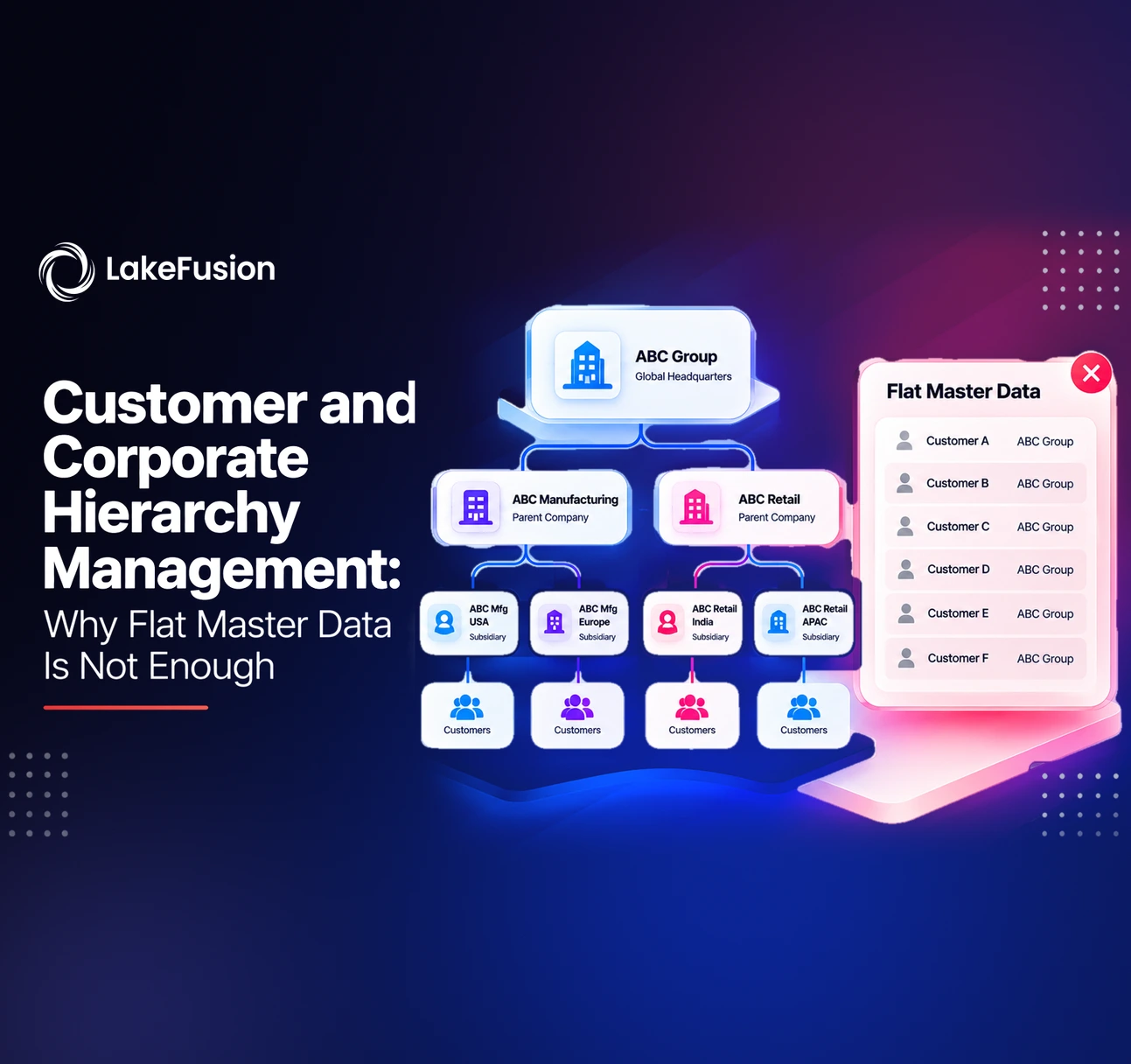
Master Data Management does one thing well. It takes messy customer and company records and turns them into trusted enterprise entities. But once you know who a customer is, you still don't know how it fits with other companies. Say a customer sits in a regional business unit. That unit belongs to a legal entity, and the legal entity belongs to a global parent. The same company might also show up in other hierarchies, depending on the region, who owns the sales relationship, or what the team is trying to do.
This is where hierarchy management MDM comes in. A modern Master Data Management on Databricks setup shouldn't stop at "this is the customer." It should also keep the parent-child links, the hierarchy paths, and the business context around that customer.
Big companies with tangled account structures feel this the most. Customer hierarchy management and corporate hierarchy data touch sales reporting, procurement analysis, customer 360 work, stewardship, AI, and analytics. Add a Graph Intelligence Platform, and you can go past simple trees and look at the wider network of relationships too.
Why Flat Master Data Creates an Incomplete Enterprise View
A flat master record is handy. I'm not knocking it. It tells you ABC Corp is a trusted business entity. It has an identifier, an address, a status, and links back to its source records.
What it doesn't tell you is this: ABC Corp → belongs to ABC Holdings → belongs to ABC Global
And that one line can change how the business reads everything.
Trusted Entity Is Not the Same as Trusted Context
Let's say you've mastered these companies:
- ABC Global
- ABC Holdings
- ABC Manufacturing
- ABC Services
- ABC Logistics
Every record can be spot on. Without the links between them, though, an analyst sees five separate customers. They're really one family. The sales team misses how big the account is.
Finance reports revenue by subsidiary and has no easy way to see the total at the parent level. Procurement buys from several suppliers and never realizes they belong to the same corporate group.
Flat mastering tells you who each company is. Hierarchy management tells you how they're related.
Enterprise Structures Rarely Stay Flat
Most companies have layers of:
- parent organizations,
- subsidiaries,
- regional entities,
- legal entities,
- business units,
- divisions,
- operating companies.
Customer structures look the same. A large multinational might buy through five subsidiaries, while the parent negotiates the actual contract.
So an Enterprise MDM Platform has to handle the entities and the relationships that connect them.
What Is Hierarchy Management in MDM?
Hierarchy management in MDM is how you define, govern, browse, and maintain hierarchical relationships between your mastered entities.
Parent-child is the one everybody knows: Parent Company → Child Company
Real hierarchies get a lot more complicated than two levels.
Customer Hierarchy Management
Customer hierarchy management arranges your customers the way your business actually works with them.
For example:
ABC Global
↳ ABC North America
↳ ABC Manufacturing
↳ ABC Services
A sales leader may want revenue totaled at ABC Global. An account manager cares about what's happening at ABC Manufacturing. A regional team mostly works at ABC North America. Each of them is right.
A solid Customer Master Data Management Solution keeps every identity as it is and still shows how they connect.
Corporate Hierarchy Management
Corporate hierarchies look at how companies, legal entities, subsidiaries, parents, and organizational units relate to each other.
They help with:
- corporate ownership analysis,
- supplier rollups,
- enterprise account structures,
- risk analysis,
- financial reporting,
- account planning.
With clean, governed corporate hierarchy data, anyone downstream can tell if two businesses are unrelated, directly linked, or part of the same corporate group.
Why Parent-Child Relationships Become Complicated
Most people picture a hierarchy as a neat and clean organization chart.
Real data doesn't work that way.
Hierarchies Can Be Ragged
Some branches go deeper than others. Take this one: ABC Global → ABC US → ABC East → ABC Services
That's four levels. Now look at this: ABC Global → ABC Europe
That's two. A hierarchy platform shouldn't make every branch the same depth just to look neat.
Hierarchies Can Mix Entity Types
One structure can hold different kinds of entities. For example: Global Organization → Legal Entity → Regional Business Unit → Customer Account
Each node has its own meaning, and the hierarchy should keep that. Treating every level as the same record type loses information.
Entity Can Appear in Multiple Placements
A single entity can sit in more than one hierarchy. That's normal. A company might be in a legal ownership hierarchy and also in a sales-account hierarchy. They answer different questions. If you force everything into one hierarchy, you throw away the context you actually need.
Hierarchy Paths Need Context
Knowing XYZ Services has a parent is okay. Seeing the whole breadcrumb is much better: ABC Global → ABC Holdings → XYZ Services
Now you can see where the entity sits and how it connects to the rest of the company. A good Hierarchy Management Platform lets business users and other systems browse these relationships and trace them back easily.
Why Hierarchies Belong Inside Master Data Management
Some teams try building corporate hierarchies on their own. They do it in reports, CRM workflows, or analytics notebooks. That brings back the same old data problem. Every team ends up with its own idea of who the parent is.
One Governed Relationship Foundation
If you manage hierarchy relationships alongside your trusted master entities, every team can reuse the same structure. You stop repeating the same logic in:
- BI dashboards,
- Applications,
- Customer Analytics,
- AI agents,
- Financial Analysis,
- Stewardship Workflows.
An Enterprise Master Data Management Platform becomes the single governed place where identity and hierarchy meet.
Preserve Relationship Provenance
Hierarchy relationships should also tell you where they came from. Your team should know who set up a relationship and why it's considered valid.
Take this link: ABC Subsidiary → ABC Parent
One source system might say it's true while another app shows a different structure. If you keep the provenance, stewards can see the difference and sort it out. If you don't, the hierarchy looks like a fact with no explanation.
Avoid Separate Hierarchy Synchronization
Running a hierarchy gets painful when you have to keep a separate copy and sync it constantly. LakeFusion hierarchy management can use the relationship edge tables you already have. You manage hierarchy views without building another copy of the hierarchy just to show the structure.
Hierarchy logic stays right next to your mastered data.
Customer Hierarchy Management Across Sales and Customer 360
Customer intelligence is probably the easiest place to see the value. Most Customer 360 projects pull attributes and transactions together around one customer. For enterprise and B2B companies, that often still leaves gaps.
See the Account Beyond One Customer Record
Say your mastered data has:
- ABC Parent
- ABC Services
- ABC Logistics
- ABC Manufacturing
A CRM user who only opens ABC Services sees that account's activity. They have no idea you already do business with the other three. With governed customer hierarchies, the team sees the local account and the larger organization together. A Customer 360 MDM Platform is much more useful when people can move up and down that structure.
Aggregate Without Losing Detail
You don't have to merge every subsidiary into its parent. If you did, you'd lose real differences in how each one operates. Keep each entity as it is and let numbers roll up when you need them.
That gives you both:
- subsidiary-level detail,
- parent-level analysis.
It works for revenue, contracts, customer relationships, service activity, and other business numbers.
Improve Search-Before-Create Decisions
Hierarchy context also helps you avoid duplicates. When someone searches for a company before creating a new record, it helps to see where a similar company sits in the corporate structure. Knowing it exists isn't enough.
A Databricks-native MDM platform can combine trusted entity resolution with governed relationships. People get better information before they decide to create something new.
Where Graph Intelligence Extends Hierarchy Management
Hierarchy management is strong. Still, plenty of business relationships don't fit in a tree.
Some of them form networks. That's where Graph Intelligence helps.
Hierarchies Answer Structured Relationship Questions
Hierarchy management works well for questions like:
- Who is the parent?
- Which entities are children?
- What is the hierarchy path?
- Which entities roll up to this organization?
These relationships have a direction and a clear structure.
Graph Intelligence Handles Broader Networks
A Graph Intelligence Platform for Databricks can cover relationships like:
- Company-To-Supplier,
- Customer-To-Account,
- Entity-To-Asset,
- Organization-To-Location,
- Company-To-Company Affiliation,
- Multi-Hop Relationship Paths.
Look at this example: ABC Parent → owns → ABC Services → buys from → XYZ Supplier
That's more than a parent-child hierarchy. It's a network of enterprise relationships. This is where Enterprise Graph Intelligence and hierarchy management work side by side.
From Hierarchies to Multi-Hop Context
With graph intelligence built on Databricks, you can stop asking: "Who is the parent of this entity?" and start asking: "What else gets connected when we follow this hierarchy and the business relationships around it?"
With Graph Analytics built on Databricks, you can access those multi-hop relationships without exporting governed data to a separate graph database.
Why Hierarchy Context Matters for AI Agents
AI agents are one more reason to manage enterprise relationships on purpose. An agent can pull up a customer record and have no clue it belongs to a bigger corporate family.
Then you get a half answer. Imagine someone asks the agent:
- "What is our total relationship with ABC Services?"
- Should it only count ABC Services?
- Should it add the subsidiaries?
- Should it roll everything up to ABC Global?
The answer depends on the business. An AI-ready Master Data Management Platform gives the agent trusted identity. Hierarchy and graph intelligence give it the structure to understand that identity.
That builds a better base for governed AI: Trusted entity → hierarchy context → broader relationship context
Don't make agents work out corporate structures from raw records every time. Give them a governed relationship model.
LakeFusion: Manage Trusted Entities and Hierarchies on Databricks
LakeFusion puts identity resolution, hierarchy management, stewardship, and Graph Intelligence together on the Databricks foundation. Move past flat master records without adding separate tools to manage relationships.
Flexible Enterprise Hierarchies
LakeFusion supports hierarchical relationships with ragged structures, mixed entity types, and multiple placements. You model your business the way it really looks. Nobody has to squeeze it into one rigid tree.
Existing Relationship Edge Tables
Hierarchy views can work straight from your existing relationship edge tables. Your team doesn't have to build another hierarchy copy and keep it in sync.
Navigable Hierarchy Context
Breadcrumb-style context shows users where an entity sits and lets them move through the levels around it.
Governed Relationship Provenance
Relationship provenance tells you how a hierarchy link got set up. That helps with stewardship and governance.
MDM Plus Graph Intelligence
LakeFusion MDM sets up trusted entities. LakeGraph then grows those entities into richer relationship networks and multi-hop insights.
Put a Lakehouse Master Data Management Platform and Graph Intelligence on the same Databricks foundation, and you can handle structured hierarchies and broader connected-data use cases in one place.
Flat Records Tell You Who. Hierarchies Tell You Where They Fit.
Mastering your customer and company records is the first step you can't skip. But trusted identity covers only part of the picture.
Hierarchy management MDM gives you the context to understand parent-child relationships, corporate structures, organizational rollups, and the different hierarchy views that can all be right. Graph Intelligence goes further by linking mastered entities into bigger relationship networks.
LakeFusion helps you manage trusted identities, hierarchies, and connected enterprise context right on Databricks. Your apps, analytics, business teams, and AI get a clearer view of who an entity is, where it belongs, and how it connects.
Move beyond flat master data. Explore LakeFusion Master Data Management and Graph Intelligence, or request a demo.
Frequently Asked Questions
What is hierarchy management in MDM?
It's how you define and govern the structural relationships between mastered entities. That includes parent-child links, corporate structures, customer account hierarchies, and organizational rollups.
What is customer hierarchy management?
It groups related customers into business structures like global parents, regional organizations, subsidiaries, and individual accounts. Each entity keeps its own identity.
Why is corporate hierarchy data important?
It shows you ownership, parent-subsidiary structures, account rollups, supplier relationships, and other links between organizations. You can't see any of that from flat records.
Can one entity belong to multiple hierarchies?
Yes. The same entity can sit in several valid business structures. A legal hierarchy and a commercial account hierarchy are a common pair.
How does Graph Intelligence complement hierarchy management?
Hierarchy management handles structured relationships like parent-child trees. Graph Intelligence takes those trusted entities and connects them into wider networks, multi-hop links, affiliations, and other relationships that don't fit in a tree.

Accelerate your edge with LakeFusion insights
Get practical perspectives on master data, governance, and building scalable, AI-ready data foundations.