
.avif)
Business data doesn't sit in neat little rows. A customer belongs to a corporate group. A supplier ties back to a product and a location. Accounts roll up to a parent. People, partners, contracts, assets, transactions, they all connect to each other. And those hooks often matter more than any single record.
Normal analytics tells you about each entity. Graph intelligence tells you how they're linked, how far those links run across several hops, and what that means when you're making a call.
Already on Databricks? Then a Graph Intelligence Platform can add relationship context right around the data you already govern. No separate graph database. Add Master Data Management built on Databricks, and you can first settle who your entities are, then connect them in ways that feed analytics, daily workflows, and AI.
Trusted entities first, trusted networks next. That's why enterprise graph intelligence pays off. Messy, scattered relationships become something you can actually walk through.
What Is Graph Intelligence?
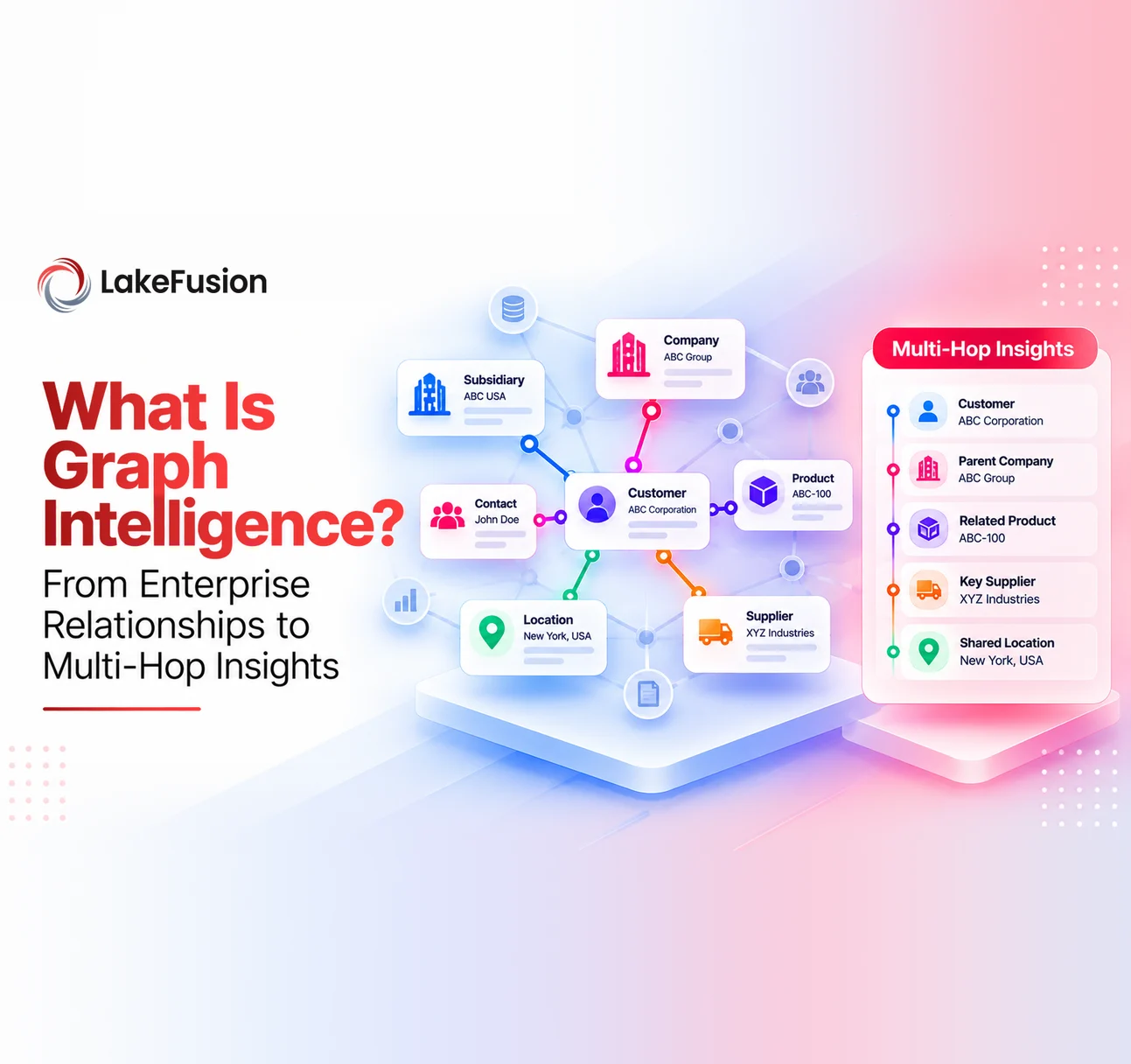
Graph intelligence uses graph models and analytics to understand how business entities relate to each other.
Instead of keeping everything in rows and columns, a graph model builds around:
- Nodes, the things themselves: customers, suppliers, companies, accounts, assets, locations;
- Edges, the relationships between those things;
- Properties, the extra details attached to nodes and relationships.
Quick example.
ABC Holdings owns ABC Logistics.
ABC Logistics supplies XYZ Manufacturing.
XYZ Manufacturing buys a component tied to Location A.
A regular table can hold each of those facts. Separately. A graph lets you follow the whole chain in one pass. You ask about the network, not one record at a time.
Graph Intelligence Goes Beyond Visualization
Lots of people hear "graph" and picture a network diagram. Diagrams are fine. But relationship intelligence is about more than a picture.
What counts is being able to query relationships, analyze them, act on them, and reason across them.
You might want to know:
- Which subsidiaries end up under the same corporate parent?
- Which suppliers connect, even indirectly, to a particular organization?
- Which accounts share relationships?
- Which entities sit within three hops of each other?
- How does one customer tie into suppliers, contracts, or other entities?
You can't answer these with a plain row-level query. They're relationship questions.
Graph Intelligence vs Graph Analytics
Graph analytics is a big piece of graph intelligence. Same thing? No. Graph analytics looks at graph structures, follows connections, and finds patterns in networks.
Graph intelligence goes further. It brings in governed entities, clear relationship definitions, working business processes, and links to your other data tools. For a company, running a graph algorithm isn't the goal. The goal is to make relationship context useful in apps, AI, analytics, and day-to-day processes.
Why Enterprise Relationships Are Hard to Understand in Tables
Tables still matter. Nobody's saying throw them out. The pain shows up when a question forces you to join layer after layer of relationships. One relationship? Easy. Five that depend on each other? That gets ugly quick.
Relationships Are Distributed Across Systems
Part of a company hierarchy may live in the CRM. Supplier links sit in procurement. Parent company details might come from an outside data source. Customer relationships could be in yet another app.
Even once you pull all that into one place, the relationships stay spread over different tables and schemas. An Enterprise Data Management Platform gives you a more stable foundation. Graph intelligence then maps out how those entities actually connect.
One Entity Can Have Multiple Roles
One company can be:
- a customer,
- a supplier,
- a partner,
- a subsidiary,
- a parent organization.
Take ABC Corp.
In one system, it's a customer. In another, it's a supplier. Unless you sort out who this company really is, your systems may treat those as two strangers. A good Enterprise MDM Platform settles the identity. After that, graph intelligence can show the different roles and links around the mastered entity.
Hierarchies Are Often More Complex Than Parent-Child Trees
Real hierarchies get messy. One entity can sit in several org structures. Some trees are lopsided. Some mix different entity types.
Some put the same entity in multiple places, depending on the business context. Graph models handle this well because they don't stop at a single rigid hierarchy. Don't force everything into a single tree. Model the network the way it really is.
How Multi-Hop Queries Turn Relationships Into Insights
Multi-hop queries are one of the best things about graph intelligence. A hop is one step from a node to the next, across one relationship.
For example: ABC Parent → ABC Subsidiary
That's a single hop.
Add this: ABC Subsidiary → XYZ Supplier
Now the supplier sits two hops from the parent. One more relationship, and you're at three.
Why Multi-Hop Queries Matter
Many useful business questions require more than one connection to answer. A procurement team might ask:
- Which suppliers belong to the same corporate group?
- A sales team might ask: Which customer subsidiaries link to accounts we already serve?
- A risk team might ask: Which organizations connect to this company through shared relationships, even indirectly?
- An AI agent might ask, "Show every entity within three relationship hops of ABC Corp.
Try that with repeated joins, and it turns clunky the deeper you go. Graph Analytics built on Databricks makes the network easier to query and put to use.
Multi-Hop Context Changes the Answer
Say you have these relationships:
- ABC Holdings → owns → ABC Services
- ABC Services → buys from → XYZ Supply
- XYZ Supply → associated with → Location A
If you look at ABC Holdings alone, you may never hear about Location A. A multi-hop query walks the network and finds that link. It matters a lot. Risk, opportunity, ownership, and dependency tend to hide a few relationships away from where you started.
Relationship Intelligence Adds Meaning to Traversal
Walking through relationships only helps if they mean something.
An edge like ABC Holdings → ABC Services
gets far more useful once you name it: OWNS
Same goes for ABC Services → XYZ Supply.
which could be: SUPPLIES_TO
Those relationship types carry the business meaning. That's what turns graph traversal into relationship intelligence.
Where Graph Intelligence Fits With Master Data Management
A graph works far better when the entities inside it are already trusted. If they aren't, you've only connected duplicates and conflicting records. So MDM and graph tools go hand in hand.
MDM Resolves the Nodes
Before you ask how things connect, you need to know what each thing is. A Databricks-native MDM platform can clean up scattered records across systems. It uses matching, survivorship, stewardship, and entity-resolution workflows.
Picture this:
- ABC Technologies LLC
- ABC Tech
- ABC Technologies
Those might all need to become one trusted company identity. One mastered identity makes a much better graph node than three loose source records.
Graph Intelligence Connects the Nodes
With trusted entities in place, graph intelligence can build the links between them. Here's a simple way to think about it:
MDM answers: Who is this entity?
Graph intelligence answers: How is this entity connected?
You need both. One gives you identity, the other gives you context.
Graph Can Also Feed MDM
It runs both ways. Graph context can turn up details that flow back into your mastering workflows. LakeFusion LakeGraph can send graph-to-MDM suggestions. Relationship context then helps the master-data process, instead of sitting in its own analytics corner. Identity resolution and relationship intelligence work much more closely together.
Common Enterprise Graph Intelligence Use Cases
You'll see the value of enterprise graph intelligence fastest when you point it at real business questions.
Corporate Hierarchy Intelligence
Big companies usually run through subsidiaries, regional entities, brands, and legal organizations. Graph intelligence ties those into one network you can browse.
That opens up questions like:
- Which entities roll up to the same parent?
- Which subsidiaries belong to this corporate group?
- Where does a certain legal entity sit in the network?
Customer intelligence, supplier analysis, reporting, and account planning all get easier.
Customer and Account Relationship Intelligence
A customer relationship often runs past a single CRM account. One company might have several subsidiaries, buying entities, business units, or regional accounts.
Graph intelligence connects those identities. Your teams see the whole account network and stop working off isolated records. Pair that with an AI-ready Master Data Management platform and your AI and analytics get trusted customer identity plus relationship context.
Supplier Network Analysis
Suppliers can sit inside larger corporate structures too. You might think you buy from five unrelated vendors. Turns out they all roll up to one parent. A graph shows you that. You get a wider view of your supplier network. Relationship context can also show how suppliers link to other entities in your business.
AI Agent Context
AI agents now need more than single records. An agent might know who ABC Corp is thanks to mastered identity. It still has to find out:
- its subsidiaries,
- connected suppliers,
- related customer accounts,
- corporate parents,
- other entities several hops away.
A Graph Intelligence solution for AI agents hands over that network context. The agent doesn't have to guess every relationship from raw tables. That helps a lot when you expect agents to reason across complex business relationships.
Why Graph Intelligence Does Not Require Another Graph Database
Plenty of companies think graph tools mean moving data into a separate graph database. Often, they don't. If you already run on Databricks, LakeFusion LakeGraph uses a property graph model on top of your existing Databricks and Delta setup. So you build relationship intelligence next to data you already govern. No extra, disconnected data store to look after.
Keep Graph Close to Enterprise Data
A Databricks-native Graph Intelligence platform works with the business data that's already in your lakehouse. You skip keeping separate copies just for graph work. It also keeps graph close to your analytics, governance, AI, and master-data setup.
Operationalize Relationships
Graph intelligence is more valuable when relationships drive real activity. LakeGraph supports scheduled pipelines and operational graph workflows. Relationship data stays part of a living data process, not a static picture on a screen.
If you've configured it, relationship conditions can also trigger downstream actions like updates, pipelines, or webhooks. The point is simple. Finding a relationship isn't enough. Put it to work.
LakeFusion: Graph Intelligence Built for Databricks
LakeFusion brings Graph Intelligence and Master Data Management together. You work with trusted entities and trusted relationships on one Databricks foundation.
Databricks-Native Property Graph
LakeGraph gives you a property graph model on Databricks and Delta. You don't need a separate external graph database. You get a Lakehouse Graph Intelligence Platform that sits close to your existing data setup.
MDM and Graph Together
LakeFusion MDM builds trusted business identities. LakeGraph connects those identities through relationships.
Your teams then move naturally from: trusted entities → trusted relationships → multi-hop intelligence
You skip the headache of building graph context on top of unresolved source records.
Operational Graph Pipelines
LakeGraph runs scheduled pipelines, so graph relationships stay current when your data changes.
That fits everyday use. It isn't a one-time analysis.
Graph-to-MDM Intelligence
Graph relationships can produce suggestions that feed back into MDM. Network context helps you understand your entities better.
AI and MCP Access
LakeFusion also gives you one MCP access point across MDM and Graph. That's a strong foundation for AI agents that need trusted entity identity and relationship context. Don't give agents raw rows. Give them a governed network of entities and connections.
Conclusion
Graph intelligence moves you from single records to the networks those records form. Graph analytics shows direct connections. Multi-hop queries find relationships several steps out.
Relationship intelligence puts business meaning on those links. Add trusted MDM entities and you've got a much richer base for analytics, operations, and AI. LakeFusion puts Master Data Management and Graph Intelligence together right on Databricks. You work out who an entity is, see how it connects, and put those relationships to work.
Turn trusted enterprise entities into connected business intelligence. Explore LakeFusion Graph Intelligence or request a demo.
Frequently Asked Questions
What is graph intelligence?
It means using graph data models, relationship analysis, and network traversal to see how business entities connect and what those connections mean for your decisions.
What is enterprise graph intelligence?
It's graph tools applied to business entities like customers, suppliers, companies, accounts, assets, and org structures.
What are multi-hop queries?
They follow several relationships out from a starting entity. They can show indirect links that a direct record lookup wouldn't catch.
What is the difference between graph analytics and graph intelligence?
Graph analytics queries and analyzes network structures. Graph intelligence adds business context, trusted entities, operational relationships, and business workflows.
How does graph intelligence work with MDM?
MDM sets up trusted business entities. Graph intelligence connects them and analyzes the relationships between them, so you get both identity and network context.

Accelerate your edge with LakeFusion insights
Get practical perspectives on master data, governance, and building scalable, AI-ready data foundations.