
.avif)
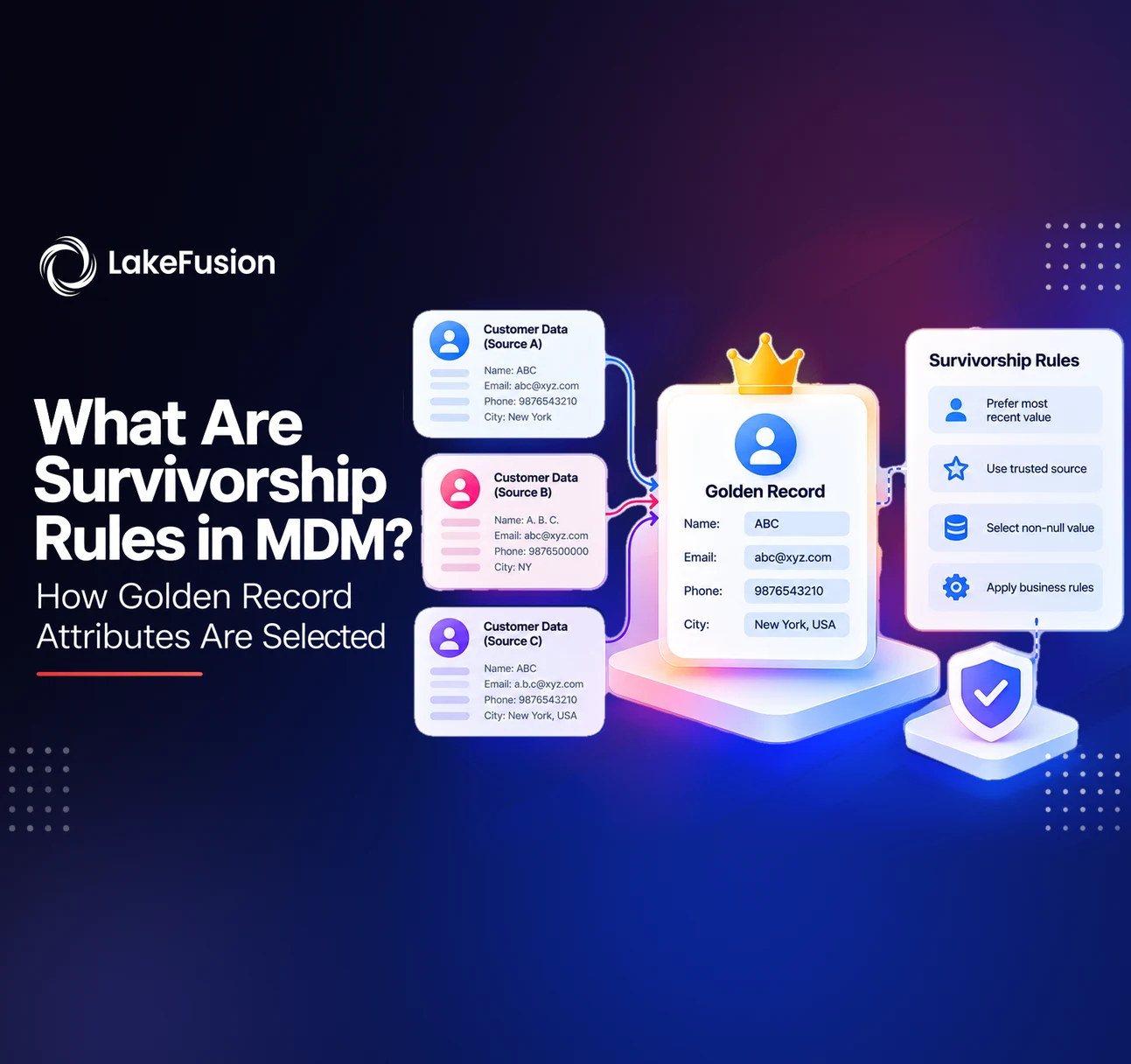
Building a trusted master record involves more than finding records that belong to the same entity. After matching customer, supplier, company, or product records, the next question is which information should appear in the final mastered record. One system may have the newest address, another may contain the verified legal name, and a different system may have better contact details.
This is where MDM survivorship rules become important. A modern Master Data Management Software platform can use survivorship logic to decide which source value should become the trusted value after records are matched and merged. At the same time, the original source information and its lineage can remain available for review.
A well-planned survivorship MDM process can look at source precedence, recency, completeness, validation, and business rules together. This helps the final record reflect the information the organization has the most reason to trust.
What Are MDM Survivorship Rules?
MDM survivorship rules are business and technical rules used to choose the attribute value that should remain when matched records contain different information about the same entity.
Take these three customer records as an example:
| Source | Customer Name | Phone | Address |
|---|---|---|---|
| CRM | XYZ Corporation | 555-0182 | Chicago |
| ERP | XYZ Corp. | 555-0182 | Chicago |
| Billing | XYZ Corporation | 555-0117 | New York |
Entity matching may show that all three records belong to the same customer. Survivorship deals with the next step: Which customer name, phone number, and address should the mastered record use?
There may not be one answer for every attribute. CRM may be the preferred source for contact information. ERP may own legal company information, while billing may be the right source for payment-related fields.
For this reason, survivorship should not normally depend on one broad rule where the same source automatically wins every field.
How Survivorship Fits Into Match and Merge
Survivorship usually comes after matching and merging, although some MDM processes can perform these activities alongside each other.
Matching establishes whether two or more records refer to the same real-world entity. Merging brings those records together under a common identity. Survivorship then decides which attribute values should appear as authoritative. A common workflow can look like this:
1. Identify Matching Records
An AI-powered MDM platform can use deterministic, probabilistic, or AI-assisted matching methods to find records that may refer to the same real-world entity.
2. Group Records Into an Entity
After the match reaches the required confidence level, the platform can connect the related source records to one mastered identity.
3. Evaluate Conflicting Attributes
The platform then checks the values held across the matched records. For example:
- different company names,
- multiple addresses,
- conflicting phone numbers,
- different lifecycle statuses.
4. Apply Survivorship Rules
The system then applies the configured golden record rules to the conflicting values. The system uses those rules to decide which information should survive.
5. Preserve Source Lineage
Selecting one value does not mean the other source values should disappear. The source information should remain traceable so teams can understand where the surviving value came from.
This becomes especially useful for enterprises using Master Data Management on Databricks, where mastered information needs to stay connected with the wider governed data foundation.
Common Types of Survivorship Rules
Different attributes can need different survivorship methods. Mature MDM programs often use several strategies instead of depending on one rule for every situation.
Source Precedence
Source precedence assigns greater importance to one system for a particular attribute. For example:
- ERP wins for legal entity names.
- CRM wins for sales contact details.
- Billing wins for payment status.
- Procurement wins for supplier classification.
This approach works when the organization has already decided which system owns a particular field. The problem starts when the same source ranking gets applied across every attribute. A system that owns one type of information may not have the most reliable value for another.
Most Recent Value
Some fields change often and need the newest acceptable information. Examples include:
- phone numbers,
- addresses,
- email addresses,
- contact roles.
In this case, the system checks the timestamps attached to the values and selects the latest value that meets the required conditions.
Still, recency alone does not prove the information is correct. A recently entered value can contain an error. That is why organizations may combine recency with source reliability, validation, or other checks.
Most Complete Value
A completeness rule looks for the value that provides more usable information.
For example:
"XYZ Manufacturing Corporation"
may be selected instead of:
"XYZ Mfg."
when both values identify the same organization.
This method can help with company names, addresses, product descriptions, and other fields where extra detail matters.
Most Trusted Value
Organizations can also give different trust levels to sources or individual records. For example, an address checked and approved by a data steward may be preferred over a newer address that hasn't been verified yet.
This lets MDM survivorship rules look beyond a value's age or its source system. Data quality and governance can also factor into the decision.
Conditional Survivorship
More complex environments may need rules that check several conditions before selecting a value.
For example: Use the ERP legal name when the value has been verified. If it has not been verified, use the CRM name when it was updated within the last 12 months. If neither condition is met, send the conflict to a data steward.
Conditional rules give enterprises more control than a simple fixed source hierarchy.
Why Attribute-Level Survivorship Matters
One common mistake in survivorship MDM is deciding that a single system should control the complete master record.
Enterprise systems usually have different responsibilities. One system may be strong for customer relationships, while another handles legal, financial, or operational information.
A customer record may use:
- CRM for relationship data,
- ERP for legal identity,
- billing for financial information,
- support platforms for service contacts.
A Databricks-native MDM platform should therefore allow attribute-level survivorship. Teams should not have to select one system as the universal authority for every part of an entity.
This approach keeps the mastered record closer to how information is managed across the enterprise.
Survivorship Across Multiple Data Domains
The need for survivorship rules grows as an organization masters more than customer information. A Multidomain MDM Platform may handle customers, suppliers, companies, products, locations, and assets. Each domain can have different data owners, sources, and business rules.
Customer Survivorship
Customer survivorship may use CRM for engagement and relationship information while using ERP for legal identity and billing-related fields.
Supplier Survivorship
For suppliers, procurement systems may be the main source for supplier status and classification, while ERP may provide the information needed for payment-related attributes.
Product Survivorship
Product mastering can be more involved because specifications, descriptions, classifications, and commercial information may come from separate systems.
Company and Relationship Data
Corporate entities can require survivorship for company names, identifiers, ownership information, and hierarchy relationships.
When those relationships matter alongside the mastered entities, a Graph Intelligence Platform can help teams understand parent companies, subsidiaries, affiliations, customer-supplier connections, and other relationships that cross data domains.
Survivorship Rules and Data Stewardship
Automation can deal with many routine conflicts, but some decisions need human review.
For example, two trusted systems may show different legal names, and both values may have strong supporting evidence.
When the rules cannot safely select one value, the MDM platform can send the case to a data steward.
Stewards can:
- compare source values,
- review supporting evidence,
- inspect match confidence,
- approve an attribute
- override automated rules
- document why a decision was made.
A strong enterprise Master Data Management platform therefore uses both automation and human governance. Survivorship doesn't have to be fully automatic when the available evidence doesn't clearly support one value.
How Survivorship Supports Enterprise Data Management
The effects of survivorship go beyond what appears on a master record. Once mastered attributes move into applications, reports, workflows, and AI systems, the selected values can affect how those systems work with the data.
An Enterprise Data Management Platform should therefore include survivorship as part of its trusted data architecture.
Poorly designed survivorship rules can result in issues such as:
- outdated customer addresses,
- incorrect supplier status
- inconsistent product attributes,
- unreliable account hierarchies
- conflicting AI responses.
Clear rules provide a controlled way to map different source values to attributes the enterprise has approved for use.
Industry Requirements Can Change Survivorship Logic
Survivorship rules can change depending on the business type and the data being managed.
MDM for Manufacturing
MDM for Manufacturing may give greater importance to ERP and product lifecycle systems for part numbers, supplier information, and product specifications. Regional data lineage may also need to remain available.
MDM for Financial Services
MDM for Financial Services may require tighter controls around legal entities, account relationships, verified identifiers, and auditability.
MDM for Healthcare and Life Sciences
MDM for Healthcare and Life Sciences may focus more on verified provider, organization, product, and reference information. Certain sensitive or highly governed attributes may also need additional stewardship.
MDM for Retail and Consumer Goods
MDM for Retail and Consumer Goods may bring together customer, supplier, and product information from commerce, merchandising, and operational systems where data can change frequently.
Because these requirements differ, a reusable MDM architecture should still allow room for domain-specific and industry-specific survivorship policies.
Best Practices for Designing Golden Record Rules
Golden record rules work best when teams can understand, maintain, and connect them to clear business ownership.
Define Ownership Before Rules
Before setting technical source precedence, define which teams and systems own each attribute.
Avoid One Global Source Hierarchy
A system can be the trusted source for one field and still be a poor choice for another.
Combine Multiple Signals
Where needed, consider source precedence, recency, validation, completeness, and stewardship together instead of relying on one signal.
Preserve Every Source Value
The survivorship process should identify the trusted attribute without removing the original source information and evidence.
Review Rules Regularly
Data quality, system ownership, and business requirements change over time. Survivorship logic should be checked and updated as those changes take place.
Conclusion
LakeFusion helps enterprises go beyond simple source precedence by bringing matching, survivorship, stewardship, and multidomain mastering together through a Databricks-native approach.
Our enterprise data management software helps organizations deal with fragmented customer, supplier, product, and company records while keeping the evidence and governance connected to the mastered attributes.
LakeFusion can also bring MDM together with Graph Intelligence, giving organizations a broader foundation for trusted entities, products, and relationships.
For organizations building analytics, applications, and AI on Databricks, this approach keeps survivorship decisions closer to the governed data environment, rather than separating them into another master data stack.
Explore LakeFusion Master Data Management to build governed survivorship workflows and trusted enterprise records around your Databricks environment.
Frequently Asked Questions
What are survivorship rules in MDM?
MDM survivorship rules decide which attribute value should become authoritative when multiple matched records contain different information about the same entity.
What is source precedence in MDM?
Source precedence gives a particular source system greater priority for a defined attribute. For example, an organization may use ERP for legal names and CRM for contact information.
How is survivorship different from matching?
Matching checks whether records refer to the same entity. Survivorship happens after that decision and determines which attribute values should represent the matched entity.
Can survivorship rules vary by attribute?
Yes. Attribute-level survivorship is often useful because different enterprise systems can own different parts of the same entity.
Can stewards override survivorship rules?
Yes. Mature MDM systems can send uncertain or exceptional cases to governed stewardship workflows, where stewards can review the available information and override an automated decision when required.

Accelerate your edge with LakeFusion insights
Get practical perspectives on master data, governance, and building scalable, AI-ready data foundations.