
.avif)
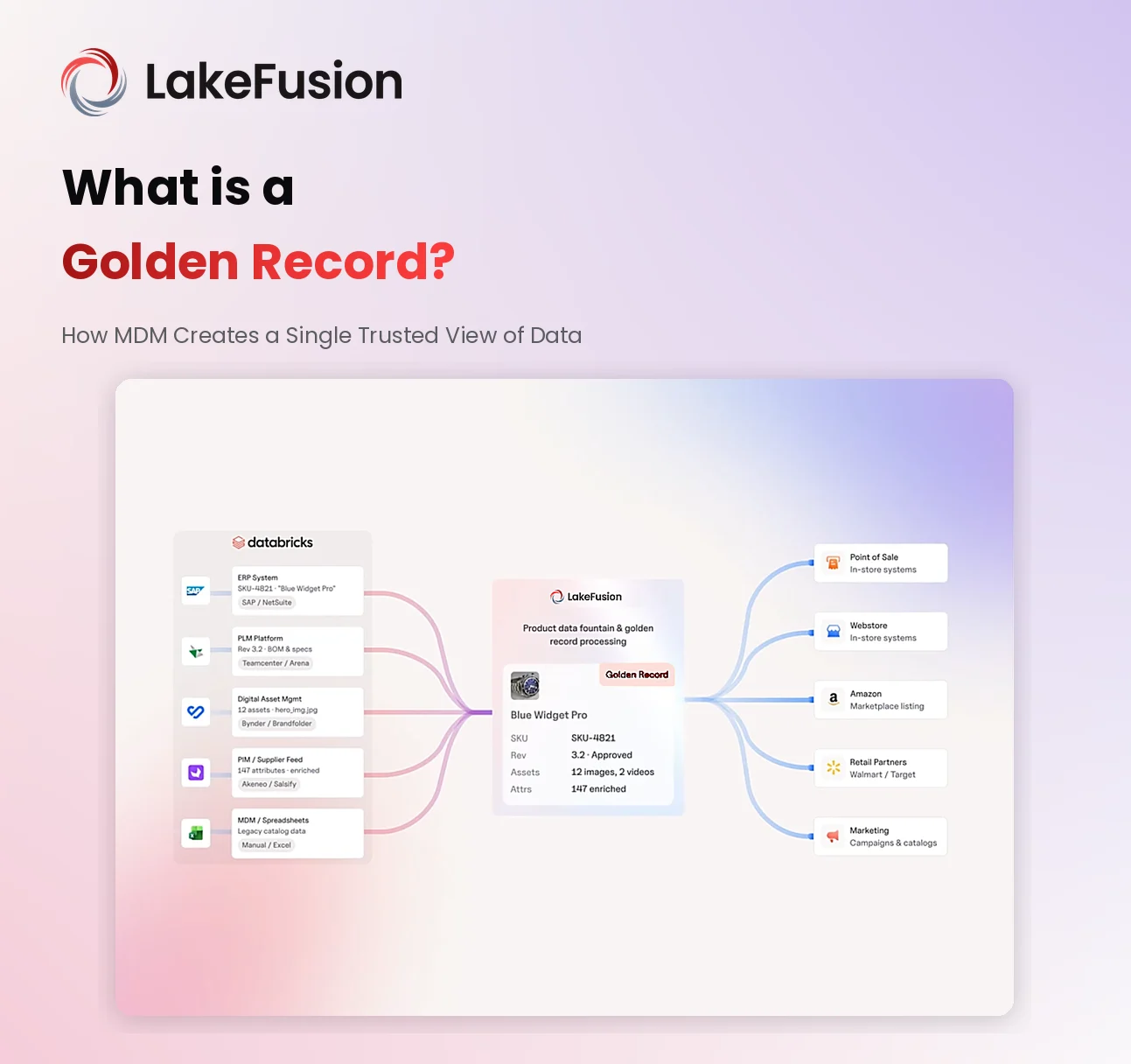
Enterprise systems almost never share the same details for a customer, supplier, company, or product. A CRM holds the customer's latest contact info. ERP stores the official legal company name. Billing uses a separate address. An outside source adds the parent company or an external ID. Every system can be right on its own and still show a different picture of the same thing.
That leaves teams with a clear problem: which record can they actually trust? A golden record fixes this by pulling the strongest attributes from all the scattered records into one controlled version of the entity.
Building one takes more than just combining duplicates. It needs entity resolution, matching rules, survivorship, lineage, stewardship, and governance.
That is why the golden record sits right at the heart of modern master data management. It hands applications, analytics, operations, and AI one steady entity to use so no team has to sort out conflicting source data on its own.
What Is a Golden Record?
A golden record is the controlled, trusted version of a real-world entity, created by resolving and combining details from many source records.
That entity can be:
- A customer
- A supplier
- A company
- A product
- An account
- A provider
- A location
- Another important enterprise entity
A golden record does not always wipe out the original source records. Those can stay in place for tracking while the mastered version gives the whole company one trusted view. Picture the same customer sitting in four systems. The CRM has the newest email. ERP has the checked legal name. Billing holds the preferred billing address. An outside business data provider lists the corporate parent.
A golden record MDM process can see that all four records point to the same organization and build one controlled customer entity that takes the most trusted attributes from each source. What you get is not just cleaner data. You get data with a clear identity, controlled attributes, and a full trail of where everything came from.
Why Enterprises Need Golden Records
Collecting everything in one place isn't sufficient to resolve conflicting identities on its own. You can have different versions of the same customer or supplier in the same warehouse or lakehouse if a company pumps in CRM, ERP, procurement, billing, and operational data.
A golden-record approach tackles the entity-level issues that simple data integration leaves untouched.
Duplicate Records Distort the Enterprise View
Duplicates can turn one customer into several or make one supplier look like many vendors. That hits reporting, segmentation, revenue numbers, procurement visibility, and later AI work. So the first step toward a trusted golden record is knowing which records truly belong together.
Source Systems Hold Conflicting Attributes
Different apps often own different pieces of an entity. One source may be solid for legal details while another is stronger on contact info.
The golden record provides a clear way to choose which source feeds each attribute, instead of grabbing one whole record and calling it correct.
Business Relationships Need a Trusted Identity
Sorting out a company name is only half the job. Companies also need to map parent companies, subsidiaries, account hierarchies, supplier structures, household links, or other related entities. A trusted master identity gives those relationships a steady base.
Downstream Teams Need Consistent Data
Without mastered entities, every analytics or application team builds its own rules for cleaning and matching. One dashboard may count five customers while another counts three. Golden records give everyone the same controlled master data so downstream teams work from the same entity definitions.
How MDM Creates a Golden Record
Building a solid golden record takes several steps.
Modern master data management combines automation, matching intelligence, governance rules, and human stewardship to decide which records belong together and which attributes should represent the mastered entity.
1. Bring Together Source Records
The work starts with data from the systems where enterprise entities already live. That can cover CRM, ERP, billing, procurement, operational platforms, product systems, outside enrichment sources, or data already sitting in a lakehouse.
The goal isn't to grab everything. Teams need to know which systems hold each entity and which attributes each source can be trusted to supply.
2. Standardize and Profile the Data
Records often arrive in messy formats. Company suffixes vary. Addresses follow different patterns. Phone numbers carry different country codes. Product IDs follow their own rules.
Profiling spots:
- Missing values
- Formatting inconsistencies
- Duplicate patterns
- Data-quality issues
- Source reliability
- Important matching attributes
This cleanup work makes the matching steps that follow more accurate.
3. Resolve Records That Represent the Same Entity
Entity resolution sits at the core of golden-record work. The MDM platform reviews records to decide which ones represent the same real-world customer, supplier, company, or other entity.
Matching can draw on:
- Deterministic rules
- Fuzzy or similarity matching
- Probabilistic matching
- External identifiers
- AI-assisted techniques
- Multiple attribute combinations
The key point is that matching cannot rest only on exact matches.
ABC Technologies Ltd. and ABC Tech may be the same organization, while two companies with almost identical names may still be completely separate. A solid mastering process must distinguish between those two situations correctly.
4. Match and Merge Related Records
Once matching records are found, MDM groups or merges them under controlled business logic. The original records do not simply vanish. They stay linked to the mastered entity so teams can see which sources fed the final record. This keeps the trail intact while giving downstream systems one trusted version.
How Survivorship Determines the Trusted Attributes
Matching shows the platform that records belong together. Survivorship decides which values move into the golden record. That difference matters because different source systems can hold different values for the same attribute. Say three matched customer records show different addresses.
The company might set a rule like:
- ERP is authoritative for legal name
- CRM is authoritative for email
- Billing is authoritative for billing address
- Most recent verified source wins for phone number
These choices become survivorship rules. A mature golden record MDM approach can lean on source priority, recency, completeness, confidence, business rules, or steward decisions to pick which attributes land in the mastered record.
The aim is not to crown one perfect source system. It is to build one trusted entity from the best available evidence across systems.
Why Lineage and Stewardship Matter
A golden record should never turn into a mystery box. Enterprise teams need to know where its information came from, why records were matched, and how attributes were chosen. That is why lineage and stewardship matter.
Lineage Preserves the Source of Truth
Golden-record lineage lets teams follow mastered attributes back to the source records that supplied them. If an address changes or a matching decision gets questioned, teams can see the origin of that value instead of treating the mastered record as cut off from its sources.
Data Stewardship Handles Ambiguous Decisions
Some matches are clear. Others are not. Two company records may share a name and location yet differ on key identifiers. Automatically merging them could create a false golden record.
Data stewardship lets business or data teams review the uncertain cases, approve or reject matches, fix information, and handle exceptions. This human check gives companies control over important decisions, while automation handles the clearer cases at scale.
Golden Record vs Single Source of Truth
People often treat golden records and a single source of truth as the same thing, but they are not exactly alike. A golden record is the controlled version of one specific enterprise entity. A single source of truth is a broader idea: a trusted database that teams rely on every day.
| Golden Record | Single Source of Truth |
|---|---|
| Represents an entity | Broader data-management principle |
| Created through MDM | Can span multiple data domains |
| Uses matching and survivorship | Relies on trusted governance |
| Maintains source lineage | Provides consistent organizational use |
| Customer, supplier, product, etc. | Enterprise-wide trusted information |
A set of controlled golden records can therefore form a big part of an enterprise's single source of truth, but the two terms should not be used as if they mean the same thing.
What Is a Customer Golden Record?
A customer golden record is a controlled version of a customer created by resolving scattered customer details across different systems. A B2B customer may sit in:
- CRM
- ERP
- billing
- support
- marketing
- third-party business data
Each system may hold a different picture of that organization. Master Data Management can link those records, set one trusted customer identity, keep the source trail, and apply survivorship rules to build the master customer record.
This becomes a key base for Customer 360 because customer analytics only work when the company first knows which records stand for the same customer.
LakeFusion has shown this approach in an enterprise Customer 360 project where scattered customer accounts were brought together into trusted master records inside Databricks.
Where Golden Records Create Business Value
Golden records deliver value when they move beyond the MDM platform and into daily work.
Customer 360
Trusted customer identities help companies pull together customer activity, corporate hierarchies, and account details.
Supplier Management
Supplier golden records reduce duplicate vendors and provide a clearer picture of supplier identities across procurement, finance, and ERP systems.
Reporting and Analytics
Reports become more reliable when they run on controlled entities instead of each team cleaning source records on its own.
Compliance and Risk
Trusted company and customer identities tighten the consistency of entity-level oversight, reporting, and hierarchy analysis.
AI-Ready Enterprise Data
AI tools need steady entity context. If the same company shows up as five records, an AI agent may get exposure, revenue, or relationships wrong unless those records have already been resolved. Golden records give AI and analytics more trustworthy entity foundations.
Why Modern Golden Records Need More Than Traditional Matching
Older MDM work leaned heavily on rules people set by hand. Rules still matter, but enterprise data has grown more tangled.
Records may have missing attributes, non-uniform structures, differing language, and linkages between records that simple exact-match logic can't uncover.
With modern MDM, you can combine deterministic logic and probabilistic methods, similarity matching, AI-based resolution, and stewardship.
The main idea is not to swap governance for AI.
It is to use smarter matching to improve resolution while keeping the final mastered entities controlled and clear.
Create Trusted Golden Records with LakeFusion
A golden record should do more than cut duplicate rows. It should give the company a controlled answer to a basic data question: Which version of this customer, supplier, company, or entity should we trust?
LakeFusion brings master data management built on Databricks. It assists businesses manage and control customers, suppliers, companies, accounts, providers, and other entities by converting scattered records into golden records. LakeFusion combines AI-based match and merge, lineage, stewardship workflows, and governance aligned with Unity Catalog, all within the familiar Databricks environment.
That means that companies don't need to establish another independent MDM store to acquire trusted master data.
Golden records can stay close to the analytics, applications, machine-learning pipelines, and AI workloads that need them.
LakeFusion has also demonstrated the model in production, such as in a professional-services project that integrated data from several companies and created a controlled Company Golden Record directly on Databricks.
When manual cleanup is no longer an option, and conflicts between source records force your teams to choose which is correct, it's time to replace it.
Frequently Asked Questions
What is a golden record in MDM?
A golden record is the controlled copy of an entity created by matching and linking information from several source records. It uses rules like survivorship, lineage, and stewardship to determine which attributes to trust.
How does MDM create golden records?
MDM profiles source data, identifies duplicate entities, ties or connects related data, ensures the data upholds a specified survivorship rule, maintains source lineage, and creates a controlled master version of the data for downstream use.
What is a customer golden record?
A customer golden record is the authoritative record of a single customer, derived from disparate customer information spread across systems like CRM, ERP, billing, and operational systems.
Is a golden record the same as a single source of truth?
Not exactly. A golden record represents one controlled entity, while a single source of truth is a broader enterprise-data concept. Controlled golden records can form a big part of that trusted database.
Why are golden records important for AI?
Golden records reduce confusion around enterprise entities. They help AI and analytics work from steady customer, supplier, company, or product identities instead of treating duplicate and conflicting source records as separate entities.

Accelerate your edge with LakeFusion insights
Get practical perspectives on master data, governance, and building scalable, AI-ready data foundations.