


Big companies keep data all over the place. It sits in CRM systems, ERP applications, finance platforms, operational databases, and the cloud. When these systems don't talk to each other, information splits up, and records start to disagree. Teams then argue about which numbers are right. Putting everything in one place won't fix that. It doesn't make data accurate, governed or ready for analytics and AI.
A well-designed Enterprise Data Management Architecture solves this. It defines how data enters the company, how it's processed, governed, and connected, and how it reaches business applications. Integration, data quality, governance, Master Data Management (MDM), and relationship intelligence work together as a single framework.
If you build on Databricks, this architecture puts trusted enterprise data right beside your analytics and AI workloads. You get a scalable base. Business teams and AI applications can then use reliable information with the right context and controls.
What Is Enterprise Data Management Architecture?
Enterprise Data Management Architecture is the plan for how a company collects, integrates, stores, governs, maintains, and uses its data. It covers the technology, processes, roles, and controls that manage information end to end.
A good architecture connects operational systems with data platforms, governance tools and business applications. It also separates two ideas: moving data and trusting data. Integration pipelines make records available. MDM decides which records describe the same entity. It then builds one consistent view of customers, suppliers, companies and other business entities.
Teams using an Enterprise Data Management Platform can follow this architecture to line up data quality, governance, mastering, and relationship intelligence. They don't have to run each one as a separate project.
Key Layers of Enterprise Data Management Architecture
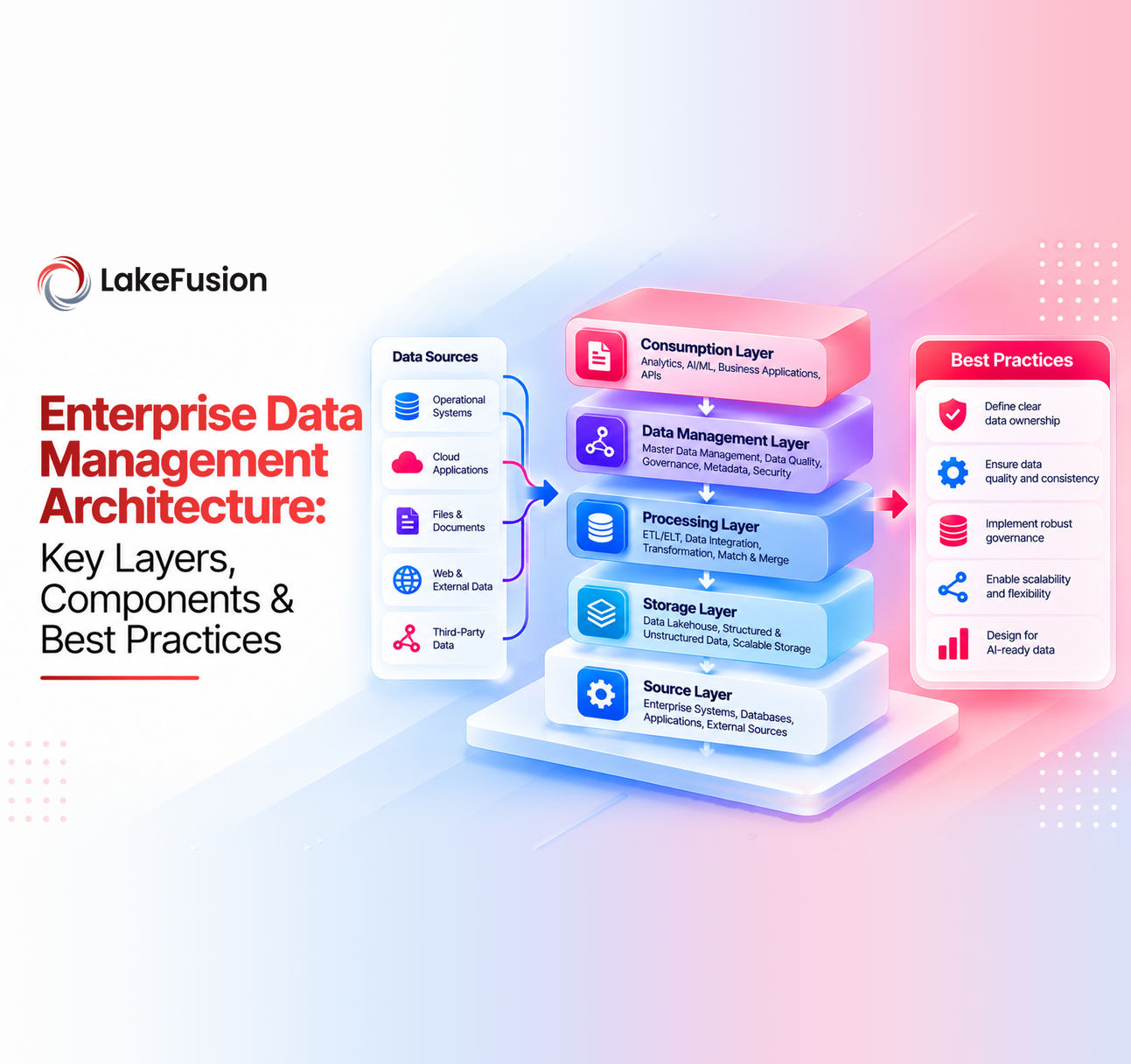
A practical architecture has several linked layers. Each layer has its own job. Together they deliver reliable information to business users, analytics systems, and AI applications.
Data Source and Integration Layer
The source layer holds your CRM, ERP, finance, procurement and operational applications. It also holds external datasets and any other system that produces enterprise information.
The integration layer brings that information in. It uses APIs, ETL and ELT pipelines, streaming or other ingestion methods. The data can then land in a lakehouse. There, teams transform it and prepare it for later use.
For Databricks users, this layer lays the base for Master Data Management on Databricks. Mastering workflows can then work on data that already lives in the lakehouse.
Data Storage and Processing Layer
This layer organizes data for daily operations, analytics and AI. A lakehouse gives structured and semi-structured data to one shared home. It also supports transformations and processing.
Central storage on its own won't remove duplicates. It also won't resolve conflicting business identities. You need data quality and master data management tools for that.
A sound Enterprise Cloud Data Management approach looks at scalability, processing needs, access patterns, and how data moves from source systems to downstream applications.
Data Quality and Master Data Management Layer
This layer makes data consistent and creates trusted business entities. Data quality checks find missing values, invalid formats and mismatched attributes. MDM goes further. It decides which records describe the same real-world entity. It also decides which attributes the mastered record keeps.
An Enterprise MDM Platform can handle entity resolution, matching, merging, survivorship, golden-record management, and stewardship. Together, these give you a dependable identity base for reporting, operational workflows, and AI.
Governance and Security Layer
Governance answers a few basic questions. Who can see the data? Who owns it? How are changes controlled? How may people use it? It can cover role-based access, policies, lineage, auditing, stewardship duties, and compliance controls.
In Databricks, Unity Catalog handles governance tasks like access control and lineage for supported data assets. MDM adds to this by creating trusted business entities.
If you're comparing Enterprise Data Governance Solutions, check how access policies, accountability, and data quality duties fit together across the whole architecture.
Relationship Intelligence and Consumption Layer
Enterprise data becomes more useful when teams can see how entities connect. A customer may belong to a corporate group. Suppliers may share owners. Business accounts may link through many subsidiaries or contracts.
Graph Intelligence models entities and their relationships. Teams can then follow direct and indirect links.
LakeFusion LakeGraph uses a property graph model on Databricks and Delta. You can study relationship context without adding a separate external graph database.
The consumption layer then serves trusted data to analytics, applications, operational processes, and AI workflows. A Graph Intelligence Platform can sit alongside MDM. It connects trusted entities and supports multi-hop relationship analysis.
Essential Components of a Modern Enterprise Data Architecture
The layers above depend on a few components working together. Every company builds them a little differently. Some capabilities matter more than others.
Metadata, Lineage, and Data Cataloging
Metadata tells you what data looks like, what it means, who owns it, and where it came from. Lineage shows where information started and how processing changed it. Cataloging helps people find datasets and learn what each one is for. Together, they make data easier to understand. They also help teams track down data problems faster.
Entity Resolution and Data Stewardship
Entity resolution finds records that point to the same real-world entity, even if names, identifiers or attributes differ. Data stewardship gives people a way to review unclear matches, settle exceptions and keep records trusted.
A Data Quality Management Solution can raise overall data reliability. MDM adds the identity resolution and governance workflows you need to look after mastered entities.
Graph Intelligence and AI Access
Graph intelligence adds relationship context to mastered entities. It helps when a business question involves ownership, affiliations, hierarchies, or links that sit several steps from the starting point.
AI applications benefit from trusted identities and from those relationships. A Graph Intelligence Solution for AI Agents can feed connected business context into AI workflows. Access and governance controls still apply.
Best Practices for Designing Enterprise Data Management Architecture
A strong architecture starts from business needs. It doesn't just stack up technology. These habits help teams build a framework that grows with their data, systems, and AI use cases.
Start with Business-Critical Data Domains
Find the entities and data domains that matter most to daily operations. Customers, suppliers, companies, and other key entities may each need their own matching rules, ownership models and quality standards. Set clear priorities first. Once your approach works, expand it.
Separate Integration from Data Mastering
Integration and MDM solve different problems. Integration moves and reshapes information. MDM builds trusted entity identity and governs the mastered records. Keep them apart. Otherwise, teams may think a merged table means accurate business entities.
Embed Governance Early
Agree on data ownership, access permissions, stewardship duties and quality expectations before data use grows. Build governance into the architecture. Don't add it later as a separate process.
Design for Interoperability and Scale
Ask how new sources, business domains and applications will plug in. Choose reusable integration patterns, shared data definitions, and clear interfaces between components. Also consider processing costs, support needs, and the effort required to keep the platform running as requirements change.
Measure Results and Improve Continuously
Track duplicate rates, matching quality, open stewardship cases, data-quality trends, governance coverage, and how long it takes to find trusted information.
Use those numbers to improve your data models, matching policies and workflows. Set targets that fit your business needs and your starting point. One benchmark won't suit everyone.
How LakeFusion Supports Enterprise Data Management Architecture
LakeFusion is an enterprise data management platform built for Databricks. It combines Master Data Management and Graph Intelligence on the Databricks and Delta foundations. Organizations can move from scattered source records to trusted entities and connected business relationships.
Databricks-Native Master Data Management
LakeFusion MDM handles entity resolution, matching and merging, survivorship, golden-record management, and data stewardship. These features build consistent business identities from records spread across source systems.
For Databricks teams, mastering stays close to the data platform. You don't need a separate external MDM data store.
Graph Intelligence for Connected Enterprise Data
LakeFusion LakeGraph delivers graph intelligence through a property graph model on Databricks and Delta. It supports relationship analysis, scheduled graph pipelines and graph-to-MDM suggestions.
You can pair trusted entity identity with relationship context. Use cases include corporate hierarchy analysis, connected account intelligence, supplier relationships and AI workflows that need a wider view of the business.
Governance and AI-Ready Data Workflows
LakeFusion's MDM and Graph features add to Databricks' existing governance controls. Its unified MCP access point across MDM and Graph serves AI workflows that need trusted entities and their relationships.
Explore the LakeFusion Enterprise Data Management Platform to see where it fits in your architecture. You can also read LakeFusion's enterprise data management case studies for real examples.
Build an Architecture That Makes Enterprise Data Trusted and Useful
Enterprise Data Management Architecture works best when integration, storage, quality, governance, mastering, and relationship intelligence act as connected capabilities. Each layer solves a different problem. Together they give you data that is consistent, traceable, and useful across business processes.
For enterprises on Databricks, LakeFusion lets you combine trusted master data with Graph Intelligence on the data foundation you already have. That supports the path from integrated records to trusted entities, connected relationships, and data that serves analytics, applications, and AI.
Ready to strengthen your enterprise data architecture? Contact LakeFusion to discuss your Master Data Management and Graph Intelligence requirements.

Accelerate your edge with LakeFusion insights
Get practical perspectives on master data, governance, and building scalable, AI-ready data foundations.


