

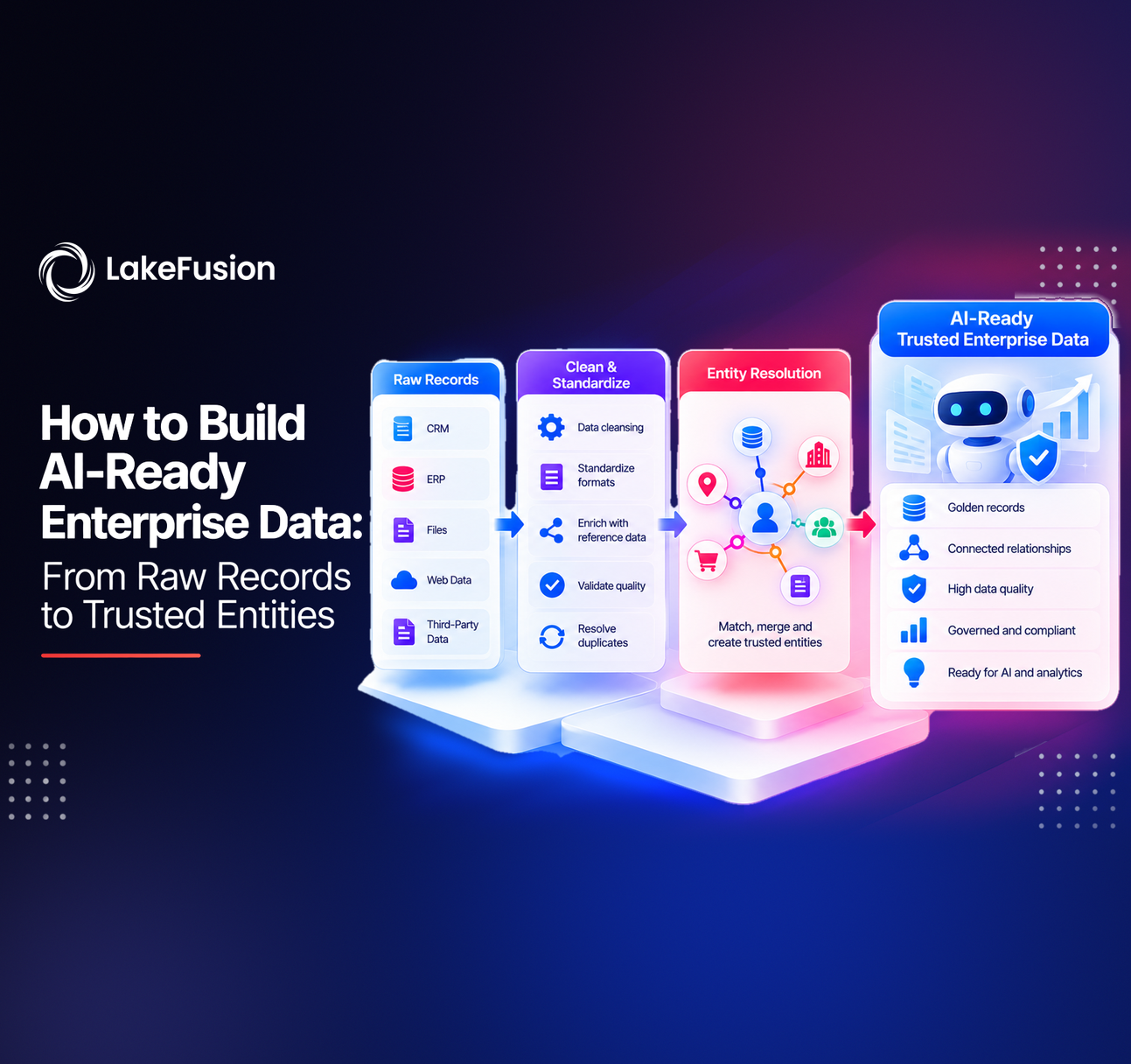

AI initiatives often struggle not because data is missing, but because it is fragmented, inconsistent, or difficult to trust. Customer details may differ across CRM systems, supplier records may be duplicated, and important relationships can remain hidden across applications. A lakehouse brings data together, but it does not automatically resolve entity identity, establish governance, or explain how records relate.
Building AI-ready enterprise data requires a structured approach. Organizations need to establish trusted entities, maintain data quality, govern access, and connect records through meaningful business relationships. These foundations help analytics, applications, and AI agents work with more consistent, relevant, and reliable information.
What Is AI-Ready Enterprise Data?
AI-ready enterprise data is information that analytics, applications, and AI workflows can reliably interpret and use. It combines consistent entity identities, strong data-quality controls, governed access, and useful relationship context.
For example, if the same company appears under several names across CRM and procurement systems, an AI application may treat those records as separate organizations. Similarly, if supplier relationships and corporate hierarchies are scattered across different systems, an AI agent may lack the context needed to answer business questions accurately.
Preparing data for AI means addressing these challenges before using information for analysis or automated actions. Master Data Management (MDM) helps establish trusted entity identities, data governance supports appropriate access and accountability, and graph intelligence reveals how entities connect across the enterprise.
Best Practices to Build AI-Ready Enterprise Data
Building AI-ready enterprise data is not a single cleansing exercise. It requires connected practices that improve identity resolution, governance, data quality, relationship context, and operational use. The following eight practices provide a practical framework for moving from fragmented records to trusted enterprise data.
Resolve Duplicate Records with Master Data Management
Enterprise systems often store the same organization under different names, identifiers, or formats. For example, ABC Corp., ABC Corporation, and ABC Co. may represent the same company across CRM, finance, and procurement systems. If these records remain separate, reports can overcount customers or suppliers, while AI workflows may treat one organization as several unrelated entities.
Master Data Management addresses these identity problems through entity resolution, matching, merging, survivorship, and stewardship. Deterministic rules can identify clear matches, while probabilistic and AI-assisted approaches can help assess less obvious cases. Survivorship rules determine which source attributes to retain in the trusted record.
A Databricks-native MDM platform helps create golden records from fragmented source data, providing consistent entity identities for downstream analytics and applications. Explore Master Data Management on Databricks to learn how trusted records can support AI readiness.
Define Data Ownership and Stewardship
Even after resolving duplicate records, enterprise data needs ongoing ownership and maintenance. Source systems change, new records arrive, and some matches remain uncertain. Without clear accountability, conflicting attributes and unresolved exceptions can gradually reduce trust in mastered data.
Organizations should define who owns critical data attributes, who can approve record merges, and how they review uncertain matches or conflicting values. Data stewardship workflows give teams a structured way to investigate exceptions, correct issues, and maintain trusted records over time.
Clear ownership also helps establish accountability for data quality. Rather than treating cleanup as a one-time project, organizations can make data stewardship part of their regular operating processes.
Build Governance into the Data Lifecycle
AI-ready data must be accessible to the right people and applications under appropriate controls. Organizations need policies for access, data quality, traceability, and the handling of sensitive or restricted information. These controls should apply throughout the data lifecycle, not only when data is delivered to an AI application.
Databricks Unity Catalog supports governance capabilities such as access control and lineage for supported data assets. Master Data Management serves a complementary purpose by resolving identity and establishing trusted master records. Governance controls and tracks data use, while MDM establishes which records represent the same real-world entity.
Combining these capabilities helps organizations create a more dependable data foundation without confusing data access governance with entity resolution.
Standardize Critical Data Attributes
Inconsistent data formats and conflicting values can affect matching, reporting, and AI-generated results. Company names, addresses, identifiers, product classifications, and status fields may follow different conventions across source systems. If organizations don't address these inconsistencies, downstream systems may struggle to compare records reliably.
Organizations should identify the attributes that matter most to their business processes and establish suitable standards for formatting, validation, and normalization. They should also define how to handle conflicts when different systems provide different values for the same entity.
Standardization should complement entity resolution rather than replace it. Similar formats do not necessarily mean that two records represent the same entity, and different formats do not necessarily mean they represent different entities. Matching rules and survivorship policies should account for these distinctions.
Connect Trusted Entities with Graph Intelligence
Knowing a customer's or supplier's identity is only part of understanding the business. A supplier may belong to a larger corporate group, serve multiple business units, or connect indirectly to a location, product, or other organization. These relationships can be hard to understand when they span separate tables and systems.
Graph intelligence represents entities as nodes and their relationships as edges. This lets you explore direct and indirect connections, investigate corporate hierarchies, understand account networks, and analyze supplier dependencies across multiple relationship hops.
LakeFusion LakeGraph uses a property graph model on the Databricks and Delta foundation, without requiring a separate external graph database. By connecting graph intelligence with trusted master data, organizations can give analytics and AI workflows both entity identity and relationship context. Learn more about the Enterprise Graph Intelligence Platform.
Make Data Accessible to AI Workflows with Appropriate Controls
AI applications and agents need more than a large volume of records. They need relevant information, consistent entity identities, meaningful relationships, and access controls appropriate to their tasks. Without these foundations, an AI workflow may combine duplicate entities, miss indirect relationships, or present uncertain information as definitive.
Organizations should define which records and relationships each workflow can access, how it should communicate uncertainty, and when a result requires human review. They should also ensure that an agent's access aligns with its intended purpose and the organization's governance policies.
Connecting MDM with graph intelligence provides AI workflows with both trusted identities and relationship context. LakeFusion also provides a unified MCP access point across MDM and Graph, supporting AI workflows that need governed access to enterprise entities and their connections.
Monitor Data Quality and Matching Outcomes
AI readiness is an ongoing process because source data, business rules, and operational needs change over time. A matching process that works well for one data domain may require different rules or stewardship for another. Organizations need a way to monitor whether their data foundation remains reliable as new records arrive.
Useful measures may include duplicate rates, matching quality, unresolved stewardship cases, data-quality results, governance coverage, and the time required to retrieve trusted information. Teams should review errors and exceptions, validate matching outcomes, and adjust rules where necessary.
Measurement should reflect business requirements and the organization's starting point. A universal target rarely fits every data domain. The purpose is to identify meaningful improvements and catch issues before they undermine analytics or AI workflows.
Operationalize Trusted Data Across Business Processes
Trusted records deliver value when they are used in real business processes. If mastered data stays isolated from reporting, operational applications, and AI workflows, teams may keep relying on inconsistent source records even after improvements to the underlying data.
Organizations should connect trusted entities and their relationships to the processes that depend on them. This can include reporting, customer and supplier analysis, application workflows, and AI-assisted tasks. They should also define how data updates are propagated and how relevant relationship changes affect downstream processes.
Graph workflows can help make relationship information operational rather than leaving it as a static representation. With the right configuration, relationship conditions can trigger downstream actions such as updates, pipelines, or webhooks. The goal is to make trusted, connected data useful in the business activities it supports.
How LakeFusion Helps Build AI-Ready Enterprise Data
Building an AI-ready data foundation requires more than one capability. Organizations need to resolve entity identity, maintain trusted records, understand relationships, and make that information available to the workflows that need it. LakeFusion brings Master Data Management and graph intelligence together on Databricks to support this connected approach.
LakeFusion MDM supports entity resolution, matching and merging, survivorship, golden-record management, and data stewardship. These capabilities help organizations create trusted entities from fragmented source records.
LakeFusion LakeGraph connects those entities through a property graph model on Databricks and Delta. It includes scheduled graph pipelines and graph-to-MDM suggestions, helping teams use relationship context alongside mastered data. LakeFusion also offers a unified MCP access point across MDM and Graph for AI workflows that need access to trusted entities and their connections.
Together, these capabilities help organizations move from fragmented records to trusted entities, from trusted entities to connected relationships, and from connected relationships to data that can support analytics, operational processes, and AI applications.
Explore Master Data Management on Databricks, the Enterprise Graph Intelligence Platform, or contact LakeFusion to discuss your enterprise data requirements.
Build a Trusted Foundation for AI
AI readiness begins with the quality, identity, and context of the data behind each answer or action. Master Data Management establishes trusted entities and governance controls and tracks data use, and graph intelligence reveals how those entities connect across the business.
By treating these capabilities as connected parts of an enterprise data strategy, organizations can build a foundation that supports more dependable analytics, applications, and AI workflows. The objective isn't simply to make data available to AI, but to make it trustworthy, governed, and useful.
Explore LakeFusion to understand how trusted master data and graph intelligence can help prepare your enterprise data for AI.
Frequently Asked Questions
What Is AI-Ready Enterprise Data?
AI-ready enterprise data has reliable entity identities, appropriate quality controls, governed access, and useful context for analytics, applications, and AI workflows.
How Does Master Data Management Help Prepare Enterprise Data for AI?
MDM resolves duplicate and conflicting records, applies survivorship rules, creates trusted golden records, and provides stewardship workflows for uncertain cases.
Why Is Graph Intelligence Important for AI-Ready Data?
Graph intelligence reveals direct and indirect relationships between trusted entities. This helps applications and AI workflows use business context that may be difficult to identify from isolated records.
What Role Does Databricks Play in an AI-Ready Data Platform?
Databricks provides the lakehouse and data foundation. MDM and graph intelligence add trusted entity identity and relationship context, complementing data governance capabilities.
How Can Organizations Measure AI Data Readiness?
Organizations can track duplicate rates, matching quality, stewardship workload, data-quality results, governance coverage, and how quickly teams can retrieve trusted information. The most useful measures depend on the organization's data and business requirements.

Accelerate your edge with LakeFusion insights
Get practical perspectives on master data, governance, and building scalable, AI-ready data foundations.


