


Big companies pull data from CRM systems, ERP applications, operational databases, and cloud platforms. When that information is duplicated, inconsistent, or siloed, trouble follows. Teams struggle to keep reporting reliable and make informed decisions. AI applications get shaky context too.
An Enterprise Data Management solution enables enterprises to keep their critical business data organized, integrated, governed and maintained. It houses Master Data Management (MDM), which generates a unified record of key entities such as customers, suppliers, companies and products.
A trusted record, consistent data quality and consistency of data across business systems can all be achieved with the right Enterprise Data Management Platform. Platforms take different approaches. Some focus on MDM. Others add data quality, integration, governance, or cloud-native data processing.
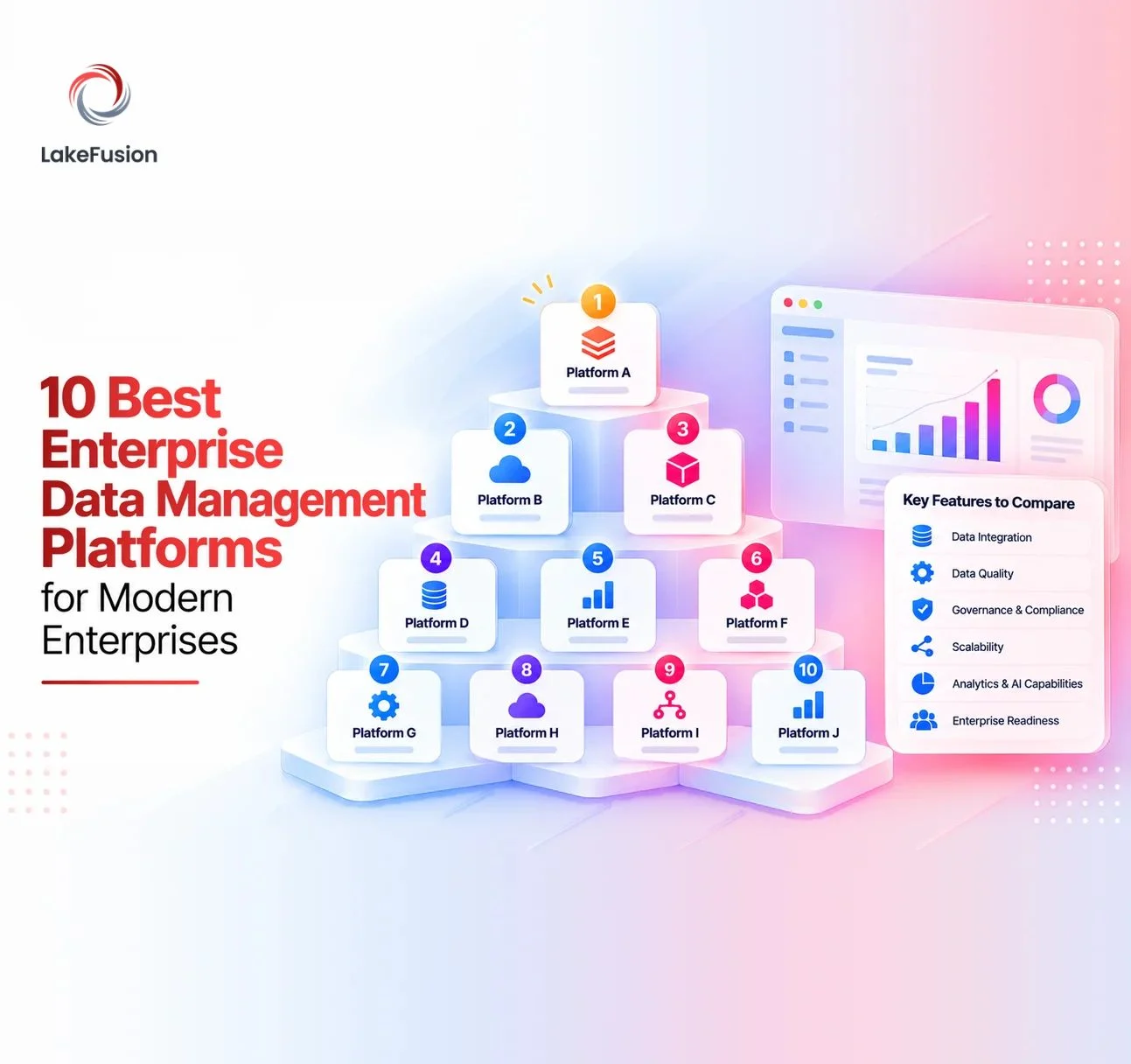
This guide compares 10 platforms. You can see their key capabilities and pick software that matches your existing data architecture.
10 Leading Enterprise Master Data Management Software
When you select Enterprise Data Management Software, you need to understand how each one deals with entity resolution, data quality, data governance, deployment and integration. These platforms handle enterprise data in various ways. They can be Databricks-native MDM or a broad enterprise data management suite.
1. LakeFusion
LakeFusion is an Enterprise Data Management Platform built natively for Databricks. It helps organizations resolve scattered records, create governed golden records, and link business entities through graph intelligence.
You don't have to move data into a separate MDM infrastructure. It pairs Master Data Management with relationship intelligence on your existing Databricks and Delta foundation. That makes it especially relevant for enterprises that invest in Databricks for analytics, operational data, and AI workloads.
How It Works
- Connects source data inside the Databricks environment.
- Applies entity resolution and entity matching using AI to identify records representing the same entity.
- Utilizes match and merge and survivorship to create trusted golden records.
- Models and explores multi-hop relationships using LakeGraph.
- Facilitates stewardship, governance and consistent access to MCP through MDM and Graph.
Key Software: LakeFusion MDM and LakeFusion LakeGraph.
Key Features
- Databricks-native execution and governed golden records.
- Entity resolution, matching, merging, and survivorship.
- Data stewardship and governance integration to Unity Catalog.
- Property graph intelligence, graph-to-MDM suggestions.
- Unified access to trusted entities and relationships for AI workflows.
Explore LakeFusion MDM and its Graph Intelligence Platform.
2. Informatica
Informatica offers enterprise data management through its Intelligent Data Management Cloud (IDMC) portfolio. It covers MDM, data integration, data quality, governance, and metadata management. With that breadth, large organizations running complex data estates across business domains and many systems may want to consider it. Enterprises should check the specific products, deployment needs, and licensing they'd need for their use cases.
How It Works
- Brings together information from multiple enterprise sources.
- Applies data quality and matching processes to improve consistency.
- Establishes mastered records and facilitates stewardship processes.
- Connects MDM with broader integration and governance options.
Key Software: Informatica MDM and Intelligent Data Management Cloud.
Key Features: Enterprise integration, data quality, entity matching, governance, and multi-domain data management.
3. Reltio
Reltio is a cloud-native data management platform that unifies entity information and keeps data connected and trusted. It's relevant for enterprises that need to bring customer, product, supplier, and other business records together across applications. Its connected-data approach supports customer intelligence, operational processes, and analytics wherever consistent entity information matters.
How It Works
- Connects records from different source systems.
- Applies matching and data unification processes.
- Creates aggregated entity profiles.
- Enables data governance and sharing of mastered data across apps.
Key Software: Reltio Data Cloud and its MDM capabilities.
Key Features: Cloud-native data unification, entity resolution, multi-domain MDM, data governance, and connected enterprise data.
4. Profisee
Profisee specializes in master data management. It is considered by organizations that have Microsoft-based data environments. It's all about eliminating duplicate records, establishing golden records and enabling the stewardship processes of business teams to maintain master data. Businesses should evaluate its compatibility with their Microsoft environment and other data management solutions.
How It Works
- Interconnects information from enterprise systems that are relevant.
- Uses matching and survivorship to merge records.
- Provides workflows for data review and stewardship.
- Sends trusted master data to supported downstream systems.
Key Software: Profisee MDM.
Key Features: Multi-domain mastering, matching and merging, golden records, data stewardship, and Microsoft ecosystem integration.
5. Ataccama
Ataccama offers a data management platform that integrates data quality, data governance, data cataloging and MDM. The comprehensive solution can be used by businesses that require them to address data quality and governance issues as well as inaccurate master data. Organizations looking at Ataccama should consider if its integrated features are comparable to their current data system, team and business domain management.
How It Works
- Assesses enterprise data for quality problems.
- Validates, matches and applies data management rules.
- Supports governance and stewardship process.
- Supports data consistency across interrelated data flows.
Key Software: Ataccama ONE.
Key Features: Data quality management, MDM, governance, cataloging, and data observability capabilities.
6. Semarchy
Semarchy offers master data management and data management through the Semarchy Data Platform. It emphasizes configurable data applications, data quality, stewardship, and multi-domain mastering. An organization can consider it when it wants to build MDM workflows around its own data models and business needs. Weigh the deployment options and implementation effort against your architecture and operating model.
How It Works
- Models business entities and how they relate.
- Creates workflows for matching, validation and data stewardship.
- Fetches data from trusted master data.
- Continues to manage data quality and changes.
Key Software: Semarchy Data Platform, including its MDM capabilities.
Key Features: Multi-domain MDM, configurable workflows, data quality, stewardship, and flexible deployment options.
7. SAP Master Data Governance
Organizations can govern and consolidate master data in SAP-centric business environments with SAP Master Data Governance (SAP MDG). It's most applicable when business processes need to have consistent information about customers, suppliers, finances, materials, etc. in SAP applications. Businesses need to evaluate its impact on their current SAP environment, the complexity of the implementation and their strategies for non-SAP systems.
How It Works
- Defines data models and governance rules for master data.
- Supports requests, approvals, and change management.
- Validates records before they're approved for use.
- Helps distribute governed master data across supported SAP environments.
Key Software: SAP Master Data Governance.
Key Features: Centralized master data governance, approval workflows, data validation, and SAP ecosystem integration.
8. IBM Master Data Management
For enterprises that must consolidate and manage vital enterprise data, IBM offers master data management solutions. Depending on which product and architecture you select, IBM MDM can manage customer and other domain data in complex IT environments. It can help businesses that have already invested in IBM products or need a centralized source of master data across systems.
How It Works
- Brings in records from relevant enterprise applications.
- Uses matching and consolidation procedures.
- Builds trusted entity views and master records.
- Supports governance and distribution to connected systems.
Key Software: IBM Master Data Management offerings.
Key Features: Entity matching, trusted master records, data governance, multi-domain use cases, and enterprise integration.
9. Oracle Enterprise Data Management
Oracle Enterprise Data Management Cloud manages change and consistency across enterprise data structures, mainly shared reference data and business dimensions. It helps distinguish this product from Oracle's customer and product master data capabilities. Its core focus is managing enterprise data change and ensuring consistency across connected business applications.
How It Works
- Creates governed views of enterprise data structures.
- Manages changes to shared dimensions and reference data.
- Pushes changes to the review and approval process.
- Facilitates controlled access to approved changes for connected applications.
Key Software: Oracle Enterprise Data Management Cloud.
Key Features: Data change governance, shared enterprise dimensions, approval workflows, and integration with Oracle business applications.
10. Boomi Data Hub
Boomi Data Hub brings master data management into the wider Boomi integration platform. It may interest enterprises that want to connect data sources, sync information, and manage trusted records as part of integration-led data operations. Whether it fits depends on your integration needs, your source systems, and how much MDM functionality you need.
How It Works
- Connects source applications through integration workflows.
- Identifies and aggregates data to form master data.
- Updates relevant information to connected systems.
- Maintains continuity of data management in conjunction with integration activities.
Key Software: Boomi Data Hub.
Key Features: Integration-led MDM, record consolidation, data synchronization, and connectivity with enterprise applications.
How to Choose Enterprise Master Data Management Software?
The right Enterprise Data Management Platform depends on your business problem, your current technology stack, and how you'll use trusted data. Before you compare vendors, name the domains that need attention. Know which systems supply the data and which business processes depend on its consistency.
Assess Data Quality and Entity Resolution
Experience how the platform identifies duplicate records, manages conflicting attributes and generates trusted golden records. Find flexible matching options, survivorship policy and workflows for ambiguous cases. Master Data Quality Management should deliver measurable improvements. Spotting errors isn't enough.
Check Integration and Architecture
Ask whether the solution suits your current environment. Look at supported connectors, APIs, data synchronization, deployment options, and whether you'd have to copy data into another platform. For Databricks-centered organizations, a native approach like LakeFusion can cut the need for a separate MDM data stack.
Evaluate Governance and Stewardship
Look for clear ownership, role-based access, review workflows, lineage, and auditability. Managing Enterprise Data takes ongoing accountability. One round of deduplication isn't enough. Confirm how business users can look into exceptions, and how permissions get enforced.
Consider Scalability and Total Cost
Review expected data volumes, the number of domains, implementation effort, licensing, infrastructure, and upkeep. Enterprise Cloud Data Management may take some infrastructure work off your plate. The total cost still depends on the product, the architecture, and your operating model.
Match Capabilities to Business Goals
Some organizations mainly need golden records. Others want broad data quality, governance, integration, or enterprise hierarchy management. Put the capabilities that solve your real problems first. Don't choose software for the longest feature list.
Why Choose LakeFusion as Enterprise Data Management Software?
LakeFusion is built for organizations that use Databricks as their enterprise data and AI foundation. It doesn't add a separate MDM repository. It runs natively in the Databricks environment. Teams manage trusted master data right where their data already lives.
Native Master Data Management on Databricks
LakeFusion MDM helps resolve scattered customer, supplier, company, and other entity records. Entity resolution, matching, merging, survivorship, and golden records give you consistent master data for analytics and business processes.
Governed Golden Records and Stewardship
A golden record is a key part of enterprise data management. Teams also need to understand match decisions, review unclear cases, and keep trusted records accurate over time. LakeFusion supports stewardship and works with Databricks governance capabilities. That helps keep data workflows governed.
Graph Intelligence Beyond Individual Records
Enterprise relationships often go past direct parent-child links. LakeFusion LakeGraph uses a property graph model on Databricks and Delta. It supports relationship traversal and multi-hop analysis. Organizations can explore corporate structures, account relationships, and supplier networks. They don't need a separate external graph database.
A Foundation for Enterprise AI
AI workflows need reliable entity identity and relevant business context. LakeFusion brings MDM and Graph together. That gets trusted entities and relationships to analytics, applications, and AI workflows. Its unified MCP access point supports governed access.
Already investing in Databricks? LakeFusion gives you a focused way to extend the lakehouse with enterprise MDM and graph intelligence. Explore the LakeFusion platform or contact the team to talk through your needs.
Conclusion
Choosing Enterprise Data Management Software is about more than pulling records together. Organizations need a dependable way to resolve identity, improve data quality, govern changes, and get consistent information to their business systems.
These platforms address those needs in different ways. Some are broad enterprise data management suites. Others focus on MDM or fit particular technology ecosystems. The best choice depends on your data architecture, business priorities, and governance needs.
If your organization uses Databricks and wants trusted entities along with connected relationship intelligence, LakeFusion offers a Databricks-native approach to enterprise data management.
Ready to turn fragmented records into trusted enterprise data? Explore LakeFusion MDM or contact LakeFusion to talk through your data management goals.
Frequently Asked Questions
What Is Enterprise Data Management?
It's how an organization organizes, integrates, governs, and maintains business data. The goal is to keep data consistent, accessible, and reliable across the company.
What Is the Difference Between Enterprise Data Management and MDM?
Enterprise Data Management is a broad range of data practices, including data governance, integration, quality and lifecycle management. Master Data Management is more focused. It maintains accurate and reliable records of critical business objects like customers, suppliers, and products.
What Should an Enterprise Data Management Platform Include?
It depends on your business needs. It can cover entity resolution, golden-record management, data quality, governance, stewardship workflows, integration, lineage, and providing trusted data for other systems.
How Does Enterprise Cloud Data Management Help Organizations?
It provides scalable data operations and connects to a cloud analytics environment. Benefits vary by platform, depending on architecture, governance model, deployment, and your existing infrastructure.
How Do Organizations Choose the Right Enterprise Data Management Software?
Focus on important data domains and business problems first. Before selecting a platform, assess its matching quality, integration, governance, scalability, deployment fit, implementation effort, and total cost of ownership.

Accelerate your edge with LakeFusion insights
Get practical perspectives on master data, governance, and building scalable, AI-ready data foundations.


