

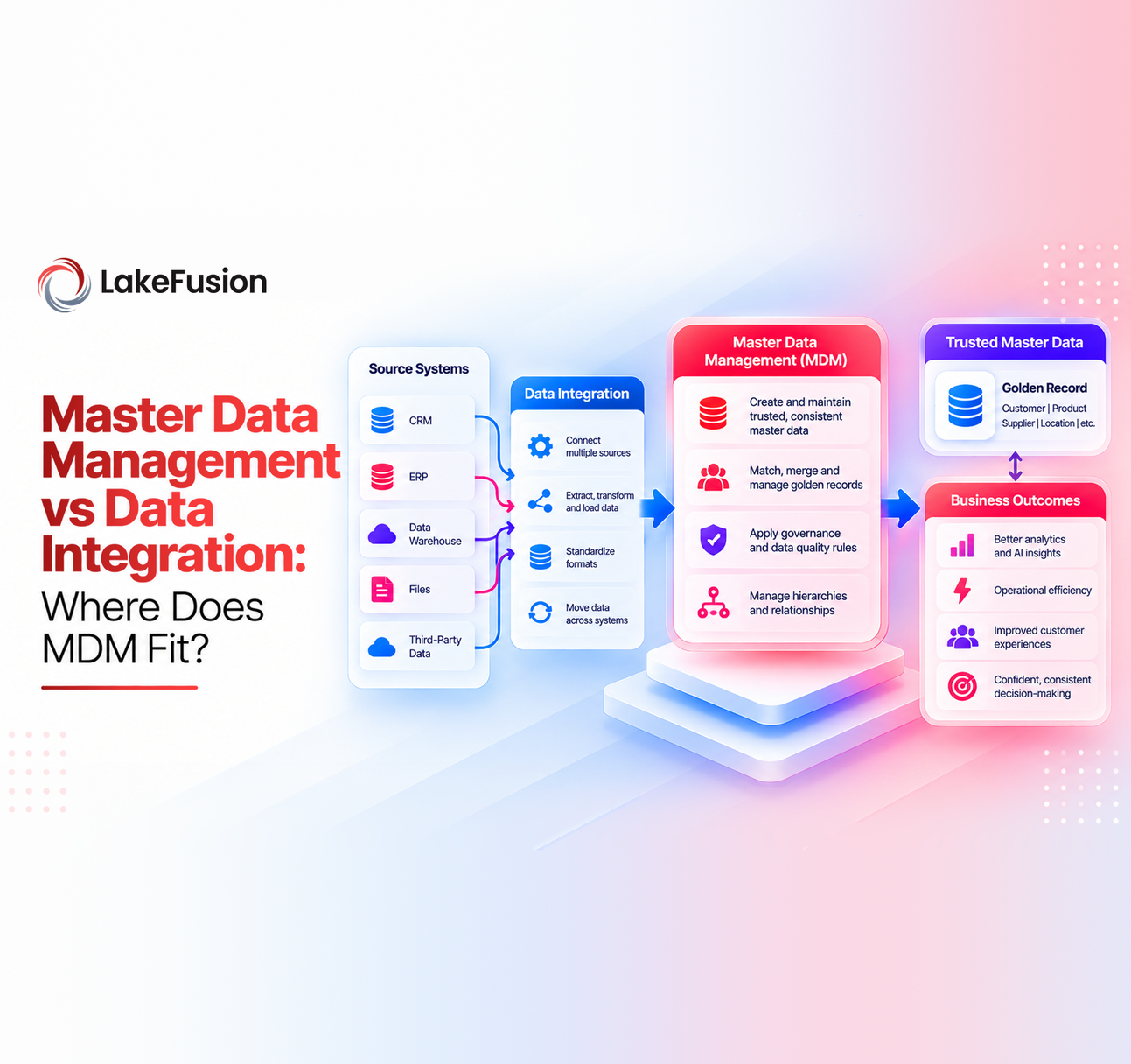

Enterprise data is rarely stored in a single system. Customer details may live in a CRM, supplier information in an ERP, billing records elsewhere, and older company data in systems from past acquisitions. Data integration aggregates this information, but it doesn't mean all records are accurate, consistent, or valuable to the business.
This is where master data management vs data integration have a difference. Data integration is about joining systems and transferring data from one system to another. Master Data Management takes a more pragmatic approach to determining which records represent the same real-world entity, which data to trust, and ensuring the right people within the business make those decisions.
An Enterprise Master Data Management Platform can integrate with existing integration pipelines for companies building a data environment on Databricks. It can convert collected source records into trusted customers, suppliers, companies, and other business entities. With Graph Intelligence built on Databricks enabled, companies can also gain insight into the relationships between those entities for analytics, applications, and AI scenarios.
Knowing where MDM fits in a broader master data architecture can help enterprises avoid a common assumption: improving data pipelines doesn't automatically mean the resulting master data is reliable.
Master Data Management vs Data Integration: What Is the Difference?
Data integration and MDM are connected, but they don't do the same job. Data integration moves, changes, synchronizes, and combines information from different systems. Master Data Management views that information from the perspective of business entities.
A simple way to look at the difference is:
| Capability | Data Integration | Master Data Management |
|---|---|---|
| Primary goal | Move and combine data | Establish trusted business entities |
| Main question | How do we get data from A to B? | Which records represent the same entity? |
| Common functions | ETL, ELT, APIs, ingestion, transformation | Matching, entity resolution, survivorship, stewardship |
| Handles duplicates? | May detect or transform them | Resolves them as part of mastering |
| Establishes trusted attributes? | Not typically | Yes |
| Business governance | Limited | Core capability |
| Relationship context | Usually structural | Can be extended through graph intelligence |
| Typical output | Integrated datasets | Governed mastered entities |
Data Integration Connects the Systems
Integration tools mainly focus on moving data from one place to another. They can pull customer information from a CRM, supplier records from an ERP, financial details from billing systems, and reference information from outside sources.
They can also clean up formats, rename fields, change timestamp formats, and place the resulting data into a shared lakehouse. Without this work, an MDM system may lack the source records needed for matching and mastering.
However, integration alone cannot tell whether:
- ABC Holdings LLC
- ABC Holdings
- ABC HLDGS
are actually the same company.
The systems may now be connected, and the records may sit together, but the identity question remains open. That is an identity problem, not a transport problem.
MDM Establishes Enterprise Identity
An Enterprise MDM Platform works after or alongside integration to work out which records belong to the same business entity.
Entity resolution can look at names, addresses, IDs, contact details, and other available fields. Depending on the data and the business case, matching may rely on fixed rules, probability-based methods, AI, or a mix of these approaches.
After matching records, MDM uses survivorship rules to decide which information appears on the mastered record. The end result is more than a large combined table. It is a controlled representation of a customer, supplier, company, or other business entity.
MDM vs ETL: Why Moving Data Is Not Mastering Data
The difference between MDM vs ETL can be easy to miss because modern ETL and ELT pipelines often do a lot of data cleaning and transformation. That work can make ETL look similar to MDM at first. However, the responsibilities remain different.
ETL Standardizes Data
An ETL or ELT pipeline can:
- normalize capitalization,
- standardize phone number formats,
- split or combine columns,
- validate data types,
- remove unwanted characters,
- map schemas,
- join datasets.
These steps can make data much easier to work with. But cleaner data does not always mean unique data.
For example, ABC Corporation, 100 Main Street and ABC Corp, 100 Main St can be cleaned and formatted the same way while still sitting in the system as two separate records.
MDM Resolves Identity
A Master Data Management Solution takes the next step by asking whether those records belong to the same real-world organization. Formatting alone cannot answer that question.
The system may need to compare several fields, assess each source's trustworthiness, review similarity scores, consider earlier steward decisions, and follow matching rules created for that business. After MDM matches records, it tracks the link between the mastered entity and the original records that contributed to it.
ETL Can Move the Mastered Result
The connection also works the other way around. After MDM has created a trusted entity, integration pipelines can take that information to other parts of the business, including:
- Downstream Applications,
- Analytics
- Reporting
- AI Workflows,
- Source-System Updates.
This means MDM does not make ETL unnecessary. ETL carries data into and out of the mastering process. MDM handles the identity and governance decisions that sit between those movements.
Where MDM Fits in a Modern Master Data Architecture
A modern master data architecture should keep data movement and identity management separate while letting them work closely together. A simple flow can look like this: Source Systems → Integration / Lakehouse → MDM → Trusted Entities → Applications, Analytics & AI
Each part of this flow has a different job.
1. Source Systems Produce Fragmented Records
CRM, ERP, finance, procurement, support, and operational systems create records based on their own processes. Each platform can use its own IDs, naming rules, fields, and data structures. When a company acquires another business, it can introduce even more variations into the environment.
2. Integration Brings the Data Together
ETL, ELT, APIs, streaming, or native data pipelines make records from these systems available in one shared environment. For companies working with Databricks, this can mean loading the information into governed lakehouse tables. The data is now integrated. That doesn't mean it's been mastered.
3. MDM Resolves and Governs the Entities
A Databricks-native MDM platform can handle the next part of the process directly against the data already available in Databricks.
This includes:
- Entity Resolution
- Match and Merge
- Survivorship
- Data Stewardship
- Hierarchy Management
- Source Cross-References
- Duplicate Prevention
This is where integrated records start becoming trusted master data.
4. Trusted Entities Feed Downstream Systems
Once trusted entity identities are created, reporting systems, applications, operational processes, and AI workloads can use them.
Integration remains important because mastered information still needs to reach the systems that use it.
The major difference is that downstream teams no longer have to figure out which source record represents the correct customer, supplier, or company.
Why Data Integration Alone Does Not Solve the Identity Problem
Many enterprises only see the limits of integration after bringing their data into one place. From a technical standpoint, the project may look successful.
The data has been collected.
The pipelines are running.
The tables are available.
Yet the business may still have the same customer appearing five times.
Duplicate Records Survive Integration
Combining source tables does not automatically merge duplicate business entities. Suppose a CRM has three records for one customer and an ERP contains two more.
A working ingestion pipeline can bring all five records into the lakehouse without merging any of them. An Entity Resolution Platform is needed to determine whether those five records should become one entity, represent several separate entities, or stay separate because there is not enough evidence to combine them.
Source Systems Can Disagree
Integration can also reveal differences between systems.
One platform might list: ABC Ltd
while another shows: ABC Limited
One system may have the latest address, while another may hold the official legal registration details. Data integration can bring both values into the same environment. MDM decides which value to treat as trusted based on business rules.
Business Exceptions Need Stewardship
Not every identity decision should be handled automatically. Two records may look almost identical but belong to different businesses. On the other hand, two records may look quite different while still referring to the same organization.
A Data Stewardship Platform lets approved users review uncertain cases, make decisions, and apply business rules when automated matching isn't enough.
This governance step is one of the biggest differences between ordinary data integration and MDM.
How MDM and Data Integration Work Together on Databricks
Businesses do not have to pick MDM over data integration. The better approach is to let each one handle the part of the data process it is built for.
For companies already using Databricks as their main data and AI platform, Databricks Master Data Management can bring entity mastering closer to the pipelines that already feed the lakehouse.
Integration Delivers the Source Data
Existing Databricks pipelines can collect and transform records from enterprise applications.
Those resulting tables can then become the starting point for the mastering process.
MDM Creates Trusted Entities
LakeFusion MDM can match fragmented records and apply matching, survivorship, stewardship, and hierarchy rules within the Databricks environment. This lets organizations create trusted master data without moving everything into a separate hosted MDM system.
Unity Catalog and MDM Solve Different Governance Problems
Unity Catalog Data Governance handles areas such as access, permissions, lineage, and data assets within Databricks. MDM deals with business identity.
Unity Catalog helps answer: Who can access this dataset and where did it come from?
MDM helps answer: Which records represent ABC Company, and which information should represent that company?
The two systems address different questions, so they work alongside each other rather than replacing one another.
Where Graph Intelligence Fits Beyond Data Integration
Mastering an entity solves one important issue: knowing who or what that entity is. But many business questions go further than identity. They depend on understanding how different entities connect. This is where Graph Intelligence Platform capabilities can add another layer to the architecture.
Entities Are Often Connected
A company may have:
- Corporate Parent,
- Multiple Subsidiaries,
- Customer Relationships,
- Supplier Relationships,
- Connected Accounts,
- Associated Products Or Contracts.
Integration can bring the tables containing these relationships into the same environment.
MDM can establish the trusted entities within those records. Graph intelligence can then make those connections easier to understand and use.
Graph Changes the Question
MDM can help answer:
- Who is ABC Company?
- Graph intelligence can take the question further:
- What is ABC Company connected to?
It can also help answer: Which entities ultimately roll up to the same organization?
A Databricks Graph Intelligence solution can therefore work alongside MDM when relationship data matters for supplier analysis, customer intelligence, corporate structures, risk analysis, and AI applications.
Conclusion
The difference between master data management vs data integration comes down to what each process is responsible for. Data integration connects systems, moves information, and prepares datasets for business use.
MDM identifies which records represent the same business entity, decides which attributes to trust, and keeps those decisions under proper governance. Enterprises need both.
A strong master data architecture uses integration to bring source information together, MDM to establish trusted enterprise identities, and Graph Intelligence to add the relationship context around those identities.
LakeFusion brings the mastering and relationship layer into Databricks, helping enterprises turn integrated records into trusted information that can support applications, analytics, and AI.
Build trusted master data on top of your existing data architecture. Explore LakeFusion Master Data Management or request a demo.
Frequently Asked Questions
What is the difference between MDM and data integration?
Data integration connects systems and moves information between them. MDM goes further by identifying duplicate records, creating trusted business entities, applying survivorship rules, and managing those entities across the enterprise.
Is MDM the same as ETL?
No. ETL extracts data, changes it as needed, and loads it into another system. MDM uses that integrated information to identify entities and create trusted versions of customers, suppliers, companies, and other important business records.
Does MDM replace data integration?
No. The two work together. Data integration supplies source information to MDM and can also distribute the mastered information to applications and other downstream systems.
Where does MDM fit in a data architecture?
MDM usually sits between integrated source data and the applications, analytics systems, and AI workloads that use it. Its job is to turn separate source records into governed enterprise entities.
How does Graph Intelligence complement MDM?
MDM creates trusted entities. Graph Intelligence focuses on the links between those entities, helping businesses understand corporate hierarchies, affiliations, supplier networks, and connections that may span several steps.

Accelerate your edge with LakeFusion insights
Get practical perspectives on master data, governance, and building scalable, AI-ready data foundations.


