


Enterprise data is rarely as neat as businesses would like. A customer may have one name in the CRM, another in the ERP, and a slightly different one in the billing system. Supplier names can change. Addresses may be old. Some records lack IDs, while others contain values that don't agree.
So the real problem is not finding two records that look alike. The harder part is deciding if those records actually belong to the same real-world entity.
That is where entity matching comes in. A modern Master Data Management Software platform can use deterministic rules, probabilistic models, fuzzy matching, and AI to link these records. But these methods do not solve the same problems. What works well for a clean record may perform badly when the data is incomplete or unclear.
For enterprises evaluating an AI-powered Master Data Management platform, the better question isn't "Which matching method should we choose?" It is "Which method should handle which type of record?"
How Entity Matching Works in Enterprise MDM
Entity matching compares records to determine whether they refer to the same customer, supplier, company, account, or other business entity.
Take these two records:
ABC Technologies LLC
and
ABC Tech
At first glance, they could be the same company. But the names alone are not enough to say that with confidence. The system may need to check the address, phone number, registration ID, website domain, or other available information.
That is why an Enterprise MDM Platform needs more than simple exact matching.
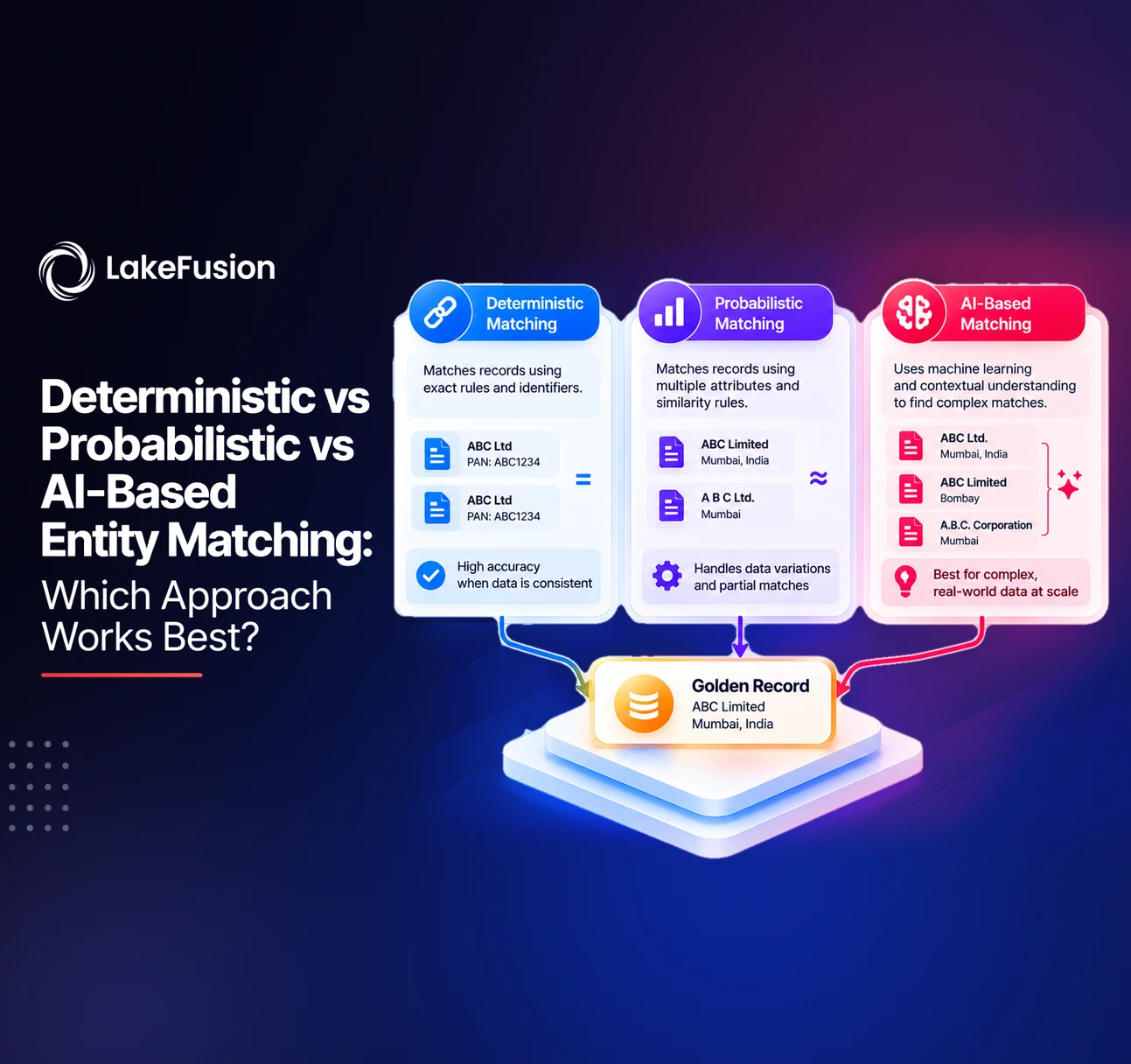
The main approaches are:
- Deterministic matching,
- Probabilistic matching,
- AI-based entity resolution.
Fuzzy matching can also be used with these approaches to assess how closely two values match. The important part is knowing when each method makes sense.
Deterministic Matching: Fast, Transparent, and Rule-Based
Deterministic matching follows rules set by business or technical teams. For example: Match when the tax ID is exact, and the company name similarity is above 90%.
Or:
Match when email address and phone number are identical.
The system does not create these rules by itself. Someone defines them and decides how they should work.
Where Deterministic Matching Works Best
Deterministic matching is a good fit when the records contain reliable identifiers.
Examples include:
- Tax IDs,
- Registration numbers,
- Account IDs,
- Government identifiers,
- Verified email addresses,
- Trusted business identifiers.
When two records share the same high-confidence identifier, there's little reason to use a more complex matching method.
This is particularly useful in Master Data Management built on Databricks, where a large amount of data may contain simple matches that can be handled without running deeper analysis on every record.
Why Deterministic Rules Still Matter
One major advantage of rules is that people can understand them. A business user can look at a result and see: "These records matched because the business identifier was identical and the company names exceeded the required similarity threshold."
There is not much mystery involved. Rules are also quick. Many work like normal joins, filters, or field comparisons, making them useful for large volumes of straightforward records.
Where Deterministic Matching Becomes Difficult
The problem starts when the rules become too rigid.
Someone has to decide:
- Which fields matter
- Which thresholds are correct
- What happens when a field is missing
- Which source systems are trustworthy
- whether the same rules should apply everywhere.
A 90% fuzzy-name threshold might work for one dataset and create poor matches in another. Things get harder when one field is missing useful information but it appears elsewhere. A fixed rule may not know what to do with that. That is where probabilistic matching can help.
Probabilistic Matching: Learning Which Signals Matter
Probabilistic matching considers several pieces of information together and determines how strongly they point to a match.
Rather than asking a team to create a rule for every possible situation, the model can learn from examples that have already been checked. This becomes useful when no single field can reliably prove that two records belong to the same entity.
Learning From Ground Truth
Suppose data stewards have already reviewed a group of candidate pairs and marked them as:
- Match,
- Non-match,
- Uncertain.
Those decisions can then be used as training data. The model may learn, for example, that:
- Last-name similarity matters more than first-name similarity
- Address differences are acceptable in certain situations
- An identifier from one source is not very reliable
- Some combinations of fields should be sent for manual review.
A Databricks-native MDM platform can use this ground truth to make matching more responsive to the data it actually handles.
Replacing Guessed Thresholds
Take fuzzy matching as an example. A deterministic rule might say: Match if company-name similarity is at least 85%.
But why 85%?
Maybe 82% gives better results. Perhaps one source needs a 95% threshold. Or maybe company-name similarity matters less when the record also includes a strong business identifier.
Probabilistic matching can look at known outcomes and learn how useful a similarity score really is. That means teams do not have to rely entirely on thresholds chosen by trial and error.
Learning Source Reliability
Not all enterprise data sources are equally dependable. An identifier coming from one ERP system might usually be correct.
The same field in another system might contain many errors. A probabilistic model can learn that difference from the available evidence. With a fixed rules engine, someone would first need to notice the pattern and then add another rule to handle it.
Where Probabilistic Matching Needs Support
Probabilistic matching still needs good examples to learn from. If the ground truth contains mistakes, missing decisions, or strong bias, the model has less dependable information to work with. This is one reason Data Stewardship Software remains important. Data stewards do not just clean up difficult records. Their decisions can also provide useful feedback for improving the matching process.
AI Entity Resolution: Handling Context and Ambiguity
AI entity resolution becomes more useful when a record's information is too messy or too context-dependent for normal rules and feature-based models to handle comfortably.
Instead of checking only selected fields, AI can look at the record more broadly. That matters when the useful clue doesn't sit neatly in the same field on both records.
Matching Across Fields
Imagine one record says: Legal Name: ABC Manufacturing LLC
Another says: DBA Name: ABC Manufacturing
The connection is there, but it sits in different fields. A traditional matching setup may mainly compare: Legal Name → Legal Name
AI can look at the wider record and recognize that the DBA name may be relevant to the legal name in another record. This ability to use information across fields is one of the main reasons AI can help with difficult entity-matching cases.
Working With Messier Data
AI-based approaches can be useful when information is:
- Unstructured,
- Incomplete,
- Spread across several attributes,
- Inconsistent,
- Difficult to normalize,
- Dependent on contextual interpretation.
That does not mean every record should go through an AI model. Doing so could add processing time and cost when a simple rule would produce the same answer. AI makes more sense for the records where context actually matters.
Where Fuzzy Matching Fits
Fuzzy matching is sometimes described as a matching strategy. It is more accurate to think of it as a way of measuring similarity. It can answer questions such as:
- How similar are these two company names?
- How close are these addresses?
- Are the differences mainly spelling or formatting changes?
You can then use that similarity score for deterministic or probabilistic matching.
For example: Deterministic approach:
Match if company-name similarity ≥ 90%.
Probabilistic approach: Use company-name similarity as one predictive feature among several.
This difference matters because a high similarity score doesn't automatically mean two records represent the same business. Two companies can have almost identical names and still be completely separate entities.
For example: ABC Logistics LLC
and
ABC Logistics Services LLC
They look close, but the companies may still be legally separate. Good entity matching therefore needs more than a number showing how similar two names are.
Which Entity Matching Approach Works Best?
There is no single method that is right for every record. The right choice depends largely on how difficult the identity decision is.
Use Deterministic Matching for Clear Cases
Best when:
- Reliable identifiers exist
- Rules are easy to define
- Explainability matters
- Speed is important.
Use Probabilistic Matching for Pattern-Based Decisions
Best when:
- Multiple signals matter together
- Manual thresholds are difficult to maintain
- Source quality differs
- Verified match history exists.
Use AI Matching for Hard Cases
Best when:
- Context spans multiple fields,
- Data is messy or unstructured
- Conventional similarity is not enough
- Ambiguous cases are creating large steward queues.
For an enterprise, the answer usually should not be deterministic, probabilistic, or AI. The better setup is to let them work in stages.
Why a Multi-Stage Matching Architecture Works Better
A good Entity Resolution Platform should not treat every record as equally difficult. There is little point in sending an obvious match to AI. At the same time, repeatedly forcing a genuinely difficult record through strict rules is unlikely to solve the problem.
Stage 1: Resolve the Obvious
Start with deterministic rules for strong identifiers and straightforward conditions. Simple records can be handled quickly, and the match reason remains easy to explain.
Stage 2: Learn the Patterns
The next group can go through probabilistic models that use known outcomes and training data. This is useful for records where several signals need to be considered together. It also cuts down the need to manually set a threshold for every possible situation.
Stage 3: Resolve the Ambiguous
Records that still don't have a clear answer can then move to AI for deeper contextual analysis. This creates a sensible funnel. Simple records stay simple, while the difficult ones get more attention.
LakeFusion, for example, combines deterministic rules, probabilistic matching, and AI-based matching so records move to the more advanced stages only when necessary. That lets enterprises balance speed, intelligence, and cost instead of applying the same model to every record.
Entity Matching Gets Stronger With Relationship Context
Sometimes a company's identity can't be understood from one record alone. Two businesses may be separate legal entities but belong to the same corporate group.
A supplier and a customer record may also refer to the same organization while representing different business roles. This is where a Graph Intelligence Platform can add another layer to MDM.
Graph context can help businesses see:
- Ownership Structures
- Subsidiaries
- Affiliations
- Customer-to-supplier relationships
- Account-to-legal-entity relationships
- Multi-hop connections.
Graph Analytics built on Databricks can connect mastered identities with the relationships surrounding them.
That extra context can help determine whether similar records are:
- Duplicates
- Related Companies
- Subsidiaries
- Separate Legal Entities
For AI and analytics use cases, knowing how an entity connects to other entities can be just as useful as matching the entity itself.
LakeFusion: Smarter Entity Matching on Databricks
LakeFusion brings several matching methods into one progressive approach. Instead of sending every candidate pair through the same process, it increases analysis only when the record needs it.
Fast Rules-Based Matching
Deterministic rules can take care of straightforward matches, especially where strong identifiers are already available. That keeps the first stage quick and easy to understand.
Learning Through Probabilistic Matching
LakeFusion uses probabilistic models trained on verified outcomes. This lets the matching process learn from real data instead of relying entirely on manually configured thresholds.
AI for Complex Matching
Unresolved records can move to AI-based matching. This is especially useful when evidence is spread across fields or when a record needs more context to make sense.
Explainable Model Decisions
Teams trust automation more when they can see why a decision was made. Explainability shows which attributes or signals drove the matching result, giving teams something to review instead of a result with no context.
Stewardship for Edge Cases
Some records should not be merged automatically. LakeFusion keeps human review available for these cases, letting business stewards make the final call when the evidence is unclear.
The result is a better division of work. Automation handles routine records while people focus on cases that need human judgment.
Databricks-Native Architecture
With Lakehouse Master Data Management, matching and mastering can work close to the enterprise data already sitting in Databricks rather than requiring a separate, disconnected MDM environment.
Relationship Intelligence Built In
LakeFusion also adds relationship intelligence through graph capabilities. That means enterprises can look beyond who an entity is and understand how it connects with other parts of the business.
Conclusion
The discussion around deterministic matching, probabilistic matching, and AI entity resolution shouldn't be about picking a winner.
Each method has a job. Rules are quick and easy to explain. Probabilistic models can learn from actual outcomes and reduce the need for constant threshold changes. AI helps when evidence is messy, spread across fields, or hard to interpret with conventional matching.
LakeFusion brings these methods into one matching architecture. That lets enterprises use a simple approach when the answer is obvious and add more intelligence when records become harder to resolve.
Build more accurate entity matching directly on Databricks. Explore LakeFusion Master Data Management or request a demo.
Frequently Asked Questions
What is entity matching?
Entity matching checks whether different records refer to the same real-world customer, supplier, company, or other business entity.
What is deterministic matching?
Deterministic matching uses predefined rules, such as exact identifiers, field comparisons, or fuzzy-match thresholds, to decide whether records should be treated as a match.
What is probabilistic matching?
Probabilistic matching uses statistical or machine-learning models to consider several signals and estimate how likely two records are to belong to the same entity.
What is AI entity resolution?
AI entity resolution uses contextual reasoning to handle difficult record pairs, especially when useful information spans multiple fields or includes unstructured data.
Is fuzzy matching the same as entity resolution?
No. Fuzzy matching tells you how similar two values are. Entity resolution goes further by considering that similarity along with identifiers, source reliability, business rules, and other context to decide whether the records actually represent the same real-world entity.

Accelerate your edge with LakeFusion insights
Get practical perspectives on master data, governance, and building scalable, AI-ready data foundations.


