
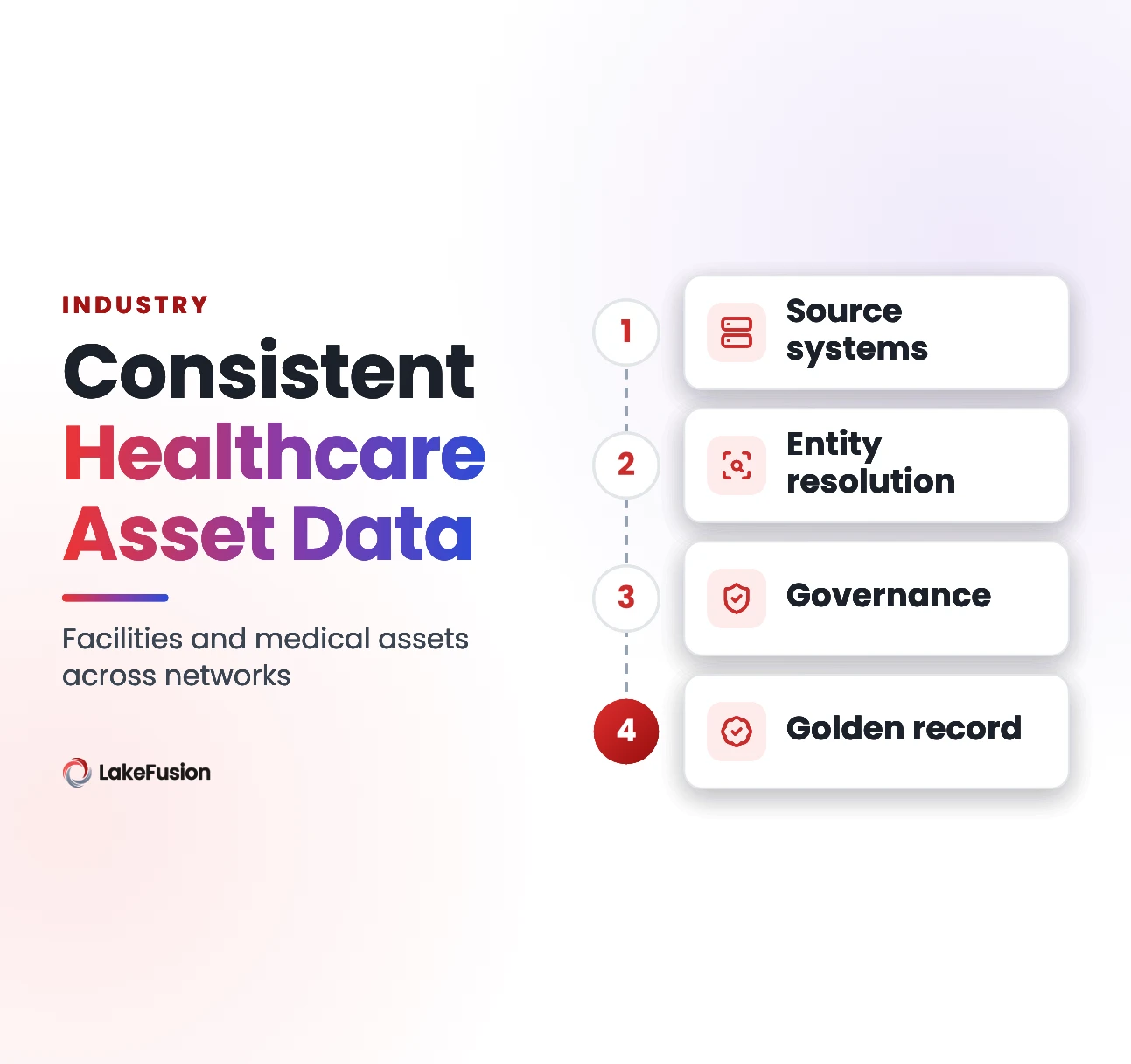

Healthcare networks need accurate information about their facilities, medical equipment, departments, and operational assets. Hospitals, clinics, diagnostic centers, and specialty care sites often keep this information in separate systems. Over time, differences in naming conventions, identifiers, ownership records, and update routines create messy data.
A hospital may show up under different names in facility directories, maintenance apps, and finance systems. Medical equipment can have duplicate records, old locations, or missing ownership details. These gaps make it harder for healthcare teams to know what assets they own, where those assets are, and how facilities link up.
Healthcare Facility and Asset Data Management helps address these gaps. It builds consistent, governed records across healthcare operations.
With Master Data Management (MDM) and relationship intelligence, networks can build trusted facility and asset information. That supports clear operational visibility, reporting, and better decisions.
What Is Healthcare Facility and Asset Data Management?
Healthcare Facility and Asset Data Management means finding, organizing, governing and maintaining accurate information about healthcare locations and the physical assets used in them.
It covers several data domains, including:
- Healthcare facilities: Hospitals, clinics, laboratories, diagnostic centers and specialty care locations.
- Medical equipment: Imaging machines, patient monitors, diagnostic equipment and other clinical assets.
- Facility structures: Departments, operating units, service locations and parent organizations.
- Asset information: Equipment identifiers, categories, ownership, status and location.
- Operational relationships: Links between facilities, departments, equipment and healthcare organizations.
Say ABC Health Network runs several hospitals and outpatient clinics. Each facility may keep its own equipment list. Central operations teams may manage maintenance, buying and financial information in different applications.
Without a consistent data approach, the same equipment or facility can look different in each system.
A structured approach to Healthcare Facility Master Data builds trusted records for important entities. Relationship intelligence then connects those records and gives a wider operational view.
Why Healthcare Networks Struggle With Facility and Asset Data Consistency
Healthcare networks often grow through new facility openings, acquisitions, department changes and equipment buying. Their data setups change with them. Information management habits don't always keep up.
Several problems cause inconsistent records.
1. Facility Information Is Scattered Across Systems
Facility details may sit in enterprise resource planning systems, hospital information systems, maintenance apps, finance platforms and internal directories.
Each application may use different facility names, codes and organizational structures. That makes it hard to keep one consistent view of locations across the network.
2. Medical Equipment Records Become Duplicated
Procurement, biomedical engineering, maintenance and finance teams may each record medical equipment on their own.
For example, XYZ Hospital might keep an imaging machine under an internal equipment ID. The maintenance app uses a different identifier. With no reliable matching process, teams may treat the records as two separate assets.
That hurts Medical Equipment Data Management and makes asset reconciliation harder.
3. Asset Location and Ownership Information Becomes Outdated
Equipment moves between departments, buildings and facilities. Ownership and maintenance duties can change too.
When connected systems don't pick up these updates, teams work with old information about where assets are, whether they're available or who looks after them.
4. Facility Relationships Are Difficult to Track
Healthcare organizations often run through complex structures. Parent health systems, hospitals, outpatient centers, departments, and specialty units all fit together. A flat list of facilities can't show those links. Teams need to see how locations tie to larger organizations and how assets are distributed across those structures.
5. Data Governance Varies Across Departments
Departments may follow different steps to create, update and approve records. With no clear owner, duplicate records stay unresolved. Conflicting values go unnoticed. Important changes may never reach every application that needs them.
8 Best Practices to Improve Healthcare Facility and Medical Asset Data Consistency
Better consistency takes more than tidying spreadsheets or merging facility directories. Healthcare networks need a repeatable framework. It should identify entities, standardize information, manage relationships, and govern updates.
1. Establish a Standardized Facility and Asset Data Model
Start by defining the core information every relevant system should keep about facilities and medical assets. A shared data model gives everyone the same definitions. Records become easier to compare across applications.
For healthcare facilities, consider standardizing:
- Facility name and unique identifier
- Facility type and operational status
- Registered and physical address
- Parent healthcare organization
- Departments and operating units
- Geographic and organizational hierarchy
For medical equipment, keep attributes such as:
- Equipment name and unique asset identifier
- Equipment category and manufacturer
- Model and serial number
- Current facility and department
- Ownership and maintenance responsibility
- Operational status and relevant dates
Not every application needs every attribute. The organization should still agree on shared definitions and critical identifiers. A standardized model is the base for Healthcare Data Management Solutions. It cuts the inconsistencies between departments.
2. Resolve Duplicate Facility and Equipment Records
Duplicate records are a major cause of unreliable operational information. Healthcare networks should use entity resolution to find records that may describe the same facility or medical asset across systems. Matching can look at:
- Facility names and location details
- Internal facility identifiers
- Equipment serial numbers
- Manufacturer and model information
- Asset tags and procurement references
- Other identifying attributes you have
A reliable matching process mixes deterministic rules for strong identifiers. It adds probabilistic or AI-assisted matching when records are incomplete or inconsistent.
Take ABC Medical Center. It may appear as ABC Medical Center in one system and ABC Med Center in another. Matching rules can spot the likely link and send uncertain cases to a data steward.
Approved match-and-merge workflows combine duplicates. They avoid merging separate facilities or equipment records by mistake.
3. Create Trusted Golden Records
Once you've found duplicates, you need a steady way to keep authoritative information.
Master Data Management does this with golden records. A golden record pulls validated information from different sources into one trusted picture of a facility or asset.
Organizations should write survivorship rules. They say which source supplies the preferred value for each attribute.
For example:
- An approved facility administration system may maintain facility names.
- Asset management records may supply equipment identifiers.
- The maintenance application may govern maintenance status.
- An authorized finance system may supply financial ownership information.
Data stewards should review conflicting values. They approve changes when automated rules can't pick the right outcome. This approach builds Hospital Asset Data and reduces repeated manual reconciliation.
4. Connect Facilities, Departments, and Medical Assets
Facility and asset records get more useful when their relationships are clear. A hospital may hold several departments. Each has different equipment and different operational duties.
Those departments may also link to a parent health system or a shared service organization. Graph intelligence can show these links as entities and relationships. Relevant relationships may include:
- Healthcare system operates facility
- Facility contains department
- Department uses medical equipment
- Asset assigned to facility
- Equipment maintained by service team
- Facility belongs to parent organization
For example, XYZ Health System may run three hospitals and several outpatient clinics. Each hospital has departments with different equipment lists. A connected relationship model makes it easier to see which assets belong to which locations. You also see how facilities tie into the wider organization.
This is where Healthcare Relationship Intelligence adds value. It goes beyond keeping facility and equipment records in isolation.
5. Define Data Ownership and Governance Responsibilities
Consistent data needs clear accountability. Healthcare networks should decide who can create, update, validate, and approve facility and asset information. A practical governance model should define:
- Data owners: Approve business definitions and policies for facility and asset domains.
- Data stewards: Review duplicates, resolve exceptions and maintain data quality.
- System administrators: Manage platform setup and operational permissions.
- Data consumers: Use approved information and report inconsistencies.
Role-based access controls help enforce these duties. Organizations should also set steps for facility openings, closures, equipment transfers, ownership changes and other major updates.
Governance means someone reviews changes and handles them the same way every time. Departments don't each keep their own records their own way.
6. Integrate Facility and Asset Data Across Applications
One central record doesn't fix consistency if other systems keep using old information. Healthcare networks should set up reliable integration workflows. They link source applications, the master data environment and approved consuming systems.
Important points include:
- Naming authoritative sources for critical attributes
- Mapping source fields to standardized data models
- Setting up batch or scheduled update pipelines
- Publishing approved golden records to downstream applications
- Keeping source identifiers and data lineage
- Watching for failed updates and sync problems
Organizations on Databricks can adopt a Master Data Management approach on Databricks. It manages trusted entities next to their existing lakehouse data.
The goal isn't always to replace every operational application. It's to build a trusted database that supports consistent information exchange.
7. Monitor Medical Equipment Data Quality Continuously
Facility and equipment information changes all the time. New assets get bought. Equipment moves. Facilities expand. Departments get reorganized.
Healthcare networks should monitor data quality continuously. Occasional manual audits aren't enough. Useful indicators include:
- Duplicate facility and equipment records
- Missing asset identifiers
- Incomplete facility attributes
- Conflicting equipment locations
- Records awaiting stewardship approval
- Outdated facility and department relationships
- Failed data synchronization processes
For Healthcare Operations Data, these measures help teams catch inconsistencies before they spread across applications. Data quality monitoring should also include clear ownership and escalation steps. Spotted issues then lead to real fixes.
8. Make Trusted Facility and Asset Data Available for Analytics
Consistent records pay off when operational teams and applications can use them. Healthcare networks should make approved facility and asset information available to the right analytics, reporting, and operational workflows.
For example, an operations team may want to study how equipment spreads across hospitals. It may compare asset lists between locations or see how facilities sit under a health system. Trusted master records give consistent entity identities. Relationship intelligence adds the context that shows how facilities, departments, and assets connect.
Keep access controls in place. Applications and users should only get information they're allowed to use.
How LakeFusion Supports Healthcare Facility and Asset Data Management
LakeFusion combines Databricks-native Master Data Management with graph intelligence. Organizations build trusted entities and connect their relationships.
Its capabilities can support healthcare networks that manage facility, equipment and organizational information across several systems.
Build Trusted Facility and Asset Records With MDM
LakeFusion MDM supports deterministic, probabilistic and AI-assisted matching. It finds records that may stand for the same real-world entity.
Organizations can use these capabilities to:
- Find duplicate facility and asset records
- Match entities across enterprise datasets
- Run match and merge workflows
- Set attribute survivorship rules
- Create governed golden records
- Send uncertain matches to data stewards
- Keep a traceable history of entity changes
That gives you a steady base for managing facility and asset master data. Explore the Enterprise Master Data Management solution to see how LakeFusion supports trusted entity management on Databricks.
Connect Facilities and Assets With LakeGraph
LakeFusion's graph capabilities help organizations show relationships between trusted entities. Healthcare networks can use this approach to link facilities, departments, medical equipment and parent organizations. Those relationships add context for operational analysis and connected data workflows.
LakeGraph uses a property graph model on the Databricks and Delta foundation. It ties relationship intelligence to governed master data. You don't need a separate external graph database.
Explore the Healthcare Relationship Intelligence approach through LakeFusion Graph Intelligence.
Support Governance and Controlled Data Access
LakeFusion supports role-based access control. Organizations can set roles, permissions and scopes for the people who manage master data.
That builds accountability for creating, reviewing, and updating entities. Access to trusted information stays under control too.
LakeFusion brings MDM and graph intelligence together on Databricks. Organizations get a connected database for enterprise operations, analytics, and AI workflows.
Build a More Consistent Healthcare Facility and Asset Data Foundation
Healthcare networks need accurate facility and medical asset information to understand how they operate. Scattered records, duplicate equipment entries, old locations and disconnected organizational links make that hard.
A structured approach brings several pieces together. Standard data models, entity resolution, golden record management, governance, integration, and graph intelligence all play a part.
Master Data Management builds trusted facility and asset records. Graph intelligence connects those entities and shows how they relate across the healthcare network. LakeFusion brings these capabilities together on Databricks. Organizations move toward trusted, governed and connected enterprise data.
Ready to improve facility and medical asset data consistency? Explore LakeFusion or contact the team to talk about how Databricks-native MDM and graph intelligence can support your data management plan.
Frequently Asked Questions
1. What is healthcare facility and asset data management?
Healthcare Facility and Asset Data Management means finding, organizing, governing and maintaining information about healthcare locations, departments, medical equipment and related operational assets.
2. Why is healthcare facility master data important?
Healthcare Facility Master Data gives consistent records for hospitals, clinics, departments and other healthcare locations. It cuts duplicate records and keeps facility information reliable across applications.
3. How can healthcare networks improve medical equipment data management?
They can standardize equipment attributes and set unique identifiers. They can also resolve duplicate records, define data ownership and keep trusted asset records through Master Data Management. Regular data quality monitoring helps catch outdated or incomplete information.
4. How does graph intelligence help healthcare facility management?
Graph intelligence links facilities, departments, equipment and parent organizations through clear relationships. Teams can explore organizational structures, how assets are spread out and dependencies across the healthcare network.
5. What is the role of MDM in healthcare data management?
MDM finds duplicate records and applies matching and survivorship rules. It builds trusted golden records and supports data stewardship. It gives healthcare applications and analytics a consistent entity base.

Accelerate your edge with LakeFusion insights
Get practical perspectives on master data, governance, and building scalable, AI-ready data foundations.