
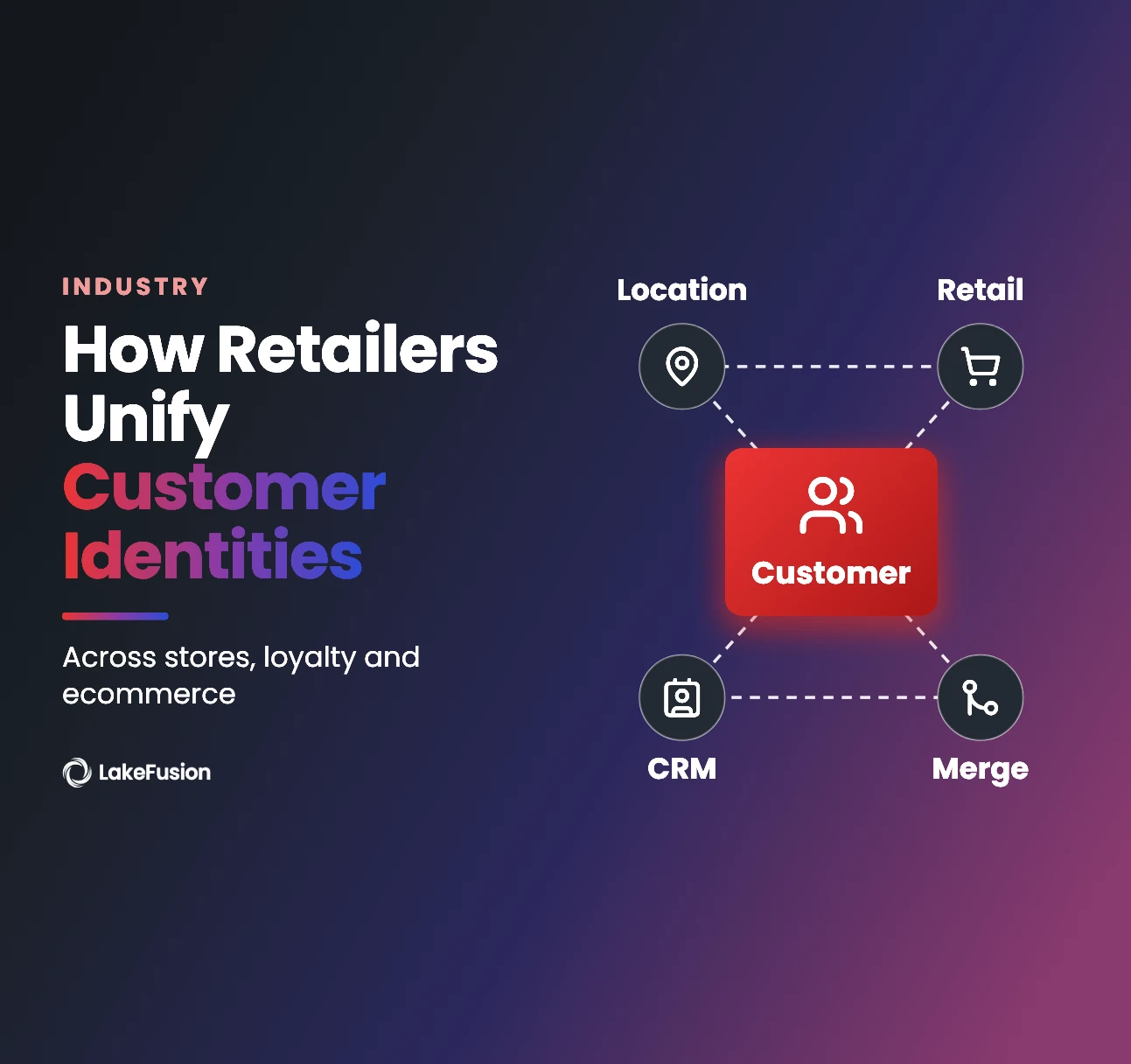

Customers deal with brands in stores, on websites, through apps, loyalty clubs, and support teams. Each touchpoint can leave behind its own customer file, ID, and buying history.
When those files stay separate, retailers can't really see who the person is or how they move from one channel to the next. Retail customer identity resolution links scattered files into one consistent identity for each customer.
Companies combine entity resolution, master data management, and relationship intelligence to get a clearer view of their shoppers.
Tools like retail and consumer goods data management solutions set this up so teams can personalize better, support more effectively, and improve reporting and omnichannel work.
What Is Retail Customer Identity Resolution?
Retail customer identity resolution means finding customer records that belong to the same person and linking them even when they live in different systems and channels.
Someone might join the loyalty program with one email, order online with a different one, and hand over a phone number at the register. Without identity resolution, those three actions sit in three different profiles.
The job is to join the records into one identity while still keeping the original source details.
Common Customer Identity Sources In Retail
Most retailers pull customer info from these places:
- Physical Stores: Point-of-sale transactions, receipts, returns, and customer account registrations.
- Ecommerce Platforms: Online orders, customer profiles, browsing activity, and saved addresses.
- Loyalty Programs: Membership IDs, reward balances, points, and redemption history.
- Mobile Applications: App registrations, preferences, and digital interactions.
- Customer Service: Support requests, contact details, complaints, and service history.
- Marketing Platforms: Campaign engagement, subscriptions, and customer preferences.
Why Retailers Struggle to Unify Customer Identities
Customer data lives in systems that rarely talk to each other. Each one keeps its own IDs, formats, and files. That makes it hard to build one reliable view of the customer.
1. Different Identifiers Across Sales Channels
The same person ends up with different IDs depending on where they shop or sign up. For example:
- A loyalty membership number in the store system.
- An email address in the ecommerce platform.
- A mobile number in the customer service application.
- A customer ID in the CRM.
- A transaction identifier in the point-of-sale system.
Those IDs almost never match automatically. Retailers need matching that looks at several details at once instead of betting on one single ID.
2. Duplicate and Inconsistent Customer Records
People type their details differently every time. Names get misspelled, phone numbers follow different styles, and addresses change. A retailer can easily end up with several files for one person because of:
- Different email addresses.
- Name variations or typographical errors.
- Multiple loyalty accounts.
- Different billing and delivery addresses.
- Incomplete registration information.
Those gaps hurt customer data quality and make matching harder.
3. Disconnected Loyalty and Purchase Histories
Loyalty systems often stay separate from store and online order systems. So a retailer might know what a member bought online but have no idea what they bought in the shop.
That leaves big blind spots around:
- Total customer spending across channels.
- Loyalty participation and redemption behavior.
- Repeat purchases and buying frequency.
- Product preferences across online and offline channels.
- Customer engagement over time.
Without that link, personalization and loyalty programs work from partial data.
4. Changing Customer Information
People change emails, phone numbers, addresses, and account details all the time. Retailers have to update the files without creating new duplicates or losing the old history.
A good process needs to tell the difference between:
- A genuine change to an existing customer's information.
- A new customer with similar details.
- A duplicate record that needs merging.
- A shared contact detail used by multiple individuals.
Identity resolution has to keep running as this information changes.
7 Ways Retailers Can Unify Customer Identities Across Channels
Retail customer identity resolution requires data management, matching, governance, and relationship intelligence to work together. These seven steps help build a more consistent customer view.
1. Consolidate Customer Data from Every Channel
The first step is pulling customer info from every system that touches a shopper. Retailers need to list the main sources and know exactly what each one holds. Common sources include:
- CRM and customer service platforms.
- Ecommerce websites and mobile applications.
- Loyalty management systems.
- Point-of-sale applications.
- Marketing automation platforms.
- Order and transaction management systems.
Retailers can keep their existing tools and still connect the customer data they produce. A retail MDM platform builds a trusted customer record across those systems while the day-to-day apps keep doing their normal jobs.
2. Apply Intelligent Customer Matching
Retail customer matching decides whether two records from different systems actually belong to the same person.
Exact matching works when the IDs are clean. Most of the time the data has missing bits, spelling differences, and mixed formats.
A better approach mixes a few methods:
- Deterministic Matching: Uses exact identifiers or predefined business rules.
- Probabilistic Matching: Evaluates the likelihood that records belong to the same individual.
- AI-Assisted Matching: Uses contextual information to help assess more complex or ambiguous matches.
- Steward Review: Routes uncertain matches to authorized users for validation.
Two records might share a similar name and phone number but different emails. The matching step weighs everything available and decides if it's the same customer. Learn more about how customer entity resolution joins scattered records.
3. Create a Golden Customer Record
Once matching finds duplicates, the next job is to combine them. A golden record is the trusted version of a customer that pulls the best details from all the linked source files.
It shouldn't just overwrite everything with one chosen value. Retailers need clear survivorship rules that specify which source wins for each detail type.
For example:
- A verified loyalty account may provide the preferred membership identifier.
- A recently validated address may be preferred for delivery.
- A customer-approved email may be used for communication.
- Transaction systems may remain authoritative for purchase history.
A governed golden record keeps things consistent while still holding onto the original source details and where they came from. This is a key piece of customer 360 data management because the point is a reliable customer view, not just a pile of unlinked profiles.
4. Connect Omnichannel Customer Relationships
Identity gets more useful when it's tied to the wider set of relationships. A customer can have several loyalty memberships, household links, accounts, addresses, and contacts across different channels.
Graph-based relationship management helps retailers see those connections. For example, retail graph analytics can support relationships between:
- Customers and loyalty accounts.
- Customers and household members.
- Customers and transactions.
- Customers and preferred stores.
- Products and customer purchases.
- Customers and service interactions.
LakeGraph gives teams an operational graph model on Databricks, so they can work with relationships right next to the mastered entities. Retailers can see the full network around each customer.
5. Establish Customer Data Governance
Joining identities also brings governance work. Retailers hold personal details, contact info, purchase histories, loyalty data, and preferences. Those records have to follow privacy rules and company policy.
A customer data governance framework should cover:
- Defined ownership of customer attributes.
- Role-based access to sensitive information.
- Data quality and validation rules.
- Stewardship for uncertain identity matches.
- Data lineage and source tracking.
- Retention and deletion processes.
- Controls for consent and communication preferences.
Matching should never override a customer's consent or communication limits. For more on the security model, companies can check LakeFusion Trust and Security.
6. Maintain Customer Data Quality Continuously
Customer records keep changing as people shop, sign up, update details, and use the services. A one-time matching job won't keep identities accurate for long. Retailers need ongoing steps to monitor and fix data quality. Important activities include:
- Detecting new duplicate records.
- Validating customer attributes.
- Reviewing uncertain matches.
- Updating golden records when source information changes.
- Tracking changes and data provenance.
- Monitoring the quality of incoming customer records.
This keeps retail customer identity resolution working as new channels and new customer contacts appear.
7. Make Unified Customer Data Available Across Business Teams
The last step is getting the trusted customer data out to the teams that actually need it.
Different groups use the data for different jobs. For example:
- Marketing: Builds more accurate customer segments and campaign audiences.
- Store Operations: Recognizes customers across physical store interactions.
- Ecommerce: Uses consistent identities across online accounts and transactions.
- Customer Service: Retrieves relevant customer history and account information.
- Loyalty Teams: Connects memberships, points, and redemption activity.
- Analytics Teams: Measures customer behavior across channels.
This gives everyone the same base for omnichannel work and stops each team from building its own identity rules.
How LakeFusion Supports Retail Customer Identity Resolution
LakeFusion helps retailers build trusted customer entities and linked business relationships through master data management and graph analytics on Databricks.
LakeFusion MDM matches, merges and stewards customer records across source systems, turning them into trusted golden records that feed apps, reporting, and AI work.
Connected Customer Context Through LakeGraph
LakeGraph adds relationship intelligence to the mastered customer data. Retailers can use the linked relationships to see how customers connect to loyalty accounts, households, stores, transactions, and other business entities. This gives a fuller picture than a flat list of matched records.
Governed Data on Databricks
LakeFusion master data management is built on Databricks and works with Unity Catalog for governance, access, and lineage.
Unity Catalog handles the base governance layer while LakeFusion focuses on resolving the trusted business entities and linking their relationships.
Customer records, including personal data, never leave the retailer's Databricks environment or the Unity Catalog boundary, which makes privacy reviews simpler.
Build a Unified Customer View Across Every Retail Channel
Retailers can't deliver consistent omnichannel experiences when customer identities stay split across stores, loyalty programs, ecommerce, and support systems.
Retail customer identity resolution is the base for linking those records, building golden customer profiles, and keeping relationships connected across channels.
LakeFusion supports this through MDM and graph analytics on Databricks. It helps retailers create trusted customer entities that back operations, reporting, and AI. One global sportswear retailer resolved more than 30 million consumer profiles to almost 17 million unique shoppers, roughly doubled its deduplication rate, and went live in about 10 weeks.
Explore LakeFusion customer success stories to learn more.
To discuss how LakeFusion can support your retail data strategy, book a demo.
Frequently Asked Questions
1. What is Retail Customer Identity Resolution?
Retail customer identity resolution is the process of identifying and connecting customer records across stores, ecommerce platforms, loyalty programs, and other retail systems to establish consistent customer identities.
2. Why is customer identity resolution important for retailers?
It helps retailers reduce duplicate records, connect purchase histories, improve customer data quality, and establish a more consistent view of customer interactions across channels.
3. What is the difference between customer matching and identity resolution?
Customer matching identifies records that may belong to the same individual. Identity resolution uses matching results, business rules, and governance processes to establish and maintain a consistent customer identity.
4. How does Master Data Management support retail customer data unification?
Retail master data management consolidates fragmented customer records into trusted golden records. It uses matching, merging, survivorship, and stewardship to maintain consistent customer information across systems.
5. How does Graph Analytics improve retail customer data?
Graph analytics connects customers to loyalty accounts, households, stores, transactions, and other business entities. These relationships provide additional context for analytics and operational applications.
6. How does LakeFusion help retailers unify customer identities?
LakeFusion provides MDM capabilities for entity resolution, matching, merging, golden records, and stewardship, alongside LakeGraph for managing business relationships. Both operate on the Databricks foundation.

Accelerate your edge with LakeFusion insights
Get practical perspectives on master data, governance, and building scalable, AI-ready data foundations.