
.avif)
Here's a problem you've probably met. One customer, three systems. The CRM lists "ABC Technologies LLC." Billing says "ABC Tech." Somewhere else the address is spelled a different way. So is that one customer or three? Master data management software is built to answer that. It finds the duplicates, pulls details together from different sources, and builds a master record you can rely on.
Match and merge is the part that does most of the work. Without it, you get duplicate records, reports nobody believes, and decisions made on numbers that don't hold up.
Master Data Management on Databricks lets you run all of it inside your lakehouse. Entity resolution, governance, and processing at scale come together in one place.
What Is Match and Merge in Master Data Management?
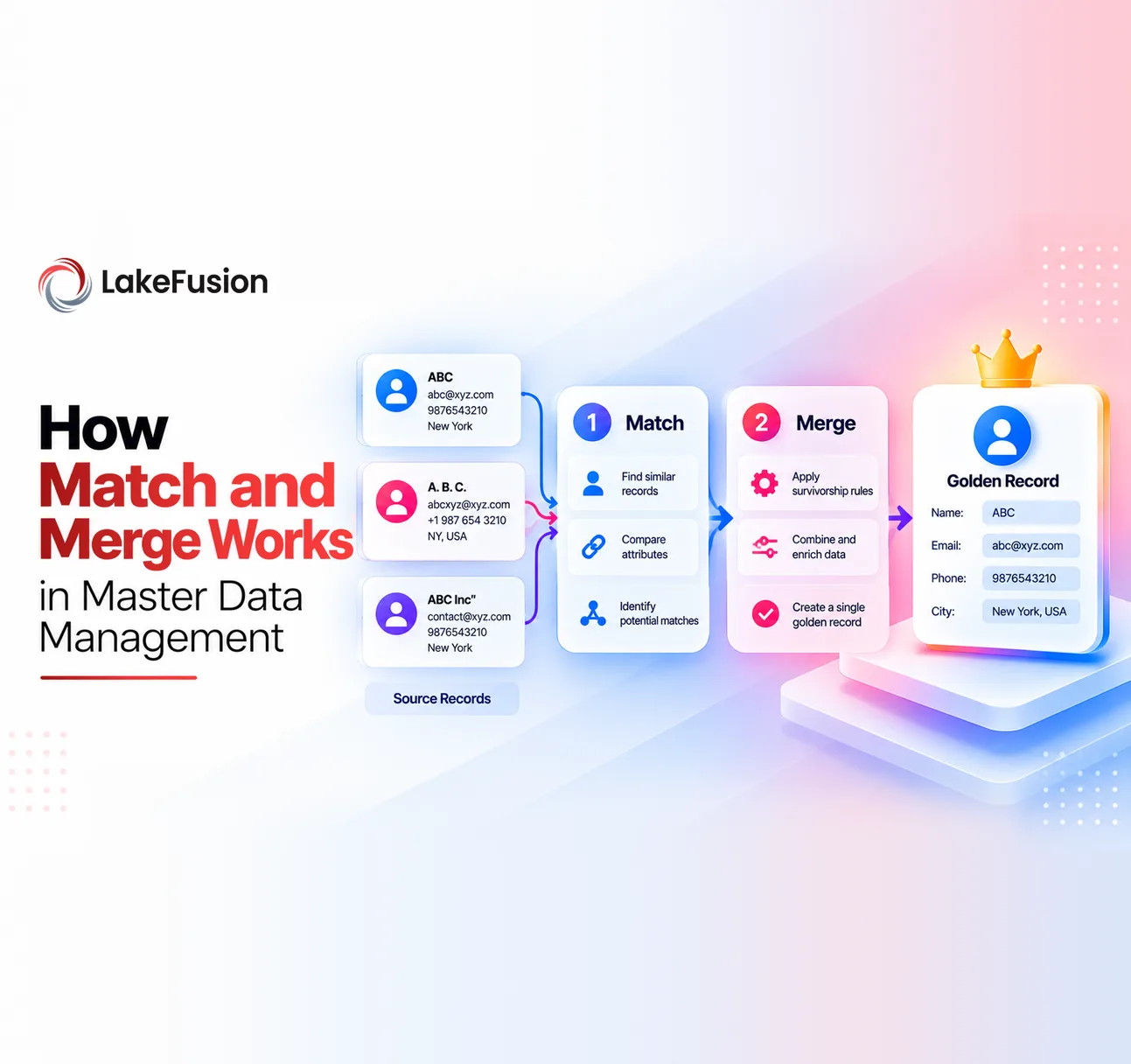
Easiest way to see it: two jobs and a tiebreaker. First, you find the records that describe the same real-world thing. Then you combine them into one trusted master record. The tiebreaker decides which details make it into that record.
- Match: Checks if two or more records point to the same real-world entity.
- Merge: Combines the matched records using the business rules you set.
- Survivorship: Picks which attribute values stay in the final master record.
When all three work, your customer, product, and supplier data lines up across every system.
How Record Matching Works
Matching compares what each record says and asks a simple question. Same entity, or not? You can use exact rules, similarity scores, probabilistic models, or AI-assisted matching. It depends on your data and what the business needs.
Look at these three records:
- ABC Technologies LLC
- ABC Technologies
- ABC Tech
Same company? Probably. But the names don't match letter for letter. So the process checks the other attributes and runs your configured rules before it links them.
It can check company names, addresses, identifiers, contact details, and any other helpful field.
How Record Merging Works
After you confirm a match, the merge starts. It doesn't just throw every field into one pile. It follows survivorship rules, keeps the source references that matter, and respects your governance requirements.
You come out with a master record for that entity. It also keeps enough history that you can see where it came from and manage it later.
Why Match and Merge Matters for Enterprise Data
Duplicates and mismatched records hurt more than you'd think. The damage spreads into reporting, customer experience, daily workflows, and AI-driven decisions.
Reducing Duplicate Records
When several systems each make their own record for one entity, the information gets scattered. Match and merge finds those duplicates and gives you one consistent view.
Improving Data Consistency
Two systems can hold different values for the same attribute. A governed merge uses business rules to choose which one to keep. That's how your master data stays consistent.
Supporting Reliable Analytics and AI
Analytics and AI need accurate information about each entity. If a customer or supplier shows up under several identities, the reports go wrong. So do the decisions that follow.
A strong Enterprise MDM Platform gives you trusted records for reporting, applications, and AI workflows.
The Three Core Stages of Match and Merge
Spotting similar names is only the start. A solid match-and-merge process needs matching logic, consolidation rules, and governance that never switches off.
1. Identify Potential Matches
You begin by checking records for possible duplicates. You can choose from a few matching methods, depending on how messy your data is. Deterministic matching runs on clear rules. An exact match on a unique identifier is the classic case.
Probabilistic matching looks at several attributes together. It estimates how likely two records are the same entity, based on what they share and where they differ.
AI-assisted matching takes the harder cases. Maybe the fields relate in tricky ways. Maybe the data varies so much that fixed rules can't keep up.
A well-built Entity Resolution Platform can mix these methods to cover different levels of difficulty.
2. Apply Merge and Survivorship Rules
You've found the matches. Now the system has to decide how to combine what the records say. Survivorship rules say which source or attribute value wins. They can look at:
- Source-system reliability
- Data completeness
- Recency of the value
- Validation status
- Business-defined priorities
Here's an example. Two records list different phone numbers. The business might trust the number from a verified source over an older one from a weaker system.
Keep survivorship configurable and easy to read. Your data team should be able to see why a certain value won.
3. Create and Maintain the Master Record
The merged result becomes the trusted master version of the entity. Keep the identifiers, source references, and lineage details attached, so your team can trace how it was built.
The work doesn't end there. New source records arrive, attributes change, business relationships shift. Any of that can call for more matching, merging, or steward decisions.
Matching Approaches: Deterministic, Probabilistic, and AI-Based
No single matching strategy fits every dataset. Entity types and source systems are too different.
| Approach | How it works | Best suited for |
|---|---|---|
| Deterministic matching | Applies explicit rules and conditions | Reliable identifiers and predictable data |
| Probabilistic matching | Evaluates attribute-level evidence to estimate match likelihood | Records with incomplete or inconsistent values |
| AI-assisted matching | Uses AI to evaluate complex or ambiguous record pairs | Cases that are difficult to resolve using fixed rules alone |
Most teams end up using more than one. You get a decent balance of precision, scale, and room for human review.
A common flow goes like this. Deterministic rules clear the easy cases first. Probabilistic methods take the less obvious ones. AI-assisted matching works on the stubborn pairs. Whatever stays unclear goes to a data steward.
An AI-powered Master Data Management approach still has to follow your governance rules. Automation should make decisions easier to explain and keep people involved. It shouldn't take accountability away from the business.
The Role of Data Stewardship in Match and Merge
Automated matching can't settle every case with full certainty. Some records carry conflicting identifiers or missing attributes. Others have odd variations that only someone with business context can read.
Data stewardship gives you a governed way to review and settle those cases.
Reviewing Uncertain Matches
A data steward reviews candidate records, compares attributes, and decides whether to link them or keep them separate. If your system supports feedback-based learning, those decisions can also sharpen the matching rules and models.
Managing Merge Decisions
Stewardship workflows keep merges inside company policy. They also let you fix a bad match, resolve conflicts, and keep people trusting the master data.
Preventing New Duplicates
Match and merge cleans up existing duplicates. You still need to stop new ones from creeping in. Search-before-create workflows, validation, and real-time matching can find an existing entity before anyone makes a new record.
A dedicated Data Stewardship Platform helps teams handle these calls consistently, even as data volume and complexity keep climbing.
Common Challenges in Match and Merge
It matters a lot. Rolling it out across a whole company still brings some headaches.
Inconsistent Source Data
Systems differ in formats, naming conventions, identifiers, and how complete the data is. Standardize the data and pick the right matching logic. That fixes most of it.
Incorrect Matches
Loose rules can glue together records from different entities. Sensible thresholds, validation, and review workflows reduce false positives.
Missed Matches
Strict rules can miss records that belong together but have small variations or gaps. Using several matching strategies helps you catch more.
Unclear Survivorship Rules
If business teams can't agree on which sources or values win, the merged record may not match how the business really works. Set survivorship policies together with the right business stakeholders.
Limited Traceability
Your team needs to know why records matched and why a certain value survived. Keep the decision details, provenance, and source references. They make troubleshooting and governance far easier.
How Match and Merge Fits into a Modern Data Architecture
In a company, match and merge shouldn't sit alone. It belongs next to data ingestion, transformation, governance, and operational workflows.
A lakehouse architecture gives you a place to process data from many systems at scale. By itself, though, a lakehouse won't hand you trusted master records. You still need dedicated MDM capabilities for entity resolution, merging, survivorship, stewardship, and upkeep.
On Databricks, Databricks-native MDM brings master data processes closer to your data platform while still meeting enterprise governance needs.
Unity Catalog covers governance for data assets, including access controls and lineage. MDM does a different job. It resolves entities and builds trusted master records. The two work well side by side in a governed data setup.
Sometimes relationships between entities matter as much as the entities themselves. A Graph Intelligence Platform adds that context by connecting entities and showing how they relate. You can then work with trusted entities and the networks that link them.
How LakeFusion Supports Match and Merge?
LakeFusion offers enterprise master data management built on Databricks. You can resolve duplicate records, set up trusted entities, and manage master data through governed workflows.
Its MDM capabilities cover matching approaches, entity resolution, match and merge, survivorship, golden records, and data stewardship. Your team gets consistent entity records while maintaining control over business rules and governance.
There's also a Search Before Create workflow. It checks for existing records before anyone makes a new entity. This reduces duplicates and keeps data quality high at the point of entry.
Want relationship context next to your trusted master records? LakeGraph adds graph intelligence using a property graph model on the Databricks and Delta foundation. See how entities connect without needing a separate external graph database.
Combine master data management and graph intelligence on Databricks to build a trusted, governed, AI-ready data foundation.
Explore the Master Data Management platform or learn more about LakeFusion Graph Intelligence.
Conclusion
Match and merge sits at the base of master data management. Matching finds records that represent the same entity. Merging combines what they say. Survivorship rules choose which values land in the trusted master record.
You can improve at all of this by combining the right matching approaches with clear business rules, stewardship workflows, and consistent duplicate prevention. Inside a governed data architecture, match and merge gives your analytics, operations, and AI consistent master data.
LakeFusion brings these MDM capabilities to Databricks. Enterprise teams can resolve entities, govern trusted records, and link master data to wider relationship intelligence.
Ready to improve the quality and reliability of your enterprise master data? Contact LakeFusion to explore master data management on Databricks.
Frequently Asked Questions
1. What is match and merge in MDM?
You find the records that represent the same entity and combine them into one trusted master record. Matching spots the likely duplicates. Merging combines them using business rules.
2. What is the difference between matching, merging, and survivorship?
Matching asks whether records are the same entity. Merging combines the ones that matched. Survivorship picks which attribute values stay in the final master record.
3. What are the main types of MDM matching?
Most people name three: deterministic, probabilistic, and AI-assisted. Many companies use all of them together. That covers exact identifiers, inconsistent attributes, and tricky or unclear record pairs.
4. How do survivorship rules work in MDM?
They decide which values stay when matched records disagree. A rule can favor source reliability, recency, completeness, validation status, or a business-defined priority.
5. How does Databricks support match and merge?
Databricks provides a lakehouse foundation for processing and governing enterprise data. Dedicated MDM capabilities built on Databricks can use that base for entity resolution, matching, merging, survivorship, and stewardship.

Accelerate your edge with LakeFusion insights
Get practical perspectives on master data, governance, and building scalable, AI-ready data foundations.