
.avif)
Enterprise data does not stay clean by itself. Customer records shift, suppliers merge, product details clash, new source systems arrive, and automated matching hits cases it can't resolve with full certainty.
Data stewardship comes into play in that scenario. Data stewardship is the day-to-day responsibility of ensuring, fixing, and checking the quality of the business data the company uses.
Stewards lie between automated matching rules and real business decisions in master data management. They investigate uncertain matches, resolve conflicting values, clear exceptions, and keep trusted golden records accurate over time.
When master data becomes a one-time project, it's time to implement solid MDM data stewardship. It creates a consistent process that maintains the accuracy, governance, and usability of customers, suppliers, companies, products, and other enterprise entities.
Stewardship isn't an additional chore for companies that require solid data for analytics, applications, and artificial intelligence. It is how the company keeps trust alive.
What Is Data Stewardship?
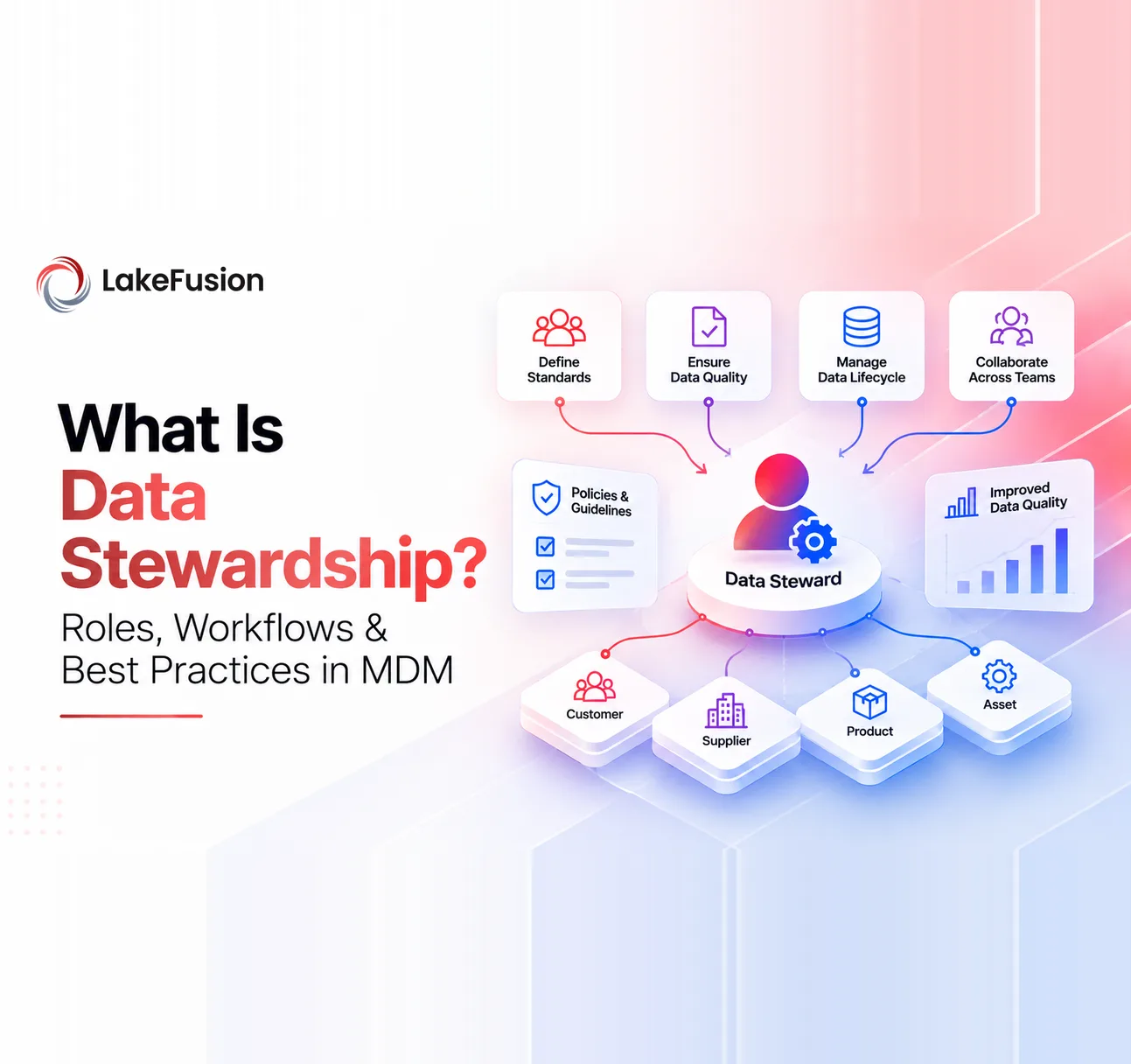
Data stewardship is the day-to-day responsibility of ensuring enterprise data is accurate, consistent, controlled, and useful for business.
A data steward usually owns one business domain or a group of records. The steward does not run the systems. The steward looks after the meaning and quality of the data.
For example, a customer-data steward may check:
- possible duplicate customers,
- conflicting addresses,
- questionable matches,
- incomplete attributes,
- customer hierarchy changes,
- source-system discrepancies.
A supplier steward may decide if two vendor records point to the same legal entity or pick which source should supply the official supplier name.
Why Data Stewardship Matters in MDM
Master Data Management platforms can handle much of entity resolution, matching, merging, and survivorship on their own. But enterprise data still holds gray areas.
Two records may look similar but be stored as separate records.
For example:
ABC Manufacturing LLC
and
ABC Manufacturing Services
They may be in the same company, a subsidiary, or two distinct companies. If they can be merged without sufficient proof, this can do as much damage as leaving the genuine duplicates alone. That is why MDM data stewardship exists to handle the cases that need business judgment.
Stewardship Protects Golden Records
A Golden Record should give the trusted enterprise view of an entity. When source systems disagree or match confidence is low, stewards step in so doubtful choices don't slide into that trusted record.
Stewardship Adds Business Context
Algorithms can line up attributes. Business people often see links that individual fields do not show.
A steward may know that:
- Two suppliers recently merged,
- One product code is obsolete
- A company operates under multiple legal names
- One source system is authoritative for a specific attribute.
That knowledge sharpens the mastering choices.
Stewardship Supports Accountability
Without a clear owner, open data problems can sit forever. A set data steward workflow names who checks each issue, what proof they need, and how the choice gets logged.
What Does a Data Steward Do?
The role is different depending on the business and industry, but most stewards perform similar work over and over.
Review Potential Matches
A master data management software platform may flag two records as possible duplicates but hold off on merging them.
The steward looks at the proof and chooses whether to:
- approve the match,
- reject the match,
- defer the decision,
- request additional information.
Resolve Attribute Conflicts
Source systems often disagree. One system may hold a newer address while another holds the validated legal name. The steward weighs the evidence and picks which values become official under the survivorship and governance rules.
Maintain Golden Records
Stewards watch the mastered entities and make sure they still match business reality as source data shifts. They may fix values, sign off on updates, or dig into odd changes before those changes move downstream.
Manage Hierarchies and Relationships
Enterprise entities almost never stand alone. A steward may need to check:
- Parent-Company Relationships,
- Subsidiaries,
- Supplier Hierarchies,
- Customer-Account Structures,
- Product Classifications.
Investigate Data Quality Exceptions
Stewards also clear records that break set quality rules, such as missing identifiers, mixed values, or wrong classifications. This links stewardship tightly with enterprise data quality.
The Data Steward Workflow in MDM
A solid data steward workflow should let people dig into unclear records without forcing them to hunt across many systems by hand. A common workflow runs like this.
1. Detect the Issue
The MDM platform flags an event that needs review.
Examples include:
- a potential duplicate,
- conflicting attribute values,
- missing required information,
- uncertain entity match,
- hierarchy exception,
- unusual record change.
Not every issue should reach a steward. High-confidence calls can often run on their own.
2. Route the Case
The issue goes to the right steward based on factors such as:
- business domain,
- geography,
- entity type,
- business unit,
- access permissions.
Routing puts the case in front of the person who holds the right context.
3. Review the Evidence
Good stewardship tools should lay out the proof behind the call. A steward may line up:
- source records,
- matching attributes,
- source lineage,
- confidence indicators,
- historical decisions,
- related entities.
The aim is to make the choice clear instead of leaving stewards to guess why the system flagged the records.
4. Make the Decision
The steward may approve a merge, reject a proposed match, update a value, fix a relationship, or send the case on for more review. That choice should sit in the governance record.
5. Update the Master Record
Once approved, the choice updates the mastered entity under the company's rules. The resulting golden record can then feed downstream systems, analytics, and other workflows.
6. Preserve the Audit Trail
The stewardship process should keep details about:
- Who made the decision
- What changed
- When it changed
- Which source records were involved
- Why was the action taken?
This matters for master data governance, accountability, and later checks.
Data Stewardship vs Data Governance
Data stewardship and data governance are similar but not the same.
| Data Governance | Data Stewardship |
|---|---|
| Defines policies | Executes policies |
| Establishes ownership | Performs operational review |
| Defines quality standards | Resolves quality exceptions |
| Sets source authority | Applies source authority |
| Defines escalation processes | Works through escalations |
| Establishes accountability | Carries out accountable decisions |
Data Stewardship vs Data Quality
Data quality verifies the accuracy, completeness, validity, consistency, and usability of data. The people and the actions that remove the issues and maintain the quality are the stewardship.
For example, a data quality rule could note the absence of a tax identifier on a supplier record. The steward is responsible for what comes next. Similarly, data cleansing may clean an address on its own, while stewardship steps in when two cleaned addresses clash. The tools overlap, but the jobs stay different.
Best Practices for MDM Data Stewardship
Good MDM data stewardship should cut manual work while making key choices easier and more consistent.
Automate Clear Decisions
Stewards should not waste time on obvious matches. High-confidence duplicate detection, standardization, and survivorship choices can often run on their own. People should look only at the gray areas.
Give Stewards Evidence, Not Just Alerts
A queue that simply says "Review Record 12345" creates extra work. Solid stewardship tools supply:
- Side-By-Side Records,
- Match Evidence,
- Confidence Levels,
- Source Information,
- Lineage,
- Relationship Context.
The steward should see right away why the case needs attention.
Route Work by Domain
Customer stewards should not have to settle supplier or product issues. Sending cases by domain puts the choices in the hands of people who know that part of the business.
Define Source Authority Early
Stewards should know which sources rank higher for certain attributes. Without that rule, two people can pick different answers for the same clash.
Capture Every Decision
Human stewardship needs an audit path. Choices should join the record history instead of vanishing into emails or outside ticket systems.
Measure Stewardship Performance
Useful numbers may include:
- Number of Exceptions,
- Resolution Time,
- Recurring Issue Types,
- Percentage of Automated Decisions,
- Rejected Versus Approved Matches.
These numbers show where matching rules, source quality, or workflow design can get better.
Data Stewardship on Databricks
Stewardship should sit near the governed data foundation, not in a separate, older MDM stack, as companies bring enterprise data into Databricks. Master Data Management on Databricks allows entity resolution, golden-record generation, survivorship, and stewardship to be performed around the data in the lakehouse.
LakeFusion MDM pairs these mastering tools with governed workflows for validating uncertain matches and maintaining trusted entities.
This cuts the gap between:
- source data,
- MDM decisions,
- governance,
- analytics,
- downstream AI.
When stewardship sits near the data itself, mastered records stay tied more tightly to the lineage and business context that explain them.
Build Governed Data Stewardship with LakeFusion
Strong data stewardship turns MDM from a pure matching job into a working system that keeps enterprise data trusted.
Automation clears the high-confidence choices. Stewards handle the unclear matches, clashing values, exceptions, and relationships where business knowledge counts most.
LakeFusion brings entity resolution, golden records, survivorship, hierarchy management, and governed stewardship workflows together on Databricks. This helps companies build and maintain trusted customer, supplier, company, product, and other master data.
The outcome is not just cleaner records. It is a governed master database that analytics, applications, teams, and AI can trust more.
Ready to put data stewardship to work on Databricks? Explore LakeFusion Master Data Management or book a demo.
Frequently Asked Questions
What is data stewardship?
Data stewardship is the everyday role of ensuring enterprise data is accurate, consistent, and governed. Stewards clear exceptions, settle conflicts, check matches, and help keep trusted master records solid.
What does a data steward do in MDM?
An MDM data steward checks for duplicate records, resolves attribute conflicts, validates golden records, maintains relationships and hierarchies, and investigates data-quality exceptions.
What is a data steward workflow?
A data steward workflow typically identifies and alerts the appropriate steward to an exception, provides the evidence, logs the steward's decision, updates the master record, and maintains an audit trail.
How does data stewardship support master data governance?
Master data governance sets the policies and ownership. Stewardship applies those policies to real records and exceptions through daily workflows.
Can data stewardship be automated?
Some stewardship can run on its own. High-confidence matching and standardization choices often need no human review, while unclear or higher-risk cases go to stewards.

Accelerate your edge with LakeFusion insights
Get practical perspectives on master data, governance, and building scalable, AI-ready data foundations.