


Many companies spend heavily on data platforms, cloud infrastructure, analytics, and AI. Then the data still can't be trusted. One customer shows up under three names. Two teams define "revenue" differently. Important links between records sit unconnected. Nobody owns the fix, so the mess grows with every new dataset.
A real Enterprise Data Management Strategy goes well past storage and integration. It spells out how you'll build trusted data, raise quality, control access, link business entities, and feed applications and AI workflows. It also ties your technology spending to measurable results.
You need a practical framework, clear ownership, and tools that fit the architecture you already run. Here's how to put together a strategy that scales with your business.
What Is an Enterprise Data Management Strategy?
It's a plan for managing business data from creation to retirement. It sets priorities, assigns responsibilities, establishes governance rules, identifies technology needs, and describes the processes that keep information reliable and easy to access.
A solid strategy usually covers these areas:
- Data quality: Keeping information consistent, accurate, and complete.
- Master data management: Building trusted records for your key business entities.
- Data integration: Linking information across systems and applications.
- Governance and security: Deciding who owns data, who can access it, and who is accountable for it.
- Metadata and lineage: Knowing what data means, where it started, and what depends on it.
- Graph intelligence: Linking entities so relationships and business context show up.
- Operationalization: Getting trusted data to approved users, applications, and AI workflows.
How to Build an Enterprise Data Management Strategy That Works
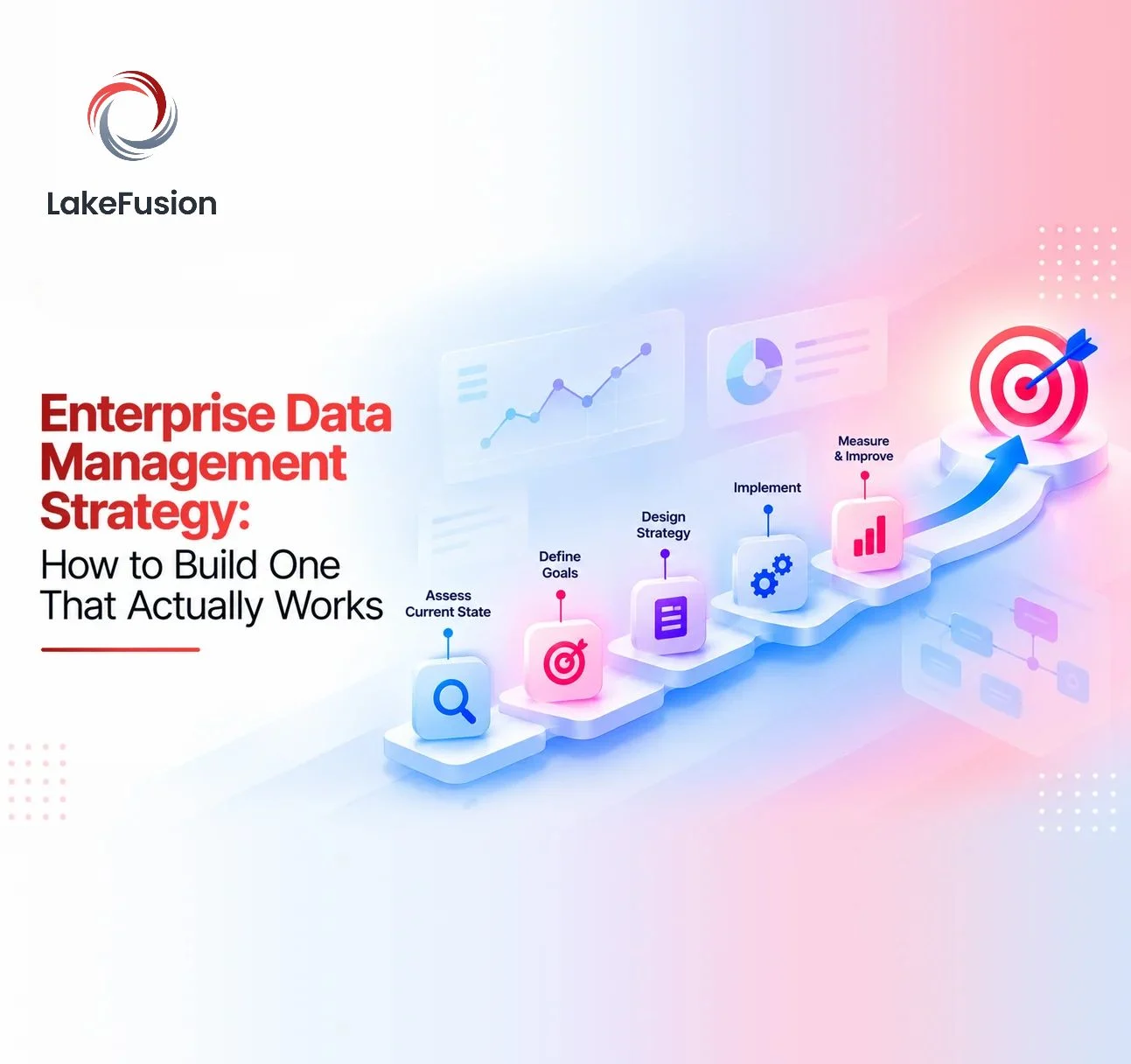
Good strategy ties business goals to specific data practices. These steps move you from scattered data habits to a scalable operating model.
1. Define Business Goals and Priority Data Domains
Start with the business problems you want to solve. A goal like "improve data quality" is too fuzzy. You can't rank it or measure it. Tie each data initiative to an operational or commercial result instead. Examples of business objectives include:
- Reduce duplicate customer and supplier records.
- Make reports match across departments.
- Set up reliable master data for critical business entities.
- Tighten governance and access controls.
- Get a clearer view of business relationships and dependencies.
- Give analytics and AI applications trusted information.
Then pick the data domains that matter most. Customers, suppliers, employees, locations and financial entities are common candidates.
Practical action: Build a priority matrix. Score each domain on business value, current data quality, risk, and the effort to implement. Begin small. Show results. Widen the scope as your operating model matures.
2. Assess Your Existing Data Architecture and Gaps
Before you pick tools or redraw processes, find out how data really moves through your company today. Look at your systems, integrations, data platforms, governance processes and who currently owns what.
Your assessment should answer questions like these:
- Where does critical business data start?
- Which systems hold clashing versions of the same entity?
- How do you spot and fix data quality problems?
- Who owns data definitions and signs off on changes?
- How do you enforce access permissions and governance policies?
- Which relationships between entities are hard to see?
- What stops trusted data from reaching applications and AI workflows?
Write down the gap between where you are and where you want to be. This exercise separates problems that need better integration from those that need master data management, governance, or relationship intelligence.
Running Databricks? Think about how a Databricks-native data management solution can work with your existing lakehouse. That's better than building another isolated data environment.
3. Establish Data Governance and Clear Ownership
Technology won't keep enterprise data reliable on its own. People need to know who defines, approves, protects, and improves each piece of information.
A practical governance model says who makes decisions and how those decisions stick. Set up these responsibilities:
- Data owners: Set business requirements and approve policies for their data domains.
- Data stewards: Review quality issues, settle exceptions and help keep definitions consistent.
- Platform administrators: Manage platform configuration and operational access.
- Data consumers: Follow approved usage policies and report problems.
Your strategy should also lay down rules for access, auditing, data changes and exceptions. A fitting enterprise data governance solution can put these responsibilities into practice. It does that through role-based access controls, configurable permissions and governed workflows.
If Databricks is your base platform, be explicit about who handles what across Unity Catalog, LakeFusion, and other components. Unity Catalog covers data access governance and lineage. LakeFusion MDM focuses on resolving entities and creating trusted master records.
4. Build Trusted Master Data and Improve Data Quality
Inconsistent records damage reports, analytics, customer operations and AI results. Your strategy should say how you'll identify, match, standardize and maintain critical entities. That's where an enterprise master data management solution earns its place.
Core practices include:
- Entity resolution: Find records that describe the same real-world entity.
- Match and merge: Combine duplicates using rules you've approved.
- Survivorship: Decide which source values stay when records disagree.
- Golden record management: Keep one trusted version of each entity.
- Stewardship: Send unclear matches and exceptions to people for review.
- Quality monitoring: Track recurring problems and measure improvement.
Take ABC Corp. Its CRM, billing and support systems may each hold a different customer name and ID. MDM can flag likely duplicates and build one consistent customer record.
A capable enterprise data quality management solution should keep validating and improving data over time. A one-off cleanup won't hold.
Set measurable indicators. Duplicate rates, completeness, open exceptions and the time it takes to resolve quality issues all work.
5. Connect Data Through Graph Intelligence
A complete data strategy also looks at relationships. Single records only tell part of the story. Customers link to accounts. Suppliers link to contracts. Companies link to ownership structures and business units. When those links stay disconnected, teams miss dependencies and context that matter.
Graph intelligence lets you map and explore those connections right beside your trusted entity data. Think about graph intelligence when your organization needs to:
- See how customers, suppliers, and other entities relate.
- Explore multi-level organizational structures.
- Spot dependencies across business domains.
- Give analytics and AI workflows connected business context.
- Support operational processes that rely on links between records.
An enterprise graph intelligence platform can work alongside MDM. It connects trusted entities and makes their relationships useful to business teams and applications.
Say XYZ Ltd wants to know which contracts and business units tie back to one supplier. Relationship intelligence can show those links. Each record stops being a lone data point.
When you shape your strategy, list the relationship-based use cases that matter most. Then decide where graph capabilities fit in your current architecture.
6. Design for Integration, Interoperability, and Scale
Your strategy has to work across the whole technology environment. Replacing every existing system rarely makes sense, so the architecture should fit your existing data sources and consumption patterns. Check these requirements:
- Integration with current operational systems and cloud data platforms.
- APIs that share trusted data with authorized applications.
- Support for batch processing and scheduled pipelines.
- Flexible data models and schemas that change.
- Dependable handling of updates, exceptions, and dependencies.
- Scalable processing and administration you can manage.
A modern enterprise data management software solution should slot into your wider data architecture. It should also cut needless overlap between tools. Think ahead too. New domains, applications and business needs will change how your data processes run.
Aim for reusable capabilities that serve many use cases. Don't build a separate solution for every team.
7. Make Trusted Data Available to Analytics and AI
Data pays off when people and systems can use it to decide things and get work done. Your strategy should say how trusted, governed data reaches reporting tools, applications, and AI workflows.
Getting AI-ready takes more than pointing a model at a huge dataset. Applications need steady entity identities, relevant context, and proper controls over what they can see. Put these priorities in your strategy:
- Set approved access paths for downstream applications.
- Offer trusted entity records through suitable interfaces.
- Add relationship context where it improves a business use case.
- Apply access controls to data that automated workflows use.
- Set up monitoring and exception-handling procedures.
- Check whether AI applications get reliable, relevant information.
An AI-ready enterprise data solution should help you put trusted data to work while respecting governance rules.
Picture an AI workflow that supports supplier operations. It needs a trusted supplier record. It also needs links to that supplier's contracts, business units, and related entities. MDM and graph intelligence each supply a part of that picture.
8. Establish Metrics, Accountability, and Continuous Improvement
A strategy needs ways to track progress and adjust as the business shifts.
Without metrics, you can spend money on technology and never learn whether data is more reliable or operations run any better. Set a baseline before you start. Review results on a regular schedule.
Useful metrics include:
| Area | Example measurement |
|---|---|
| Data quality | Completeness, validity, and duplicate rates |
| Entity resolution | Match accuracy and open exceptions |
| Stewardship | How long review cases take to close |
| Governance | Access-policy compliance and finished reviews |
| Integration | Pipeline reliability and processing delays |
| Adoption | How many business domains and applications use trusted data? |
| AI readiness | Whether governed or not, relevant data is on hand for approved workflows |
Give each metric an owner. Agree on how often you'll review it. Then use what you learn. Refine matching rules, update governance policies, improve integrations, and pick the next business domains. A strategy should keep changing with the company. It shouldn't turn into an architecture document nobody opens.
How LakeFusion Supports an Enterprise Data Management Strategy
LakeFusion offers enterprise data management capabilities on Databricks. It combines Master Data Management with graph intelligence, so organizations can build trusted entities and map relationships.
Databricks-Native Master Data Management
LakeFusion MDM handles entity resolution, matching and merging, survivorship, golden record creation, and data stewardship. These features help you build trusted records for critical business entities and manage duplicate or inconsistent information.
Look at the Master Data Management on Databricks solution.
Graph Intelligence for Connected Data
LakeFusion graph capabilities let organizations map relationships between trusted entities. Teams can then use that connected context in operational workflows, analytics and AI use cases.
Find out more about the Enterprise Graph Intelligence Platform.
Governance and Security
A strategy only works with proper access controls and clear governance roles. See LakeFusion Trust and Security for how it handles security and governance.
Extending Trusted Data Across Workflows
You can check how LakeFusion fits your wider data architecture, your operational needs and your technology ecosystem. Read about LakeFusion's technology partnerships, or reach out to the LakeFusion team to talk through your requirements.
Build a Data Strategy That Delivers Business Value
A strong enterprise data management strategy begins with business priorities. It turns them into clear responsibilities, dependable processes, and measurable results.
Keep the basics in view:
- Prioritize business-critical data domains.
- Set ownership and governance.
- Build trusted master records and raise data quality.
- Link entities through graph intelligence.
- Integrate data with your current systems and workflows.
- Give authorized applications and AI trusted information.
- Measure results and keep improving.
You're not trying to add more technology. You're trying to make enterprise data reliable and useful across the business.
Ready to strengthen your enterprise data strategy? Explore LakeFusion to see how Databricks-native MDM and graph intelligence can support a trusted, connected data foundation.
Frequently Asked Questions
1. What is the first step in building an enterprise data management strategy?
Name your business priorities and your critical data domains. Then look at current data quality, integration gaps, ownership, and governance. Only after that should you define the target architecture and an implementation roadmap.
2. What capabilities should an enterprise data management strategy include?
Cover data integration, data quality, Master Data Management, and governance. Add metadata and lineage, graph intelligence, operational access, and ongoing monitoring.
3. How does Master Data Management fit into an enterprise data strategy?
MDM builds trusted records for critical business entities. It resolves duplicates, applies matching and survivorship rules, and supports stewardship. It works with integration and governance. It doesn't replace them.
4. Why should graph intelligence be included in a data management strategy?
It shows how trusted entities relate and depend on each other. That context helps operational analysis, connected-data use cases, and AI workflows.
5. How can organizations measure the success of their strategy?
Watch duplicate rates, data completeness, and matching effectiveness. Add stewardship resolution time, integration reliability, and governance compliance. Also track how widely business applications use trusted data.

Accelerate your edge with LakeFusion insights
Get practical perspectives on master data, governance, and building scalable, AI-ready data foundations.


