

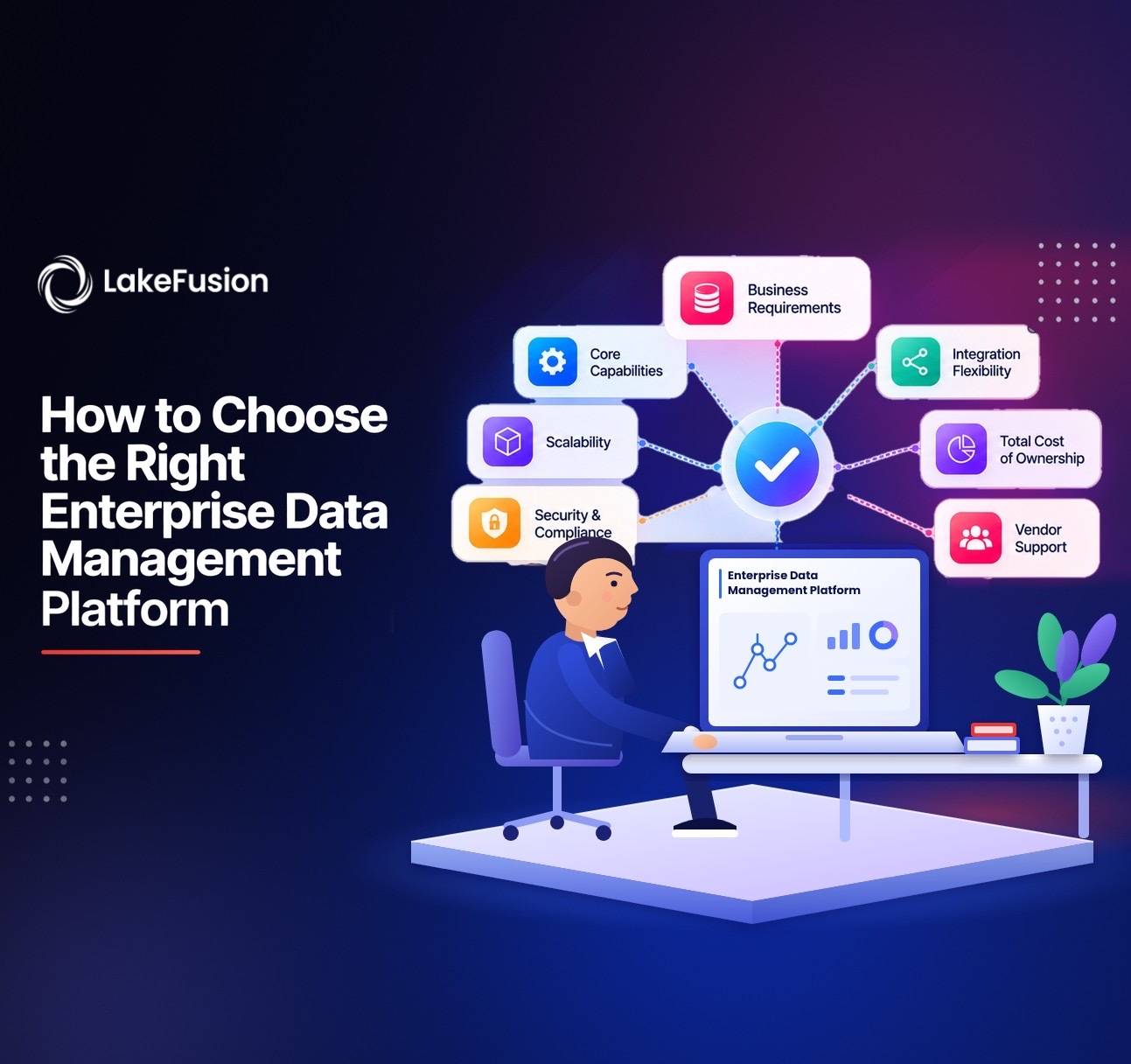

Choosing data management technology is a major decision. Your systems may be scattered, your records inconsistent, and your governance needs growing. A solution that suits one business can fall flat at another. That's especially true when data crosses departments, cloud environments, operational applications, and AI projects.
The hard part is knowing which capabilities count. Some companies need to merge duplicate customer and supplier records. Others need tighter governance, linked relationship data or easier access to trusted information for analytics and AI.
Choosing enterprise data management software takes more than a feature checklist. You have to weigh your data architecture, your operational needs, scalability, security rules and long-term goals. This guide walks you through evaluating solutions, comparing must-have capabilities, and choosing an approach that supports reliable, governed, and connected enterprise data.
Why Choosing the Right Enterprise Data Management Software Matters
Enterprise data management shapes how a company stores information, makes decisions, and operates across business systems. Without a coordinated approach, teams end up with clashing records. They clean the same data twice. They can't agree on a single view of key business entities.
The right solution can help you:
- Improve Data Reliability: Cut down duplicate records and mismatched attributes.
- Strengthen Governance: Set clear ownership, permissions, and accountability.
- Connect Business Systems: Share trusted information across applications.
- Improve Relationship Visibility: See how customers, suppliers, organizations, and other entities link up.
- Support AI Initiatives: Give analytics and AI workflows consistent, governed information.
- Reduce Operational Complexity: Standardize data management across business domains.
You're not buying one more data tool. You're choosing capabilities that solve real business problems and fit the technology you already run.
8 Factors to Consider When Choosing Enterprise Data Management Software
A structured evaluation separates what you truly need from what can wait. Use these eight factors to guide your selection.
1. Define Your Business Requirements First
Before you compare vendors, list the problems the solution has to solve. Start with product features, and you may end up with extra complexity. You may also spend money on features that don't meet your main needs.
Write down your priorities first. Common requirements include:
- Clearing up duplicate customers, suppliers or organisations
- Ensuring data quality throughout the departments
- Normalizing important business characteristics
- Setting up ownership and stewardship workflows
- Linking similar entities from different business domains
- Enabling access to data for reporting and AI applications
- Strengthening governance and operational measures
Then prioritise each requirement according to the business impact, urgency and implementation effort.
Take ABC Corp. It might prioritize supplier data consistency over everything else, since inconsistent supplier identities can disrupt procurement and lead to reporting issues. Another company may prioritize customer entity resolution or a better understanding of complex business relationships.
What to evaluate: Does the solution fit your most important use cases without requiring a re-engineering of your data architecture?
2. Evaluate Master Data Management and Entity Resolution
Companies often keep several records for the same real-world entity across CRM, ERP, finance and operational systems. Master Data Management (MDM) spots those duplicates and builds trusted records.
When you assess an MDM capability, look for:
- Entity Resolution: Finds records that describe the same entity.
- Matching and Merging: Applies rules to combine duplicates.
- Survivorship: Decides which source values to keep.
- Golden Record Creation: Builds one trusted version of an entity.
- Data Stewardship: Sends unclear matches and exceptions to people for review.
- Flexible Matching Methods: Supports deterministic, probabilistic, or AI-assisted approaches where they fit.
Ask vendors how you configure, explain, review, and improve matching decisions over time. A strong master data management solution should handle matching rules specific to your business. It should also let teams manage exceptions and keep entity records reliable.
Ensure it can accommodate the data structures and entity types that you use. Customer needs may vary across suppliers, legal entities, locations, and complex organizational hierarchies.
3. Assess Data Quality and Standardization Capabilities
Poorly structured data can also hinder analytics, operations, and AI performance. Data Quality capabilities will help you identify inconsistencies and establish repeatable rules to enhance data.
Look for capabilities such as:
- Data profiling and validation
- Completeness and consistency checks
- Duplicate detection
- Attribute standardization
- Configurable business rules
- Exception management
- Quality monitoring and reporting
Imagine addresses are stored in multiple applications at Picture XYZ Ltd. in various formats. They are standardized and thus consistent. Validation checks identify missing or invalid values.
During a product evaluation, test the solution with representative data that has real-world problems. Think incomplete attributes, inconsistent naming and conflicting source values.
Key question: Can your team track improvements in data quality and maintain these improvements as data continues to grow?
4. Check Governance, Security, and Access Controls
Data management should provide information you can trust without compromising security or accountability. There's a need to have controls in place on who can see data, modify the data, review exceptions, and administer workflows.
Evaluate the following:
- Role-based access control (RBAC)
- Configurable roles and permissions
- Data stewardship responsibilities
- Auditability and activity tracking
- Governance policy enforcement
- Integration with existing security controls
On Databricks? Find out how the data management solution works with the platform's own governance features. Unity Catalog covers data access governance and lineage. MDM capabilities focus on building trusted entities and managing their records.
A capable enterprise data governance solution should fit into that wider governance model. It shouldn't create a second, clashing set of permissions.
Read the vendor's security documentation. Clarify who handles access control, administration, and operational oversight before you decide.
5. Evaluate Graph Intelligence and Relationship Management
Enterprise data is more than single records. Customers link to accounts. Suppliers link to contracts. Organizations connect through ownership structures, transactions, and operational dependencies. Graph intelligence maps those relationships and makes connected business context easier to explore.
Consider graph capabilities if your organization needs to:
- Understand relationships between customers, suppliers, and organizations
- Explore multi-level hierarchies and dependencies
- Connect entities across business domains
- Support relationship-based analysis and operational workflows
- Give analytics and AI applications connected context
Say ABC Corp wants to find the business units, contracts, and locations tied to one supplier. Relationship intelligence can surface those links alongside trusted entity records. When you assess an enterprise graph intelligence solution, ask how it models, updates and governs relationships. Ask how it makes them available to downstream applications too.
Check whether the graph features can run inside your existing data architecture. A unified approach to trusted entities and relationships can close the gap between master data and connected business context.
6. Review Integration and Architecture Compatibility
A enterprise data management software has to work with the systems that already run your business. Replacing your infrastructure just to add new data management features is rarely necessary or practical.
Assess compatibility with:
- Operational systems and enterprise applications
- Cloud data platforms and lakehouse environments
- APIs and downstream data consumers
- Batch processing and scheduled pipelines
- Existing identity and access management
- Evolving data schemas and business requirements
Have vendors demonstrate the flow of data from source systems to the management layer to consuming applications.
If your company uses Databricks, think about a Databricks-native Master Data Management solution that fits your existing lakehouse architecture.
You want reliable data management processes. You don't want needless duplication, tricky synchronization or disconnected infrastructure.
7. Consider Automation, AI Readiness, and Operational Use
When business applications and automated workflows can use trusted data, they become more valuable. Manual exports and disconnected steps lead to missed deadlines and errors.
Check whether the solution supports:
- APIs for accessing trusted records
- Automated matching and data processing
- Stewardship review and exception routing
- Scheduled workflows and operational actions
- Governed access for AI applications and agents
- Monitoring and troubleshooting
AI readiness deserves special attention. AI systems need consistent entity identities, relevant business context, and proper access controls. A larger data pile doesn't provide that.
A suitable AI-ready data management solution should make trusted entities and relationships available to authorized applications and workflows.
Ask vendors to demo a realistic case. For example, an application could pull a trusted organization record and its related entities. Verify their access control, exception handling and process monitoring.
8. Compare Scalability, Usability, and Total Cost of Ownership
The solution must meet today's needs and remain manageable as data grows, business domains expand, and users increase. Don't look only at raw technical capacity.
Consider these long-term factors:
- The ability to add new data domains and data sources.
- Rules for matching and governance can be flexibly configured.
- The ease of use for data stewards and administrators.
- Monitoring and troubleshooting capabilities
- The implementation and maintenance effort.
- Licensing, infrastructure, and support fees and overheads.
- Vendor roadmap and product support.
Low-cost solutions can have high operating costs. Costs can rise over time due to complex integrations, manual stewardship, and constant administration.
During a proof of concept, measure technical performance and the effort it takes to maintain the system. Bring in business users too. Usability and operational fit count as much as technical strength.
How to Compare Enterprise Data Management Vendors
Once you've defined requirements, use one evaluation framework for every shortlisted solution. That reduces the risk of choosing a product based on demos alone.
| Evaluation area | Questions to ask |
|---|---|
| Business fit | Does the solution cover your highest-priority use cases? |
| MDM and entity resolution | Can it find duplicates and build trusted records? |
| Data quality | Can you configure, monitor and improve rules? |
| Governance | Are roles, permissions and responsibilities clearly defined? |
| Graph intelligence | Can it manage and expose relationships between entities? |
| Integration | Does it fit your current data architecture and required systems? |
| AI readiness | Can authorized applications reach trusted data and context? |
| Operations | Is it manageable, scalable and cost-effective? |
Run a Proof of Concept Before Committing
Use a representative dataset. Test the requirements that matter most to the business.
A useful proof of concept should:
- Test entity matching on duplicate and incomplete records.
- Check data quality and standardization rules.
- Show role-based permissions and stewardship workflows.
- Test the integrations and APIs you need.
- Explore connected entities if you need graph intelligence.
- Measure performance, usability, and administration effort.
Write down the results. Score every vendor against the same criteria. That gives you a firmer basis for your choice than feature claims or generic demos.
Conclusion
Picking enterprise data management software means balancing today's business needs against long-term architecture and operations. Put trusted records, data quality, governance, integration, graph intelligence, and reliable access for analytics and AI at the top of your list.
Use one vendor evaluation framework. Test realistic data scenarios. Count the full cost of implementation and ongoing operations. The best choice solves your actual requirements and can grow as your company does.
Ready to evaluate your options? Explore LakeFusion to see how Databricks-native MDM and graph intelligence can support trusted, connected enterprise data.
Frequently Asked Questions
1. What should organizations consider when choosing an enterprise data management solution?
Begin with business requirements. Then look at MDM, data quality, governance, integration, graph intelligence, AI readiness, scalability, and total cost of ownership.
2. How does Master Data Management differ from data governance?
MDM resolves entities and builds trusted master records. Data governance sets ownership, policies, permissions and accountability for how people manage and access data.
3. Why should graph intelligence be considered during vendor selection?
It shows how entities relate and depend on each other. That helps most when business decisions depend on connected information. Individual records won't tell the full story.
4. How can organizations evaluate data management vendors effectively?
Agree on common criteria and use representative datasets. Run a proof of concept. Then measure matching effectiveness, quality gains, governance, integration effort, usability, and ongoing operating cost.
5. Can enterprise data management support AI initiatives?
Yes. Data management capabilities can supply consistent entity identities, trusted records, relationship context, and governed access. Analytics and AI applications rely on all four.

Accelerate your edge with LakeFusion insights
Get practical perspectives on master data, governance, and building scalable, AI-ready data foundations.


