


Teams in big companies keep hitting the same wall. They need to see how things link up, not just look at separate records. A customer often sits under a larger parent. One supplier can tie into several smaller firms. The same account pops up in different jobs across CRM, ERP, and finance systems. These questions often push people toward graph tools.
That choice creates a real fork in the road for the setup. Do you add a full separate graph database, or can you handle the relationship work right on the lakehouse already in place?
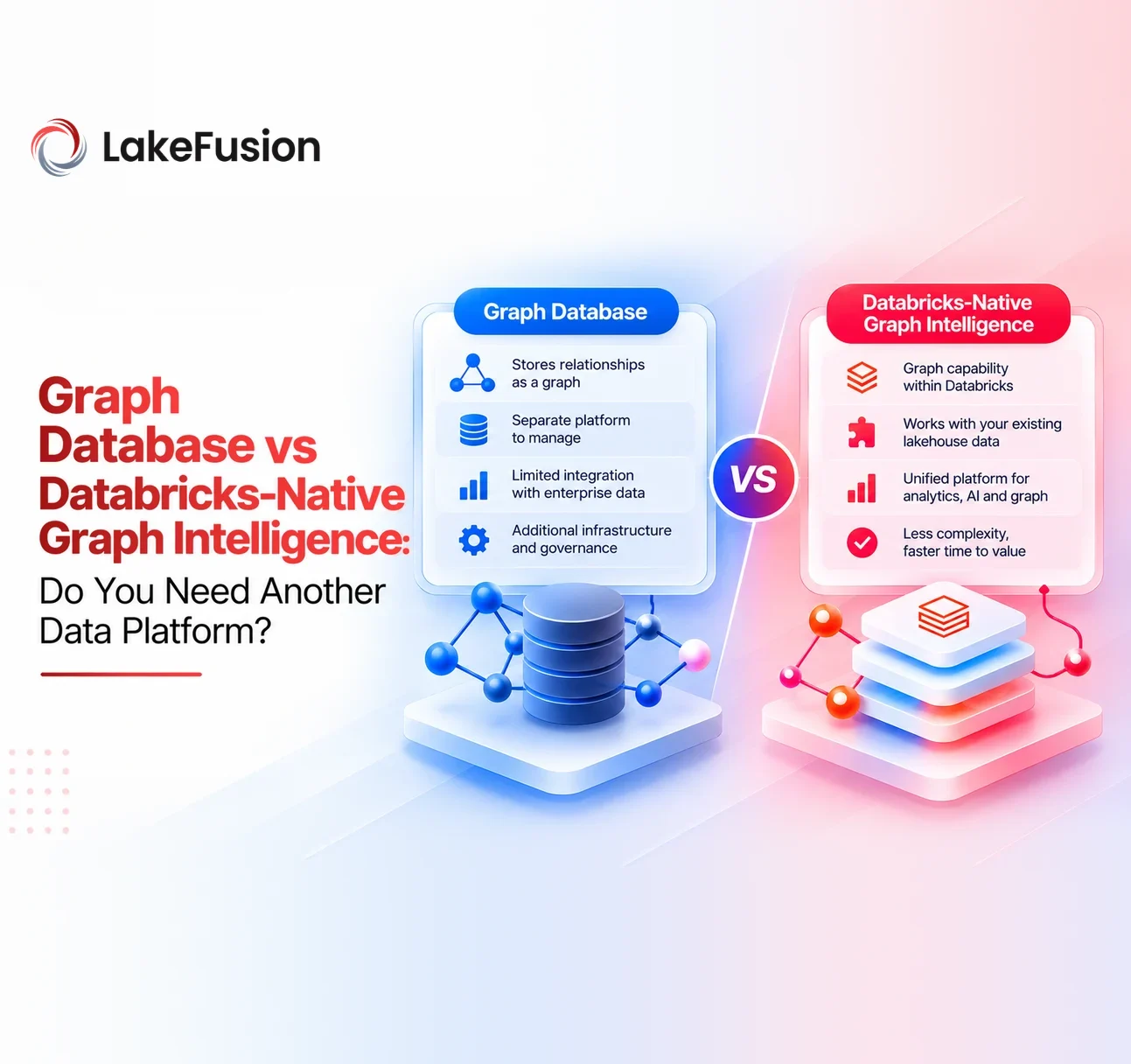
When a company has already settled on Databricks, the graph database vs Databricks debate runs deeper than query syntax or algorithm choice. It comes down to whether relationship work forces another database, another full data copy, another layer of rules, and another stack to keep running.
A Databricks-native Graph Intelligence Platform takes the opposite path. It skips shipping enterprise data to a separate graph database. Instead, it builds and runs relationships on Databricks and Delta Lake, where the data already lives.
Add Master Data Management built on Databricks into the mix, and teams can link clean, trusted entities instead of trying to draw graphs on messy source records.
Graph Database vs Databricks: What Is the Architectural Difference?
A traditional graph database is built from the ground up to store and query nodes, edges, and properties. A Databricks-native graph intelligence approach still uses graph structures and relationship logic, but the real enterprise data stays put inside Databricks. That gap counts because graph features and a full graph database are not the same thing.
Why Enterprises Traditionally Use Graph Databases
Graph databases arrived for practical reasons. Plain table setups struggle when relationships get tangled, especially when questions jump across several links.
Imagine this sequence:
- ABC Parent → owns → ABC Subsidiary
- ABC Subsidiary → buys from → XYZ Supplier
- XYZ Supplier → associated with → Location A
A normal relational system can store each of those links. The real headache starts when teams have to walk those same links over and over across many steps.
Graph Databases Represent Relationships Directly
Graph systems usually work with:
- Nodes,
- Edges,
- Properties,
- Relationship types.
That setup makes network-style questions feel natural. Users no longer have to join table after table by hand. They can simply walk from one business entity to the next through the links already spelled out.
Multi-Hop Queries Become Easier to Express
A procurement group might ask: Which suppliers sit under this corporate parent after two or three ownership steps?
A sales group might ask, "Which subsidiaries of this customer already do business with another unit inside the company?"
Those questions are multi-hop queries. A dedicated graph database handles this class of work well because relationships sit at the heart of how it stores data. The cost is that companies often end up standing up and running yet another platform just to get those abilities.
The Hidden Cost of Adding Another Graph Database
The biggest drawback is rarely the graph tech itself. It is everything else that shows up once you add one more data platform.
Another Copy of Enterprise Data
Filling a dedicated graph database usually means moving or syncing data out of the systems or platforms you already use.
That creates a second version of:
- customers,
- suppliers,
- companies,
- accounts,
- relationships,
- business attributes.
Every extra copy raises new questions about how current the data is, where it came from, who owns it, and how the copies stay in sync. For teams that already gathered their data inside Databricks, this can feel like sliding back into another isolated store.
Another Integration Layer
A separate graph database needs its own pipelines. Teams have to figure out:
- Which data leaves the source,
- How often it gets refreshed,
- What happens when source schemas change
- How graph updates stay in step,
- How mastered entity IDs stay correct.
This becomes critical when the graph work depends on an Enterprise MDM Platform. If the mastered IDs change but the graph copy lags, the relationship work runs on outdated entity details.
Another Governance Surface
Graph data often holds sensitive business links. That forces teams to set up access rules, permissions, audit trails, and day-to-day controls in yet one more place.
Teams that already trust Databricks Data Governance usually prefer to keep relationship work in that same controlled base instead of rebuilding the same rules elsewhere.
Another Platform to Operate
A new database means more infrastructure choices, more monitoring, more troubleshooting, and more specialized skills to keep on hand.
That does not make a separate graph database the wrong call in every case. But it does force a clear question: Is the graph database solving a problem that truly needs another database, or do you mainly need graph intelligence?
A Graph Database Alternative on Databricks
Choosing a graph database alternative does not mean throwing out graph ideas. It means separating the need for relationship intelligence from the assumption that relationships must live in a completely separate database.
LakeFusion LakeGraph runs a property graph model on Databricks and Delta. That lets teams work with nodes, edges, properties, and multi-hop links without adding an external graph database as another system of record.
Keep Relationship Intelligence Close to the Data
For teams already running Databricks, the core entities and business data often already sit in lakehouse tables.
A Databricks-native Graph Intelligence solution can build relationship context right around that existing base. This cuts the constant need to copy enterprise data into another specialized store.
Use the Property Graph Model Without a Separate Graph DB
The main point is that LakeGraph is not positioned as another stand-alone graph database. It uses a property graph model while it sits on Databricks and Delta.
That means teams can get graph-style capabilities without adding another major storage layer. For groups weighing graph analytics Databricks setups, this can keep the overall data picture simpler.
Why MDM Should Come Before Graph Intelligence
A graph is only as solid as the nodes inside it. If the same company shows up four times under different names, the graph creates four separate nodes for what is really one firm. That builds a relationship mess before any real analysis starts.
Master the Entity First
A Databricks-native MDM platform can clean up fragmented records before they enter the graph.
Take this set:
- ABC Company
- ABC Co.
- ABC Company LLC
Those often need to become one trusted enterprise entity first. Once that identity is locked in, relationships can point to a single controlled node instead of several messy source records.
Then Connect the Entity
This creates a clean split:
MDM answers: Who is this?
Graph answers: How is it connected?
That pairing works far better than running relationship analysis on raw duplicates. A broader Enterprise Data Management Platform can therefore use MDM for clean identities and graph intelligence for clean networks.
How Databricks-Native Graph Intelligence Supports Multi-Hop Analysis
One of the strongest reasons to adopt graph technology is the ability to walk several relationships in a row. This is where Graph Analytics built on Databricks becomes especially useful.
Corporate Relationships
A graph can hold:
ABC Parent → owns → ABC Subsidiary A
ABC Parent → owns → ABC Subsidiary B
A user can then walk that structure instead of rebuilding ownership from tables every time. This supports work such as:
- Parent-company analysis,
- Subsidiary rollups,
- Customer hierarchies,
- Supplier-family analysis.
Cross-Role Relationships
The same firm can appear in several business roles at once. One entity might act as:
- A customer,
- A supplier,
- A partner,
- Part of a wider corporate group.
An Enterprise Graph Intelligence Platform can surface those roles and links as one connected network.
Multi-Hop Business Questions
The real value shows up when a user needs to step several levels past the starting entity.
For example: Find every supplier linked to subsidiaries of ABC Parent within three hops.
Or:
Show accounts tied to companies that share the same ultimate parent.
These questions rely on walking relationships, not simple record lookups.
Graph Intelligence Should Be Operational, Not Just Analytical
A graph delivers more when it joins actual business workflows. A static picture alone rarely creates much day-to-day value. LakeGraph supports scheduled pipelines so relationship data stays part of an ongoing data process.
Keep Relationships Current
Enterprise links change all the time. Companies buy subsidiaries. Suppliers shift parent firms. Accounts link to new legal entities. Scheduled pipelines help the relationship structures move in step with the underlying enterprise data.
Use Relationships to Trigger Action
Where the setup allows, relationship conditions can drive downstream steps such as updates, pipelines, or webhooks.
That takes Databricks graph intelligence use cases past simply "show me the network." The graph can become part of how workflows react to real enterprise links.
Feed Graph Context Back Into MDM
Graph relationships can also feed graph-to-MDM suggestions. That matters because MDM and graph intelligence should not sit as two isolated products. Relationship context can help improve how enterprise entities get understood and controlled.
Graph Intelligence for AI Agents
AI agents raise the stakes on the architecture choice. Agents more and more need both clean entity identity and relationship context. An agent may already know who ABC Corp is through MDM.
But to answer harder questions, it also needs to know:
- which subsidiaries sit under ABC Corp,
- which suppliers link to those subsidiaries,
- which accounts share a parent,
- which relationships sit several hops away.
A Graph Intelligence solution for AI agents can make that controlled relationship context available without forcing the agent to rebuild the network from raw joins.
Paired with AI-ready Master Data Management, this creates a stronger base: Trusted Entities + Trusted Relationships + Agent Access
LakeFusion also gives unified MCP access across MDM and Graph features, so agents have one steady way to work with both entity and relationship intelligence.
When Does a Separate Graph Database Still Make Sense?
A Databricks-native approach doesn't mean dedicated graph databases have no place at all. Some environments already run a specialized graph database deep in the stack, or a workload has needs that truly justify a dedicated graph system.
The key point is that companies should not assume a separate graph database is required simply because they need:
- Property Graphs
- Multi-Hop Queries
- Relationship Analytics
- Corporate Hierarchies
- Connected Ai Context
For teams already standardized on Databricks, it is worth checking first whether the existing lakehouse architecture can meet those needs.
LakeFusion: Graph Intelligence Without Another Data Platform
LakeFusion joins Master Data Management and Graph Intelligence on Databricks so companies can clean identity and relationships inside one shared data foundation.
Databricks-Native Property Graph
LakeGraph uses a property graph model on Databricks and Delta, rather than requiring a separate external graph database.
Trusted Nodes From MDM
LakeFusion MDM cleans customer, supplier, company, and other enterprise identities before they join wider relationship networks.
Multi-Hop Relationship Intelligence
LakeGraph supports relationship walking and multi-hop analysis, so teams can move beyond isolated entities to connected enterprise contexts.
Operational Graph Pipelines
Scheduled pipelines help keep relationship intelligence current and usable in ongoing enterprise workflows.
MDM and Graph Together
Graph-to-MDM suggestions let relationship context feed mastering workflows instead of leaving graph analysis cut off from enterprise identity.
Built for AI Access
Unified MCP access across MDM and Graph gives AI agents controlled ways to work with trusted entities and relationship context.
For companies building on Databricks, the result is a Lakehouse Graph Intelligence Platform that adds graph features without forcing another major data platform into the architecture.
Conclusion
The answer to graph database vs Databricks depends on what the business actually needs. If the requirement is relationship modeling, multi-hop walking, enterprise graph analytics, and connected AI context, a separate graph database is not the only way to get there.
For teams already running on Databricks, a Databricks-native approach can keep graph intelligence closer to existing enterprise data, governance, MDM, analytics, and AI.
LakeFusion brings property graph features, multi-hop intelligence, operational graph pipelines, and MDM integration straight into that environment.
Build relationship intelligence without adding another disconnected data platform. Explore LakeFusion Graph Intelligence or request a demo.
Frequently Asked Questions
What is the difference between a graph database and Databricks-native graph intelligence?
A graph database is a dedicated database for storing and querying graph structures. Databricks-native graph intelligence applies graph modeling and relationship capabilities on the Databricks and Delta foundation without necessarily introducing a separate external graph database.
Is Databricks a graph database?
No. Databricks is a broader data and AI platform. LakeFusion LakeGraph uses a property graph model on Databricks and Delta to provide graph intelligence capabilities within that environment.
What is a graph database alternative?
A graph database alternative is an architecture that provides relationship modeling, graph traversal, and graph analytics without requiring a separate dedicated graph database.
Can you run multi-hop graph analysis on Databricks?
With a graph intelligence layer built for Databricks, enterprises can model relationships and perform multi-hop analysis while keeping the underlying data closer to the lakehouse environment.
How does MDM improve graph intelligence?
MDM resolves fragmented source records into trusted enterprise identities. Those mastered identities provide cleaner graph nodes, reducing the risk of building relationship networks around duplicate or conflicting records.

Accelerate your edge with LakeFusion insights
Get practical perspectives on master data, governance, and building scalable, AI-ready data foundations.


