
.avif)
Data teams inside big companies often mention master data management and data governance in the same discussion. People start thinking both tools fix the exact same issue.
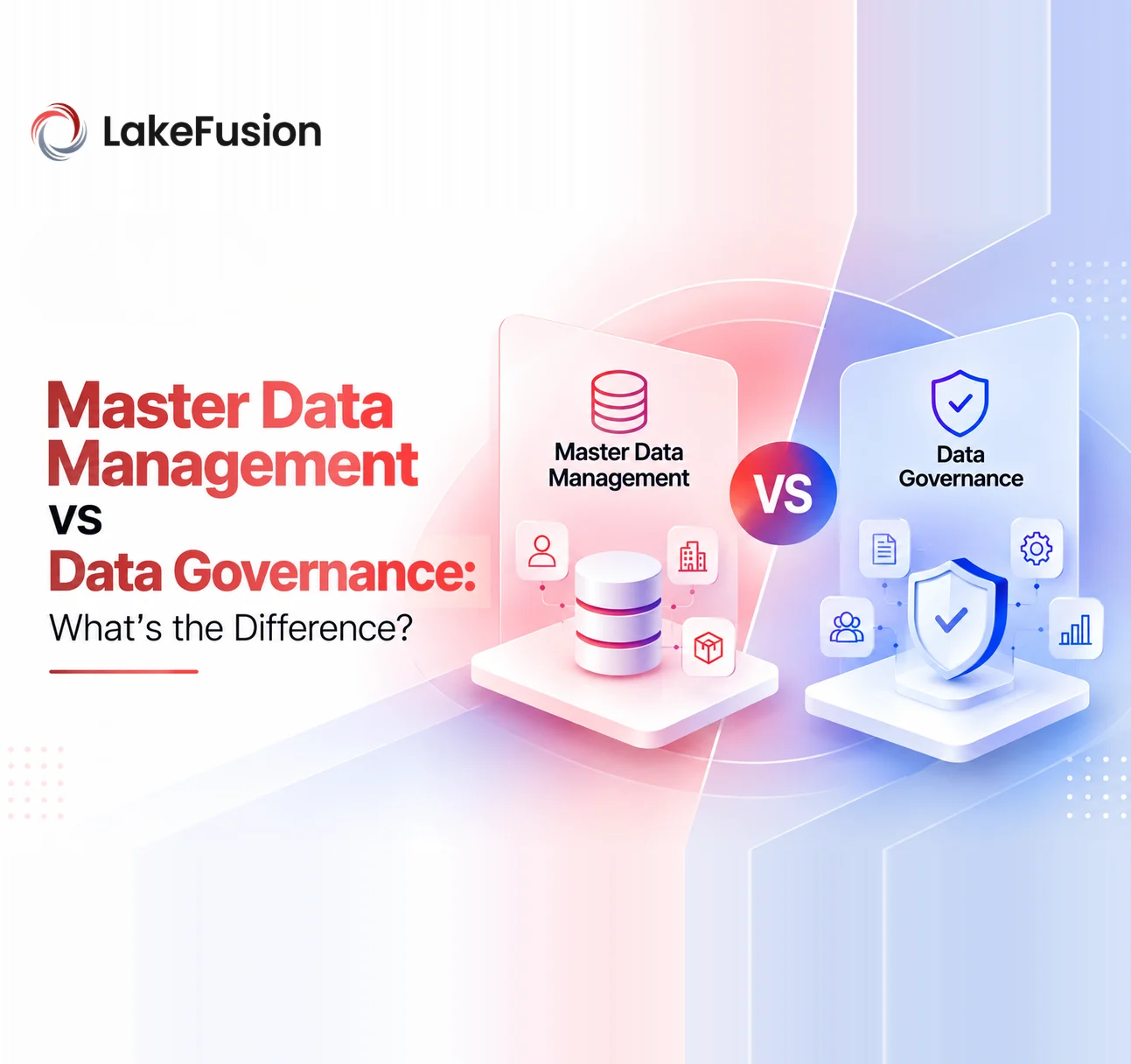
That assumption is wrong. The real split between master data management vs data governance sits in the gap between making rules and putting those rules to work. Data governance decides how the company owns, controls, accesses, standardizes, and uses data.
Master Data Management takes those same rules and applies them to the critical business entities: customers, suppliers, companies, products, and locations. Put simply, governance writes the rulebook. MDM makes the rulebook work on master data.
Strong governance policies can still leave a company stuck with duplicate customer records, inconsistent supplier identities, or conflicting product details. An MDM program that runs without governance can produce golden records with no clear owner, steward, or real accountability.
Companies therefore need both pieces working together.
What Is Master Data Management?
Master Data Management, or MDM, covers the process and technology that builds consistent, trusted versions of important business entities across many different systems.
Those entities may include:
- customers
- suppliers
- companies
- products
- locations
- assets
- employees
- reference data
A Master Data Management Software platform lets organisations clean up duplicate records, decide which values should remain, build golden records and keep those records current over time.
Entity Resolution
Entity resolution sits at the heart of MDM capabilities. It checks whether records sitting in different systems actually point to the same real-world entity.
Take these examples:
- ABC Corporation
- ABC Corp.
- ABC Holdings
- ABC Corp US
All four could refer to one single organization. MDM applies matching logic to uncover those connections.
Match, Merge, and Survivorship
After records get recognized as belonging to the same entity, MDM decides the best way to combine them.
Survivorship rules settle questions such as:
- Which source should be trusted?
- Which value is the most recent?
- Which field is the most complete?
- Which system has authority for a specific attribute?
What emerges is a governed master representation instead of a messy collection of conflicting source records.
Golden Records
A Golden Record stands as the trusted enterprise representation of an entity. It rarely replaces the original source systems. What it does create is a consistent master identity that analytics tools, applications, and AI can all rely on.
This point sits at the center of understanding master data management vs data governance: MDM works directly on the records and the identities themselves.
What Is Data Governance?
Data governance forms the framework of policies, roles, standards, processes, and controls that keep data managed responsibly across an organization. Its reach stretches wider than MDM.
Data governance settles questions such as:
- Who owns this data?
- Who is allowed to access it?
- Which standards should apply?
- How should sensitive data be handled?
- Who is accountable for data quality?
- How should changes be reviewed?
- How should lineage and compliance be managed?
Governance builds the operating model that surrounds enterprise data.
Ownership and Accountability
A governance program names the people responsible for specific data domains. For example:
- Customer data may have a business owner.
- Supplier data may be owned by procurement.
- Product data may be governed by product operations.
- Sensitive fields may require additional controls.
Clear ownership stops data problems from becoming everyone's responsibility and no one's priority.
Policies and Standards
Governance also lays down common expectations. These may include:
- Naming Standards
- Required Fields
- Retention Policies
- Access Policies
- Quality Thresholds
- Approved Sources
- Escalation Processes
Such standards drive consistency across teams and systems.
Access and Compliance
Modern governance programs also decide how enterprise data gets accessed and used. On Databricks, for example, governance can cover access controls, lineage, cataloging, permissions, and policies through Unity Catalog. That governance layer sits alongside MDM rather than replacing it.
Master Data Management vs Data Governance: The Core Difference
The clearest way to grasp master data management vs data governance looks like this:
Data governance decides how data should be managed. MDM software builds and keeps trusted master entities according to those rules.
| Area | Master Data Management | Data Governance |
|---|---|---|
| Primary focus | Trusted master entities | Policies, ownership, controls, standards |
| Main question | What is the correct enterprise record? | How should enterprise data be managed? |
| Typical capabilities | Entity resolution, match and merge, survivorship, golden records | Ownership, policies, access, lineage, standards |
| Scope | Master data domains | Enterprise-wide data |
| Operational role | Resolves and maintains records | Defines rules and accountability |
| Human involvement | Data stewardship and match review | Data owners, governance councils, stewards |
| Primary outcome | Governed master data | Governed enterprise data |
Why Data Governance Alone Is Not Enough
Even excellent policies can leave master data in a poor state. A governance framework may spell out:
- approved sources
- naming conventions
- ownership
- access requirements
- quality expectations
Those policies never automatically clean up duplicate customer records or decide whether two supplier records belong to the same company.
Look at this example:
CRM record: Acme Holdings
ERP record: ACME Corp
Procurement record: Acme Holdings Ltd.
Governance can name the teams that own those systems and the standards that should apply.
MDM still has to answer: Are these records the same entity?
Answering that needs matching, entity resolution, survivorship, and golden-record creation. Governance can set the rules of trust, yet MDM turns that trust into action at the entity level.
Why MDM Without Data Governance Is Also Incomplete
The reverse situation creates the same kind of gap. A company can build a technically strong MDM program and still struggle with ownership, adoption, and consistency without governance.
No Clear Source Authority
When two systems disagree, who decides which source should win? Without governance, survivorship rules often turn random or overly technical.
No Defined Ownership
When a match looks unclear, which business team should review it? Without governance, those decisions frequently stay stuck.
No Consistent Standards
Different domains can define "trusted" in completely different ways. Customer teams may follow one rule, procurement another, and product teams yet another. Governance brings consistency to those decisions.
No Accountability
A golden record stays trusted only when someone owns its quality and business meaning. Governed master data therefore depends on governance and MDM working side by side.
The Role of Data Stewardship
Data stewardship forms the practical link between MDM and data governance. Governance names the people responsible for data. MDM provides the workflows through which those people carry out their responsibilities.
A data steward may:
- review potential matches
- approve or reject merges
- resolve attribute conflicts
- validate survivorship decisions
- investigate exceptions
- maintain hierarchies
- review source lineage
Stewardship therefore moves beyond a governance idea and becomes an active workflow inside the mastering process.
Governance Defines the Steward's Responsibility
Data governance may decide that the procurement team owns supplier data.
MDM Gives the Steward Work to Do
The MDM system can then send a low-confidence supplier match to that same team for review. Policy turns into real action at that point.
How Master Data Management and Data Governance Work Together
A mature enterprise data programme usually follows a connected sequence.
1. Define Data Ownership
Governance names the owner of each domain. For example:
- Customer → Sales or Customer Operations
- Supplier → Procurement
- Product → Product Operations
- Company → Finance or Enterprise Data
Accountability appears before any mastering work begins.
2. Establish Data Standards
The organisation sets standards around:
- Required Attributes
- Source Authority
- Matching Rules
- Quality Thresholds
- Naming Conventions
- Access
These governance policies shape how the MDM implementation takes form.
3. Profile and Standardize Data
The MDM process checks the source data for duplication, inconsistency, missing attributes, and formatting problems. Enterprise data quality and governance begin to master at this stage.
4. Resolve Entities
The MDM platform decides which records represent the same entity. Matching can rely on deterministic logic, probabilistic models, AI-assisted techniques, or a mix of these approaches.
5. Apply Survivorship
The system chooses which values become authoritative according to the governance rules already in place. The choice may rest on:
- Source Trust
- Freshness
- Completeness
- Business Authority
- Confidence
6. Route Exceptions to Stewards
Automation cannot handle every case. Ambiguous records travel through data stewardship workflows for human review. Governance takes a direct operational role here.
7. Publish Governed Master Data
The finished golden records can support:
- analytics
- Customer 360
- supplier management
- product operations
- reporting
- downstream applications
- AI
Together, governance and MDM produce usable, governed master data here.
MDM vs Data Governance in a Databricks Environment
The gap between master data management vs data governance shows up clearly inside modern lakehouse architectures. Databricks supplies a solid governance foundation through tools such as Unity Catalog.
Unity Catalog can handle:
- data access
- permissions
- lineage
- discovery
- governance controls
Unity Catalog never replaces MDM. It can govern a customer table, yet it cannot decide on its own whether five records from different systems point to the same customer. Master Data Management on Databricks fills that gap. LakeFusion adds capabilities such as:
- Entity Resolution
- Matching
- Survivorship
- Golden Records
- Hierarchy Management
- Stewardship
A clear split of responsibility appears: Unity Catalog governs the data environment. LakeFusion MDM builds and maintains trusted business entities inside that governed environment.
Why Governed Master Data Matters for AI
AI raises the stakes for combining governance and MDM. AI systems need more than simple access to data.
They need data that stays:
- trusted
- consistent
- governed
- traceable
- correctly identified
A model can receive a perfectly governed dataset and still produce weak results when the same customer appears under five different identities. A golden customer record also loses value if the AI system cannot tell whether it has permission to use the record or where the values originally came from.
MDM Provides Identity
MDM answers the question, "Who or what is this entity?"
Governance Provides Control
Governance answers: Who can use this data, under what rules, and with what accountability? Together, the two build a stronger foundation for AI-ready data.
Common Mistakes in MDM vs Data Governance Programs
Understanding MDM vs data governance helps companies avoid several common mistakes.
Treating Governance as a Documentation Exercise
Governance should never live only inside policies and committees. It must shape the way records get matched, approved, accessed, and maintained.
Treating MDM as an IT-Only Project
Master data decisions need business context.
Technical teams can configure the platform, yet business stewards must confirm how entities should look.
Creating Golden Records Without Ownership
A golden record stays useful only when the organization agrees on who owns the domain and how changes are governed.
Governing Bad Identities
Access control and lineage never fix identity fragmentation.
A governed duplicate remains a duplicate.
Mastering Without Governance
A technically correct master record can still turn unreliable when stewardship, ownership and source authority stay undefined.
Build Governed Master Data with LakeFusion
The difference between master data management vs data governance never forces a choice of one over the other. Companies need governance to set ownership, standards, access, and accountability. They need MDM to clean up fragmented records, establish trusted identities, apply survivorship, and create golden records.
LakeFusion brings those mastering workflows straight into Databricks so companies can build governed master data inside the data environment they already run.
Entity resolution, stewardship, golden records, hierarchy management, and Databricks-native governance combine to give organizations a trusted foundation for analytics, applications, and AI without adding another separate master-data stack.
Ready to put governance into action with trusted master data? Explore LakeFusion Master Data Management or book a demo.
Frequently Asked Questions
What is the difference between master data management and data governance?
Data governance sets the policies, ownership, standards, and controls for enterprise data. MDM applies those principles to create and maintain trusted master entities such as customers, suppliers, companies, and products.
Is MDM part of data governance?
MDM and data governance remain separate yet tightly linked. Governance decides how data should be managed, while MDM turns those rules into action for master data.
What role does data stewardship play?
Data stewardship links governance with MDM operations. Stewards review ambiguous matches, resolve conflicts, validate records, and maintain data quality throughout the mastering process.
Can data governance work without MDM?
Yes, yet governance alone never cleans up duplicate identities or builds golden records. Organizations with fragmented customer, supplier, product, or company data usually need MDM alongside governance.
How does LakeFusion support governed master data?
LakeFusion delivers entity resolution, matching, survivorship, golden records, stewardship, hierarchies, and MDM workflows on Databricks while working alongside governance controls such as Unity Catalog.

Accelerate your edge with LakeFusion insights
Get practical perspectives on master data, governance, and building scalable, AI-ready data foundations.