
.avif)
Enterprise data problems almost never come from just one place. The same customer can show up under three different names. A supplier record might still have an old address. And one product often carries different IDs in ERP, CRM, and the systems people use every day.
Fixing spelling mistakes or empty fields helps, but it doesn't always show the business which record is the real one to trust. That's the core of master data management vs data quality.
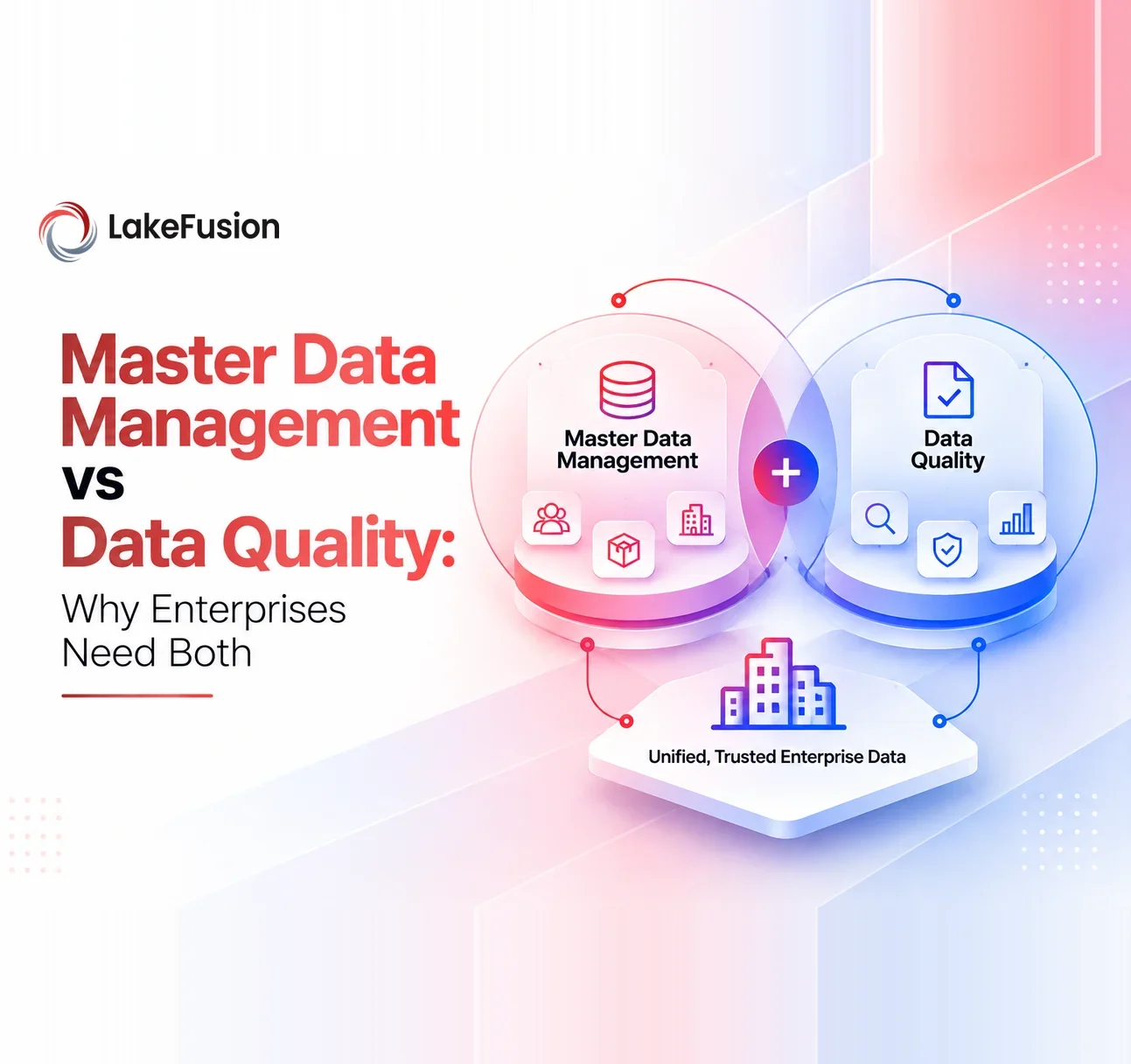
Data quality works on individual values. Master Data Management, or MDM, creates trusted identities and controlled master records that stretch across systems. Companies need both. Clean data can still be duplicated or cut off from everything else. Mastered data can still have incomplete, inconsistent, or even incorrect attributes.
The best approach combines data cleansing, data quality checks, entity resolution, survivorship, stewardship, and governance. This combination gives apps, analytics, and AI data they can trust.
What Is Master Data Management?
Master Data Management is the practice and technology that creates and maintains consistent, trusted versions of key business entities: customers, suppliers, companies, products, locations, and other core domains.
MDM isn't mainly about fixing single fields. Its role is to resolve records in various systems that correspond to the same "real-world" thing and create one authoritative version.
Entity Resolution and Matching
Most companies have many different versions of the same customer, supplier, organization, or product.
MDM uses deterministic rules, probabilistic matching, and other entity-resolution techniques to find records that probably belong together.
For example:
- CRM: Acme Corporation
- ERP: ACME Corp.
- Billing: Acme Corporation LLC
Each can be correct on its own. The business still needs to know whether they describe the same organization.
Match, Merge, and Survivorship
Once MDM finds related records, it decides how to combine their information. Survivorship rules pick which values become the trusted ones. They consider source reliability, completeness, data recency, and business priorities. The result is a governed golden record not just another cleaned-up source record.
Stewardship and Governance
Not every identity decision can or should run automatically. That's why MDM software includes data stewardship workflows. Ambiguous matches, conflicting values, and exceptions go to the right business or data people for review. This keeps MDM as an ongoing operational process instead of a one-time clean-up project.
What Is Enterprise Data Quality?
Enterprise data quality is about whether data is accurate, complete, valid, consistent, timely, and usable for its intended purpose.
A data quality program finds problems inside the data and then applies rules or processes to fix them.
When you look at master data management vs data quality, data quality basically asks: "Is this data value good enough to use?"
MDM asks: "Which records represent the same entity, and what should the enterprise treat as its trusted version?"
Accuracy
Does the data match reality? A wrong address, bad tax ID, or outdated company name can still cause problems downstream even if the record looks complete.
Completeness
Are the required values filled in? A supplier record might exist without a tax ID, contact details, or country code. Completeness rules catch those gaps before the record moves further.
Consistency
Does the same information follow common formats and standards? Usually, phone numbers, addresses, country codes, dates, company names, and identifiers differ across systems. Standardized values are easier to compare and use.
Validity
Does the data follow the business or technical rules that are set? A data-quality rule might check that:
- Required fields are populated,
- Email addresses follow a valid pattern,
- Identifiers meet expected lengths,
- Country codes use approved values,
- Dates fall within logical ranges.
These controls are essential for keeping enterprise data quality reliable.
Master Data Management vs Data Quality: What Is the Difference?
The simplest way to understand master data management vs data quality is to separate record quality from entity trust.
| Area | Master Data Management | Data Quality |
|---|---|---|
| Primary purpose | Create trusted enterprise entities | Improve the quality of data values |
| Main question | Which records represent the same entity? | Is the data accurate and usable? |
| Typical processes | Matching, merging, survivorship, golden records | Validation, standardization, profiling, cleansing |
| Scope | Cross-system enterprise entities | Individual records, fields, datasets |
| Human workflow | Data stewardship and match review | Exception management and remediation |
| Main outcome | Governed master records | Higher-quality data |
| Business value | Consistent identity across systems | More reliable data for use |
The two disciplines fix related but different problems.
A data-quality process might turn:
123 main st.
into
123 Main Street
But if five systems each hold a separate record for the same customer, fixing the address format doesn't solve the identity problem.
That needs MDM.
Why Data Cleansing Alone Is Not MDM
This is one of the most common mix-ups in MDM vs data quality conversations. Data cleansing improves the values that already exist. It can standardize names, normalize addresses, remove invalid characters, correct formats, or fill some missing values. Those improvements make matching easier, but they don't automatically create an enterprise master record.
Take these two records:
Record A
Robert Johnson
robert.johnson@example.com
New York
Record B
Bob Johnson
rjohnson@example.com
New York
Both can be perfectly formatted and pass every quality rule. The enterprise may still need to decide whether Robert Johnson and Bob Johnson are the same customer.
That requires identity resolution, matching logic, survivorship, and sometimes human stewardship. So when companies look at master data management vs data quality, they should not treat data cleansing as a replacement for mastering.
Why MDM Without Data Quality Is Also Incomplete
The reverse problem is just as important. MDM can identify records that belong to the same entity, but poor-quality values make that process harder and reduce confidence in the resulting golden record.
Poor Standardization Weakens Matching
If one system stores: United States
another stores: USA
and other stores: US
Those values often need normalizing before matching or comparison becomes reliable.
Incomplete Data Reduces Match Confidence
Two company records with strong identifiers like tax IDs, registration numbers, or domain names are usually straightforward to resolve. If those identifiers are missing, matching has to rely on weaker signals.
Invalid Values Can Pollute Golden Records
If an inaccurate source value survives the mastering process, that error can become part of the golden record. That's why master data management vs data quality should never be treated as an either-or technology decision.
MDM needs strong data-quality controls. Data quality becomes much more valuable when it sits inside a governed mastering process.
How MDM and Data Quality Work Together
A mature enterprise process usually combines both disciplines in sequence.
1. Profile Source Data
The organization first assesses the condition of its CRM, ERP, finance, procurement, product, and other source datasets. Profiling shows missing values, inconsistent formats, duplicate patterns, and unexpected distributions.
2. Standardize and Clean Values
Common transformations make records easier to compare. This can include:
- address standardization,
- phone normalization,
- casing rules,
- abbreviation handling,
- identifier validation,
- country and state normalization.
This stage improves enterprise data quality before identity resolution starts.
3. Resolve Entity Identities
MDM checks whether records from different systems refer to the same customer, supplier, company, product, or other entity.
Matching may use exact identifiers, multiple attribute combinations, probabilistic methods, or AI-assisted techniques.
4. Match, Merge, and Apply Survivorship
Related records get grouped and authoritative values are selected according to business rules. Instead of simply deleting duplicates, the system keeps useful source information while establishing a trusted master representation.
5. Create the Golden Record
The golden record that results gives a consistent identity that downstream systems can reference. It can also retain lineage showing where individual values came from.
6. Govern Through Stewardship
Data stewards can handle ambiguous cases, conflicting values, and exceptions. They make incremental improvements to the quality and trust of the master-data environment in their decisions.
This combined workflow shows the difference between master data management and data quality. Quality prepares and protects the data. MDM establishes enterprise identity and trust.
Why Enterprises Need Both for AI and Analytics
Traditional reporting already depends on reliable data. AI makes the need even stronger. An AI model can be complex, but duplicate customers, inconsistent suppliers, company identity conflicts or unreliable product attributes can lead to misleading results.
Analytics Needs Consistent Entities
Executives can't reliably calculate customer revenue, supplier exposure, or product performance if the same entity exists multiple times across systems. MDM consolidates those identities.
AI Needs Reliable Attributes
AI agents and models also require correct, complete, and valid attributes. Data-quality controls help ensure those values are suitable for use.
Operational Systems Need Both
Highly trusted data must be transferred from analytics into CRM, ERP, procurement, services, applications, and automated workflows.
In these use cases, enterprises must have the right attributes and consistent identities. MDM and data quality form the foundation of trusted data that supports analytics, applications, and AI.
Master Data Management vs Data Quality: Common Enterprise Mistakes
Understanding master data management vs data quality also helps organizations avoid several common implementation mistakes.
Treating Duplicate Removal as MDM
You don't get enterprise identity when you delete obvious duplicate rows. MDM has to deal with matching across systems, survivorship, lineage, stewardship and the dynamic nature of systems.
Cleaning Data Without Addressing Identity
Organizations may invest heavily in standardization while still leaving multiple versions of the same customer or supplier across systems. The data becomes cleaner but not necessarily more trusted.
Mastering Poor-Quality Inputs
If you ignore validation and standardization, weak source data can reduce matching accuracy and contaminate golden records.
Treating the Project as One-Time Cleanup
Both MDM and data quality require ongoing operations. New customers, suppliers, products, acquisitions, application migrations, and business changes keep introducing new data and new quality challenges.
Build Trusted Enterprise Data with LakeFusion
The debate around master data management vs data quality shouldn't end with choosing one capability over the other. Enterprises need quality controls that improve data values and MDM processes that resolve identities, establish survivorship, create golden records, and support ongoing stewardship.
LakeFusion makes these trusted-data workflows available to the Databricks environment. It helps enterprises overcome siloed data, create governed master entities, and enable trusted data for analytics, applications, and AI.
Rather than building another siloed data-management layer, organizations can develop trusted master data on a governed lakehouse foundation they already use.
Ready to turn cleaner data into trusted enterprise entities? Explore LakeFusion MDM or book a demo.
Frequently Asked Questions
What is the main difference between MDM and data quality?
Data quality is addressing the improvement of attributes via validation, standardization, profiling and cleansing. MDM aims to solve record resolution on different systems into trusted enterprise identities and golden records.
Does MDM include data quality?
Commonly, MDM uses data quality processes like profiling, validation, normalization, and standardization. MDM also includes features like entity resolution, match and merge, survivorship, stewardship, and golden-record management.
Can an enterprise use data quality without MDM?
Yes, but clean records can still remain duplicated or fragmented across different systems. Organizations that need consistent customer, supplier, company, product, or other enterprise identities typically require MDM as well.
Why is data cleansing important for MDM?
Data cleansing can help to standardize and improve source values, potentially making the matching of entities more effective and keeping inaccurate values from being added to the master record.
How do MDM and data quality support AI?
MDM ensures consistent identities and relationships and enhances the quality of data attributes that describe these entities. They collectively deliver more reliable inputs to analytics, models, AI agents, and automated workflows.

Accelerate your edge with LakeFusion insights
Get practical perspectives on master data, governance, and building scalable, AI-ready data foundations.