
.avif)
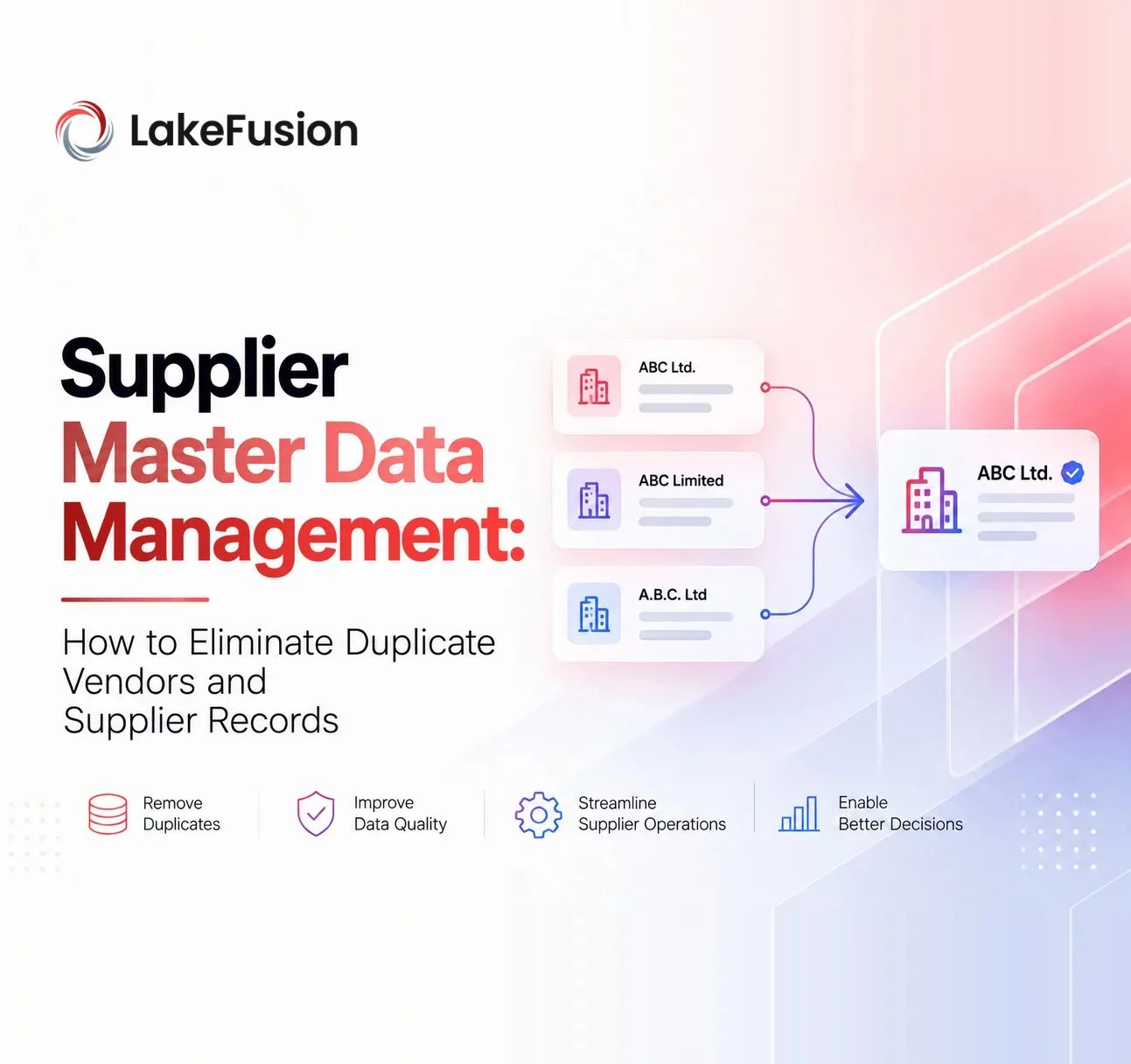
Supplier data will never be clean for long. The same vendor can appear in an ERP under a few different names, look different in procurement systems, use separate regional addresses, or be created again when another business unit starts working with it.
Acquisitions, subsidiaries, manual entry, and inconsistent identifiers make the mess bigger. You end up with a larger supplier database than your actual supplier network.
Supplier Master Data Management resolves this by identifying duplicate supplier records, transforming them into trusted supplier identities, controlling key attributes, and maintaining a consistent, trusted Supplier Golden Record that procurement, finance, operations, analytics, and AI can access and use in the same way.
The objective for enterprise data teams is not only cleaner data vendor tables. It is creating a trusted depiction of all suppliers and their relationships.
What Is Supplier Master Data Management?
Supplier master data management is the process of creating and keeping governed, trusted versions of suppliers across multiple enterprise systems. A supplier can sit in ERP, procurement, finance, sourcing, logistics, CRM, and outside business datasets. Each system often holds a slightly different version of that supplier.
Supplier MDM pulls those scattered records together and works out:
- Which records represent the same supplier
- Which attributes should be trusted
- Which identifiers should be kept
- How parent companies and subsidiaries link
- Where each mastered value came from
- How future supplier records should be matched
You get a consistent supplier identity that downstream systems can reuse instead of every team fixing vendor records on their own.
Supplier MDM vs Supplier Data Management
Supplier data management is the wider work of collecting, maintaining, checking quality, and using supplier information. Supplier MDM focuses on establishing the supplier's governed identity.
Supplier data management can include onboarding forms, contracts, certifications, performance metrics, and procurement processes. Supplier MDM determines the trusted version by assessing whether the supplier is already known, which records should be grouped, and what the trusted version should be.
Vendor Master Data Management vs Supplier MDM
People often use the terms "vendor master data management" and "supplier MDM" interchangeably. Some firms call them "vendors" when they get paid through ERP or accounts payable, and "suppliers" when they provide goods or services.
From an MDM angle, the core job stays the same: turn fragmented records into trusted entities and govern those identities consistently across enterprise systems.
Why Duplicate Supplier Records Become an Enterprise Problem
Duplicate vendors can look like a plain data-quality headache at first, but the trouble spreads well past the master-data team. When procurement, finance, and supply-chain analytics and AI systems are all built on the same supplier information, it becomes extremely painful.
The Same Supplier Is Created More Than Once
One company can show up as:
- ABC Manufacturing Ltd.
- ABC Manufacturing
- ABC Mfg.
- ABC Manufacturing USA
Some of those records are duplicates. Others may be subsidiaries or separate legal entities. Simple exact matching cannot reliably tell the difference.
Different Business Units Maintain Different Records
Regional teams often create their own supplier records without knowing another department already works with the same organization. That produces duplicate identifiers, separate spend histories, and inconsistent supplier classifications.
Supplier Attributes Conflict
ERP may hold one legal name. Procurement may have the latest address. Finance may store a different payment identifier.
Outside sources may list a different corporate parent. Without clear survivorship rules, teams are left deciding which value to trust.
Corporate Relationships Are Hidden
A supplier can be a part of a larger corporate group. Procurement teams may miscalculate total exposure and lose sight of the broader commercial relationship if they treat subsidiaries as unrelated. That is why supplier mastering has to handle relationships as well as duplicates.
How Supplier MDM Eliminates Duplicate Vendor Records
Getting rid of duplicate vendors is not as simple as deleting repeated rows. A solid Supplier MDM process mixes profiling, supplier entity resolution, supplier matching, survivorship, data stewardship, and golden-record management.
1. Profile Supplier Data Across Systems
The first step is seeing where supplier data lives and how each system stores it. Teams often check:
- Supplier names
- Addresses
- Tax identifiers
- Registration numbers
- Phone numbers
- Email domains
- Payment identifiers
- ERP vendor IDs
- External business identifiers
Profiling also shows missing fields, formatting problems, and patterns that can affect matching.
2. Standardize Important Attributes
Supplier records often contain small differences that stop exact matching.
For example:
123 Industrial Road
and
123 Industrial Rd.
may point to the same place.
Names, addresses, phone numbers, identifiers, and other fields are cleaned up before matching so tiny formatting differences don't block valid matches.
3. Resolve Supplier Identities
Supplier Entity Resolution determines if two or more supplier records are associated with a single real-world organization. Modern matching can mix several methods.
Deterministic Matching
Exact rules work when reliable identifiers exist.
For example: Tax ID + Country = Match
These rules are easy to explain but require accurate, available identifiers.
Similarity Matching
Names and addresses can be compared with similarity methods when the values are close but not identical. This picks up spelling changes, abbreviations, and formatting differences.
Probabilistic and AI-Assisted Matching
Harder supplier records may need several signals looked at together. Probabilistic and AI-driven approaches assess the probability that different combinations of names, addresses, identifiers, domains, and other attributes belong to the same entity. Typically, the most effective supplier matching approach combines methods rather than using a single method for each record.
4. Match and Merge Duplicate Suppliers
Once related supplier records are found, they get grouped under one trusted supplier identity. The aim is not to wipe out the original records. Source records stay traceable so teams can see where the information came from and how the mastered entity was built.
5. Apply Survivorship Rules
Matched records often disagree.
One source may have the newest address while another holds the verified legal name. Survivorship rules decide which values go into the trusted supplier record.
Rules can look at:
- Authoritative source
- Most recently verified value
- Completeness
- Confidence
- Business rules
- Steward decisions
This turns several fragmented records into one governed supplier representation.
What Is a Supplier's Golden Record?
A Supplier Golden Record is the trusted, governed version of a supplier built from one or more source records. It can hold the most reliable supplier attributes while keeping lineage back to the original systems.
A Supplier Golden Record may include:
- Legal company name
- Supplier identifiers
- Addresses
- Country or region
- Corporate parent
- Classification
- Status
- Contact information
- Source lineage
- Related entities
The golden record gives downstream teams one governed supplier identity instead of forcing procurement, finance, and analytics teams to sort out competing records every time they use supplier data.
Golden Record Does Not Mean One Source System
A common mistake is thinking that creating a golden record means declaring one system as the source of truth for every attribute. That rarely works in practice.
ERP may be the best source for one field while procurement or an outside source is better for another.
Enterprise MDM lets firms build a trusted supplier from the best available information across several systems.
Why Supplier Hierarchies Matter as Much as Deduplication
Clearing duplicates only solves part of the supplier-data problem. Enterprises also need to see how suppliers link to each other.
A vendor may be:
- A subsidiary of another supplier
- Part of a global corporate group
- Linked to several operating entities
- Represented through multiple regional organizations
Without supplier hierarchy management, these entities can look independent even when they sit inside the same corporate structure.
Better Supplier Visibility
Linking parent and subsidiary relationships gives procurement teams a clearer picture of who they are actually dealing with.
More Consistent Spend Analysis
Spend can be split across several vendor records or related subsidiaries. Trusted identities and hierarchies give a stronger base for analyzing supplier relationships across the organization.
Stronger Relationship Context
Supplier relationships also support wider operational, sourcing, and analytical work where knowing the entity alone is not enough.
Supplier MDM vs Vendor Deduplication
Vendor deduplication matters, but supplier MDM goes further.
| Vendor Deduplication | Supplier MDM |
|---|---|
| Finds repeated records | Establishes trusted supplier identities |
| Often focuses on one dataset | Works across multiple enterprise systems |
| May remove duplicates | Preserves source lineage |
| Usually record-focused | Entity-focused |
| Does not necessarily govern attributes | Uses survivorship and stewardship |
| Limited relationship context | Can manage supplier hierarchies |
Are these two records duplicates?
Supplier MDM asks:
Which real-world supplier do these records represent, what information should be trusted, and how is that supplier connected to other entities?
Where Supplier Master Data Management Creates Business Value
A trusted supplier foundation can support several enterprise workflows beyond data quality.
Procurement and Sourcing
Procurement teams get a more consistent supplier identity across sourcing and purchasing systems. This lowers the chance of treating the same organization as several unrelated suppliers.
Finance and Vendor Management
Finance teams can work with cleaner vendor identities and more consistent supplier information instead of sorting out duplicate vendor records on their own.
Supplier Analytics
Analytics become more reliable when spending, performance, and supplier activity link to governed supplier entities.
Corporate Hierarchy Analysis
Parent-subsidiary relationships add context to supplier networks and wider corporate relationships.
AI-Ready Supplier Data
AI systems need to know whether multiple vendor records belong to the same supplier before answering questions about exposure, spend, performance, or relationships. Trusted supplier identities cut that uncertainty.
What Should Enterprises Look for in Supplier MDM Software?
The right platform should do more than run duplicate-detection rules. Enterprise teams should check whether it can govern supplier identity through the full mastering process.
Flexible Entity Resolution
Supplier data varies a lot across sources. The platform should support deterministic rules plus more flexible matching methods for ambiguous records.
Governed Golden Records
Teams need control over which attributes survive and clear visibility into where mastered values came from.
Stewardship Workflows
Uncertain matches should go to data stewards for review instead of being merged automatically without oversight.
Hierarchy and Relationship Management
Supplier mastering becomes far more useful when parent companies, subsidiaries, and linked entities can be governed alongside the supplier record.
Architecture Alignment
The MDM layer should fit the enterprise data architecture rather than adding unnecessary copies and sync jobs.
Build Trusted Supplier Data with LakeFusion
Duplicate suppliers are not only a cleansing problem. They are an identity problem. LakeFusion Master Data Management resolves fragmented supplier records, matches and merges data, enables governed Golden Records, manages relationships, and establishes trusted supplier identities on Databricks.
LakeFusion provides a governed supplier foundation that can be reused across enterprise workflows, so procurement, finance, analytics, and AI teams don't have to reconcile competing supplier records.
For organizations already using Databricks to build their data environment, this ensures trusted supplier information stays accessible to the analytic applications, AI models, and workloads that require it.
Ready to Build a Trusted Supplier Master?
Turn duplicate vendor records and fragmented supplier identities into governed enterprise data with LakeFusion.
Explore LakeFusion Master Data Management
Frequently Asked Questions
What is supplier master data management?
Supplier Master Data Management creates and maintains trusted supplier identities across multiple enterprise systems using matching, survivorship, data stewardship, hierarchy management, and golden-record governance.
What causes duplicate supplier records?
Duplicate suppliers usually come from manual entry, inconsistent naming, multiple ERP systems, regional processes, missing identifiers, acquisitions, and separate business units creating records for the same organization.
What is a supplier's golden record?
A Supplier Golden Record is the governed representation of a supplier created by resolving multiple source records and selecting trusted attributes while keeping lineage to the contributing systems.
What is the difference between supplier MDM and vendor deduplication?
Vendor deduplication mainly finds repeated records. Supplier MDM goes further by resolving real-world supplier identities, applying survivorship, creating Golden Records, preserving lineage, and managing supplier relationships.
How does LakeFusion support supplier MDM?
LakeFusion MDM helps enterprises resolve duplicate supplier records, create governed supplier identities and Golden Records, manage relationships, and keep trusted master data inside the Databricks environment.

Accelerate your edge with LakeFusion insights
Get practical perspectives on master data, governance, and building scalable, AI-ready data foundations.