
.avif)
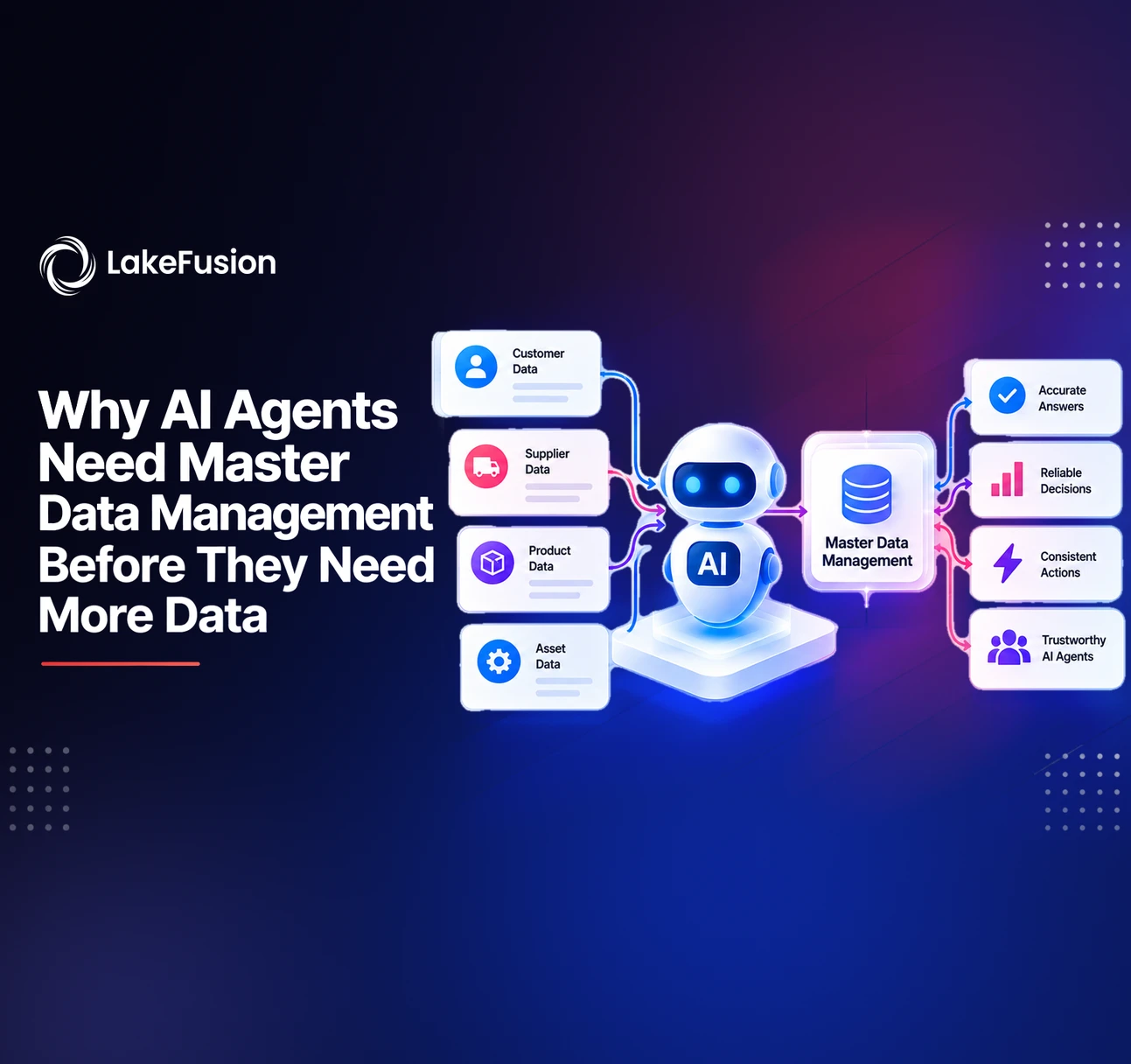
Enterprise AI agents keep getting plugged into more systems, more applications, and more business data. They query databases, pull documents, summarize records, recommend actions, and increasingly just go execute workflows on someone's behalf. But handing an agent more information doesn't automatically make its decisions any more trustworthy.
The real problem, more often than not, is identity. One customer sitting under five different names. A supplier scattered across several ERP systems. Product attributes that contradict each other depending on which region you're looking at. An agent inherits all those inconsistencies the moment it touches the data.
That's why MDM for AI needs to come before simply opening up more data access. An AI-powered Master Data Management platform gives agents something to stand on, a governed foundation of trusted customers, suppliers, companies, products, and other enterprise entities before any reasoning or action happens.
For organizations building AI on modern data platforms, Master Data Management on Databricks can build that trusted identity layer right next to the data already powering analytics and AI. This was never about handing agents more records. It's about giving them better context on which records, values, and relationships deserve to be trusted in the first place.
Why More Data Can Make AI Agents Less Reliable
Enterprise AI agents don't behave like conventional analytics tools.
A dashboard can show a human analyst something inconsistent, and the analyst interprets it, applies judgment, and maybe shrugs it off. An agent doesn't have that luxury; it might take that same inconsistency and turn it straight into a recommendation, a triggered workflow, or an update pushed into another system.
That changes the math on unresolved master-data problems. The cost just goes up.
Duplicate Records Create Multiple Versions of Reality
Say an enterprise has three supplier records sitting around:
- Global Manufacturing Ltd.
- Global Mfg.
- Global Manufacturing North America
Maybe these are the same organization. Maybe they're separate subsidiaries. Maybe they're related legal entities that never got properly linked. Nobody's sure.
Now ask an AI procurement agent a simple question: how much did we spend with this supplier last year?
If identity was never resolved beforehand, the agent might grab just one record and call it done, double-count transactions across the duplicates, or completely miss spending tied to the related entities.
And here's the thing that's not a retrieval failure. The agent found the data just fine. The real issue is that the enterprise never decided which records actually belong together.
An Enterprise MDM Platform resolves that identity question upfront, before any downstream AI has to untangle it.
Conflicting Attributes Create Uncertain Decisions
Even once records are tied to the same entity, their attributes can still disagree. CRM might be holding the newest customer phone number. ERP might have the verified billing address. Another system might hold the authoritative legal name.
An AI agent really shouldn't have to guess which system wins every single time it runs a task.
Master data management applies survivorship and source-authority rules so trusted values get established ahead of time before the agent ever touches them.
More Systems Multiply the Problem
Here's the counterintuitive part: adding more enterprise sources can actually make things worse if identity still isn't resolved.
A new CRM, a new ERP, a fresh data feed, or an acquisition any of these can introduce yet another version of a customer, supplier, company, or product that already exists somewhere else under a different name.
A Databricks-native MDM platform helps enterprises manage that fragmentation as part of the broader data environment, instead of leaving every downstream AI workflow to solve the identity puzzle on its own, over and over again.
How Master Data Management Makes Enterprise Data AI-Ready
Master data management for AI creates a governed layer between messy, fragmented source records and the agents that consume enterprise information.
That layer brings together identity resolution, trusted attributes, stewardship, hierarchy, and governance, all working as one system.
Resolve Identity Before Agents Reason
Entity resolution determines which records point to the same real-world thing. Depending on the data, that matching can lean on:
- Deterministic rules
- Probabilistic techniques,
- AI-assisted matching,
- Human stewardship for the genuinely ambiguous cases.
Once identity's resolved, an agent can work with a trusted customer or supplier directly, rather than trying to piece together identity from a pile of disconnected source rows.
For organizations evaluating Master Data Management Software, this matters more as AI shifts from retrieving information to running operational workflows.
A trusted identity becomes the anchor point that connects information across source systems without forcing every application or agent to reconstruct the entity from scratch.
Establish Trusted Values Before Agents Act
Matching tells you which records belong together. Survivorship decides which values actually represent the resulting master entity.
A business might land on something like:
- ERP owns legal company names,
- CRM owns relationship information,
- procurement owns supplier status
- the most recently verified address wins out.
These aren't arbitrary choices, they encode actual business policy into the mastered data.
That matters a lot, because AI agents increasingly act on attributes, not just describe them to a human and wait for a decision.
Keep Human Judgment in the Governance Loop
Not every master-data decision is safe to automate. Some matches stay genuinely ambiguous. Two companies might share similar names while being completely separate legal entities. A supplier might have gone through a merger nobody's updated the records for yet. A hierarchy might need business context that simply isn't visible from the individual attributes alone.
That's exactly why Data Stewardship Software still has a real place in an AI-driven architecture: automation doesn't remove the need for human judgment here, it just changes where that judgment gets applied.
Preserve Provenance and Governance
Reliable AI needs more than just a final value sitting in a field somewhere. Enterprises often also need to know:
- where an attribute actually came from,
- why it survived the mastering process,
- whether a steward approved it,
- which sources contributed to the entity,
- what permissions apply to it.
This is where governed data for AI agents pulls ahead of merely "clean" data.
Governance provides the context needed to judge whether information can be trusted and how it's allowed to be used.
AI Agents Need Products and Relationships, Not Just Entities
Trusted customer or supplier identity covers only part of what agents need from an enterprise context. Many real-world questions depend just as much on rich product information and the relationships connecting different entities.
That's why the AI data foundation usually has to stretch beyond traditional MDM.
Graph Intelligence Adds Relationship Context
Many enterprise questions aren't really about a single entity at all. They're about networks.
An agent might need to work out:
- which subsidiaries belong to a parent company,
- how a supplier connects to a product,
- which accounts belong to the same organization,
- which entities connect several relationships away from each other.
A Graph Intelligence Platform represents those relationships directly, instead of forcing the agent to piece them together from scratch.
This becomes especially valuable when an AI agent needs to move past "Who is this company?" and start asking, "How is this company connected to the rest of the enterprise?"
For organizations already working in the lakehouse, Graph Analytics on Databricks brings relationship intelligence right next to mastered enterprise data, without making agents reconstruct complicated relationship chains from disconnected tables.
Trusted Entities Plus Trusted Relationships
This sets up a pretty useful progression for enterprise AI: MDM → trusted product information Graph → trusted relationships
An Enterprise Data Management Platform that actually brings these layers together gives AI agents far richer context than raw access to source systems ever could on its own.
Instead of forcing an agent to infer identity, product meaning, and relationships all at the same time, those concepts can already be governed well before the agent ever has to act.
Why Governance Becomes More Important as Agents Become Autonomous
AI assistants mostly answer questions. AI agents can take action. That difference is exactly why master-data governance matters more now, not less.
Agents Can Amplify Bad Data Faster
A person might glance at two customer records, notice something looks off, and pause before using them. An automated agent can chew through thousands of records without ever questioning the underlying identity model behind them.
If the data's wrong, automation just speeds up how fast that error spreads. An AI-ready Master Data Management platform creates a controlled identity layer before automated workflows ever get their hands on the information.
Access and Identity Governance Must Work Together
In Databricks environments, Unity Catalog can govern much of what matters around access, permissions, and lineage.
MDM is answering a different question entirely: What is the trusted business entity inside that governed data environment?
Both layers genuinely matter here.
Access governance without mastered identity can still hand an agent permission to query five conflicting versions of the same supplier. Mastered identity without proper access governance can expose information the agent never should've touched in the first place. Put them together, though, and you get a real foundation for enterprise AI, not just half of one.
LakeFusion: Build Trusted Data for Enterprise AI Agents
LakeFusion brings MDM, and Graph Intelligence directly into the Databricks environment, so enterprises can establish trusted entities, products, and relationships before AI agents ever consume or act on them. Instead of building agentic workflows straight on top of fragmented source records, organizations can set up a governed enterprise context designed specifically for analytics, applications, and AI.
Databricks-Native MDM Foundation
LakeFusion provides Lakehouse Master Data Management for resolving fragmented customer, supplier, company, product, and other enterprise records right inside the Databricks ecosystem.
Matching, survivorship, stewardship, and mastering all happen close to the existing enterprise data foundation, rather than bolting on yet another disconnected MDM stack nobody wants to maintain.
AI-Powered Entity Matching
LakeFusion combines rules-based, probabilistic, and AI-assisted matching to handle different levels of entity-resolution complexity. Straightforward records get resolved efficiently, while the harder cases get deeper analysis or stewardship attention where it's actually needed.
Relationship Intelligence for Agents
LakeFusion Graph extends mastered entities into governed relationship networks. Agents can work directly with company hierarchies, affiliations, customer-supplier relationships, and multi-hop connections, instead of relying on isolated records that don't tell the full story.
MCP Access for AI Agents
LakeFusion also exposes governed MDM and Graph capabilities through MCP, letting AI agents interact with trusted enterprise data and platform capabilities through an interface built for agents to actually use. This builds a real bridge between governed enterprise data and the agents that are supposed to be using it.
One Foundation Across Industries
The same identity problem shows up differently by industry.
- MDM for Manufacturing can connect customers, suppliers, products, and organizational relationships.
- MDM for Financial Services can strengthen legal entity and relationship intelligence.
- MDM for Healthcare and Life Sciences can provide governed identities across genuinely complex enterprise datasets.
- MDM for Retail and Consumer Goods can connect trusted customer, supplier, and product information for AI-powered operational workflows.
Underneath it all, the requirement stays the same: agents need trusted enterprise context before they need more data piled on top.
Conclusion
Enterprise AI agents will keep getting access to more applications, systems, and workflows. That part's not slowing down. But how good those agents are will depend less on how many records they can pull and more on whether they understand the entities behind those records.
MDM for AI is what establishes that trusted foundation. LakeFusion combines Master Data Management, and Graph Intelligence on Databricks to give AI systems governed identities, and relationship context before agents start making decisions.
Build AI in a trusted enterprise context. Explore LakeFusion Master Data Management or request a demo.
Frequently Asked Questions
Why do AI agents need MDM?
Because enterprise source systems are almost always full of duplicate, fragmented, and conflicting versions of customers, suppliers, products, and companies. MDM establishes trusted identities and attributes before agents ever touch that information.
What is AI-ready enterprise data?
It's information that's resolved, governed, contextualized, and reliable enough that AI models and agents don't have to keep re-solving basic identity and consistency problems every time they touch it.
How does MDM reduce AI hallucination or incorrect outputs?
MDM won't eliminate model hallucination entirely, but it can cut down on data-driven ambiguity by giving AI systems trusted entity identities, governed attributes, source context, and validated relationships to work from.
Why do AI agents need graph intelligence?
Because it gives agents relationship context, a way to understand how companies, suppliers, customers, products, and other entities actually connect, instead of evaluating every record as an island on its own.

Accelerate your edge with LakeFusion insights
Get practical perspectives on master data, governance, and building scalable, AI-ready data foundations.