SQL JOINs bury complex relationships, and external graph copies just add more work. LakeGraph runs fast graph analytics right on Databricks. You get multi-hop traversal, zero data egress, and no separate graph database.
mins
Data to graph
secs
5-hop query
pb
In production
Data egress
External graph databases require copying your data out of Databricks. That means egress fees, stale data, sync pipelines, and a second security perimeter.
Each hop requires a full distributed query. A 5-hop traversal takes 30-60 seconds on Spark — and costs a running cluster the entire time.
Self-joining a 200M-row table 5 times produces billions of intermediate rows. SQL was designed for set operations, not path traversal.
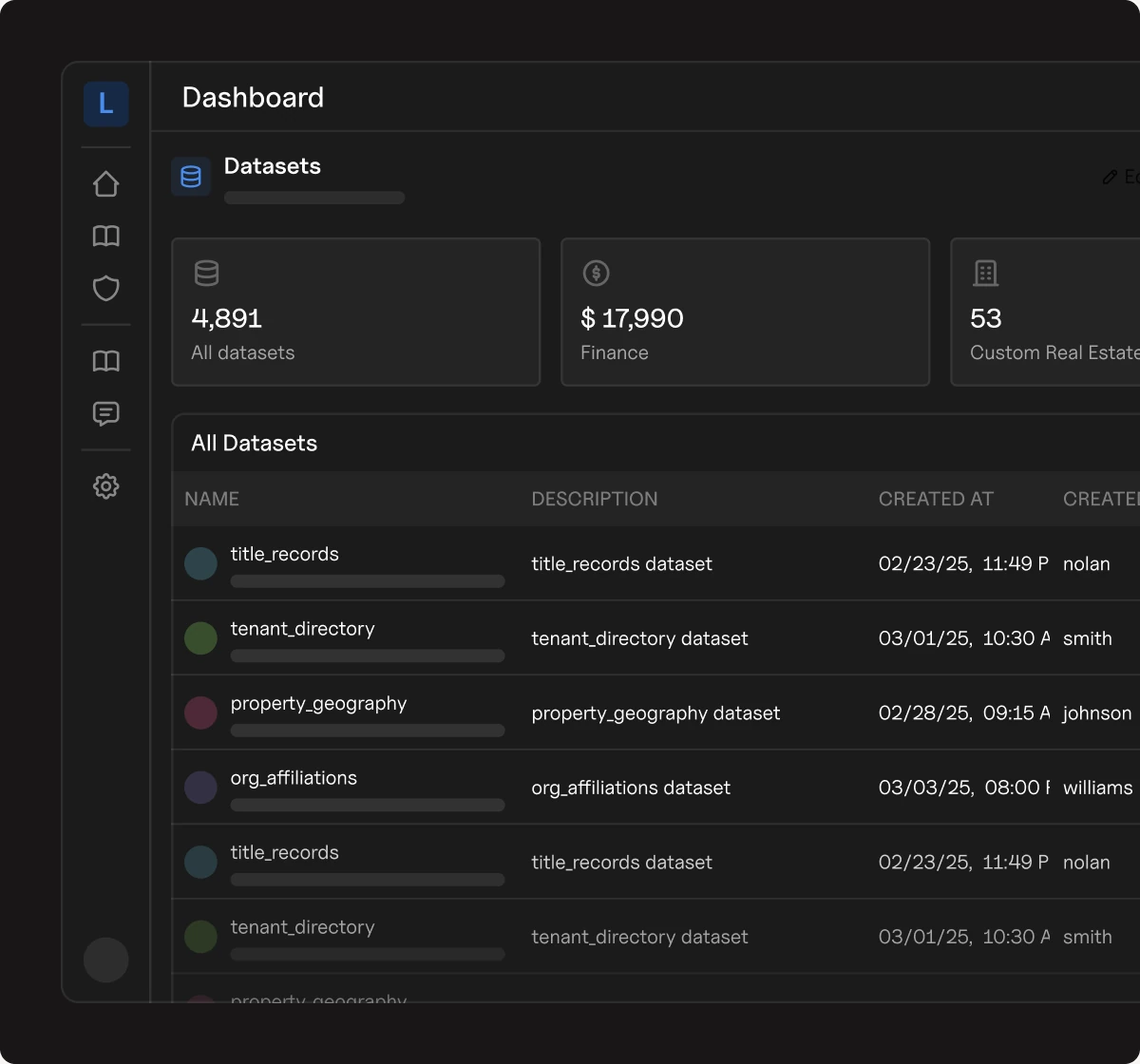
LakeGraph turns connected enterprise data into actionable enterprise graph intelligence. Model relationships, walk multi-hop networks, uncover hidden connections, and put graph insights to work inside Databricks. No extra disconnected graph system to build or keep running.
LakeGraph hands enterprise data teams the full set of tools to model, query, put to work, and govern complex relationships. Everything stays close to the Databricks data foundation that already runs your analytics and AI.
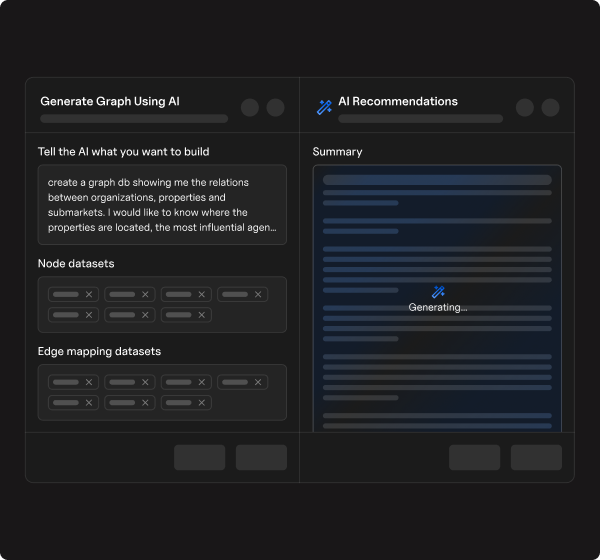
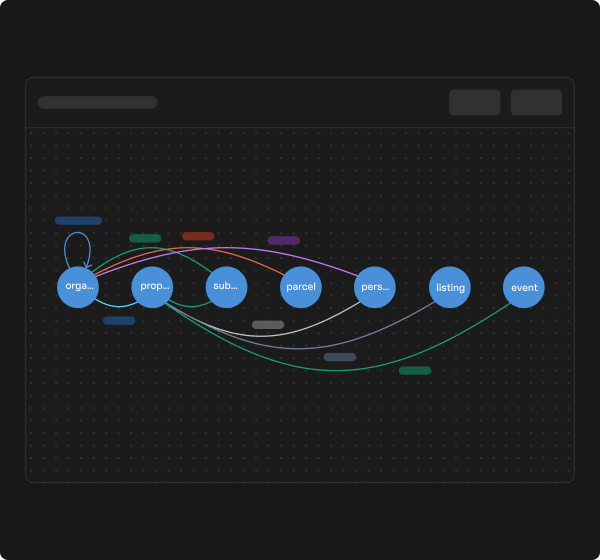
Point LakeGraph at your governed enterprise data. It speeds up graph creation with AI-assisted entity discovery and relationship inference. You still keep full control over how the graph schemas get defined. LakeGraph represents everything as a labeled property graph: entities become nodes, relationships become typed edges, and both carry properties. This property graph model creates a real, queryable graph rather than a virtual join.
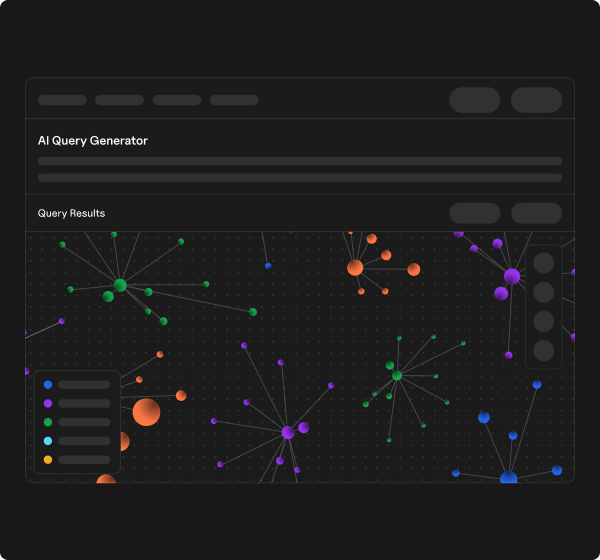
Run fast multi-hop graph queries across complex 1-to-5-hop relationships without stacking expensive SQL JOINs. Teams can surface connections across customers, companies, suppliers, assets, transactions, and other enterprise entities. 1-hop lookups return in under 5ms; 5-hop traversals complete in seconds, versus 30–60 seconds for the equivalent JOIN chain on Spark.
Build an optimized graph index around your enterprise relationships. Repeated traversal no longer needs full-table scans or rebuilding the network every time you query.
Use Lakebase and optimized adjacency structures. Query connected data interactively. No waiting for Spark cluster cold starts and no repeated scans of large relational datasets.
Take graph insights past simple exploration. Feed the relationship outputs into BI, ML pipelines, applications, stewardship processes, and other operational workflows.
Turn graph conditions into real action. Trigger alerts, update trusted records, launch pipelines, or connect the graph intelligence to external workflows and APIs.
Extend graph relationship analytics with PageRank, betweenness, closeness, eigenvector centrality, community detection, shortest paths, similarity, and neighborhood-overlap scoring. Detect natural groupings with Louvain and Leiden community detection, trace shortest paths, and surface hidden hubs and chokepoints computed directly on your graph index, with no separate analytics engine to run. Graph similarity and neighborhood-overlap scoring go a step further, ranking which accounts most closely resemble your best customers for targeted expansion.
LakeGraph delivers graph analytics on Databricks without forcing enterprises to deploy a separate graph database for Databricks workloads. Connected intelligence stays close to governed data instead of moving into another security perimeter or synchronization setup.
Keep the graph data inside your Databricks environment. Stop constantly copying sensitive enterprise datasets into an external graph database.
Avoid provisioning, securing, integrating, monitoring, and synchronizing another property graph database just to query enterprise relationships.
LakeGraph keeps graph structures on Databricks data foundations. Relationship intelligence stays closer to govern enterprise data and the downstream workloads that use it.
Physically organize the graph data around node and edge access patterns. This cuts unnecessary scans and speeds up relationship traversal.
Use Lakebase as the interactive query layer. You get responsive graph traversal without leaning on Spark execution for every relationship query.
Keep graph intelligence lined up with the access controls, lineage, and governance you already have. No separate governance model gets introduced for the connected data.
Relational tables work well for structured records. Graph relationship analytics is better suited to questions involving paths, networks, ownership structures, dependencies, and multiple levels of connected entities.
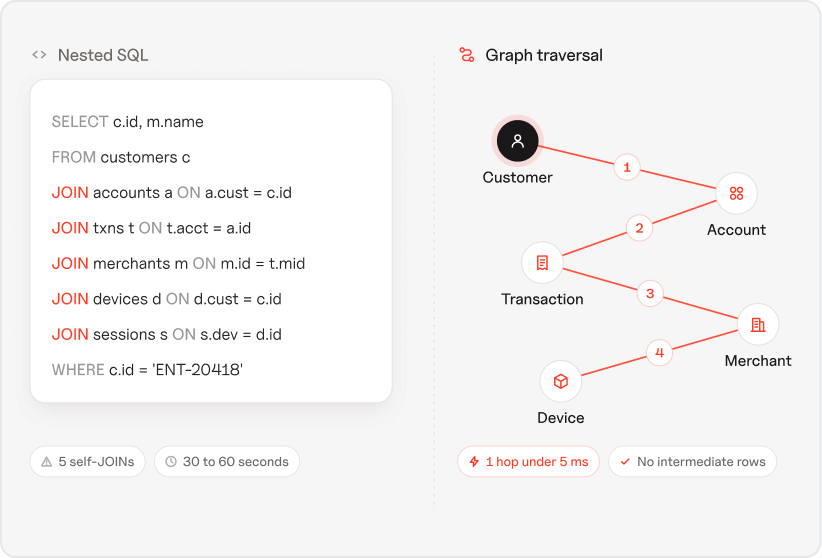
Replace the growing pile of self-JOINs and nested SQL with a graph model built specifically to walk relationships between connected enterprise entities.
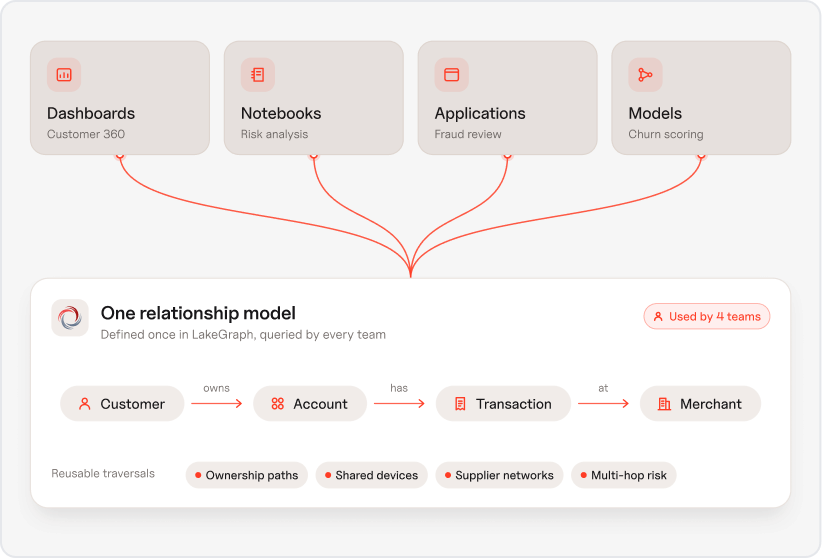
Stop rebuilding the same relationship queries across dashboards, notebooks, applications, and models. Create one reusable graph foundation that multiple downstream teams can pull from.
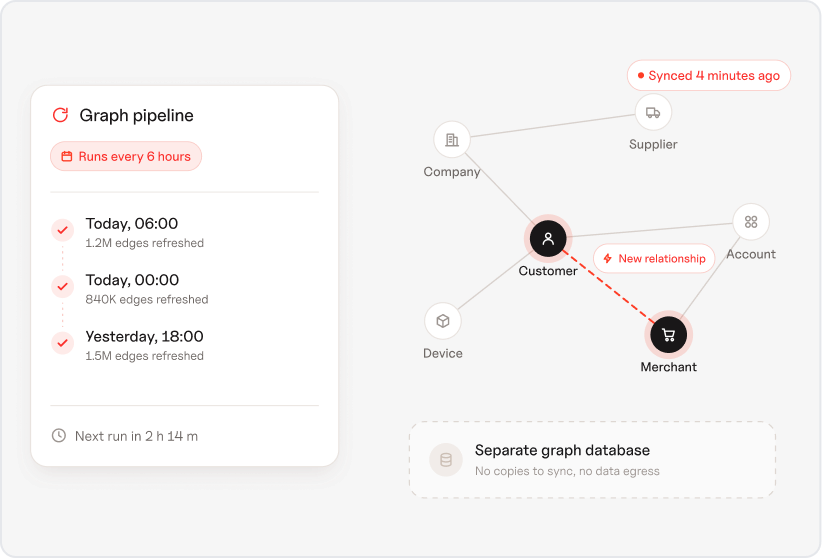
Run scheduled graph pipelines and refresh the connected intelligence as the enterprise data changes. No more manually synchronized copies sitting in a separate graph system.
LakeGraph combines a Graph Intelligence Platform with multi-hop graph queries to answer business questions where relationships matter as much as the entities themselves.







LakeGraph goes past graph exploration. Operational capabilities feed relationship intelligence back into enterprise workflows, trusted master data, & AI, so the connections you find can drive action right away
Run graph-processing pipelines on a schedule. Keep the relationship intelligence current without data teams having to trigger the refreshes by hand.
Use relationship signals to spot potential entity matches. Route the graph-derived suggestions into LakeFusion MDM stewardship for governed review.
Give AI agents one governed connection to trusted master records and graph intelligence. They can reason across both enterprise identities and relationships.
Define conditions around graph states. Automatically surface important changes, relationships, or network patterns the moment those conditions become true.
Use graph intelligence to kick off configured actions such as record updates, pipelines, webhooks, APIs, and other operational workflows.
LakeGraph brings enterprise graph intelligence to organizations that already trust Databricks with their data and do not want another platform just to understand how that data connects
Run Databricks graph analytics in the same architecture where enterprise data, analytics, ML, and AI workloads already operate.
Get the capabilities enterprises expect from a graph database for Databricks use cases without standing up another database that must be provisioned, secured, governed, synchronized, and maintained.
Keep enterprise graph intelligence close to its governed source. Stop continuously replicating data into an external relationship store.
Explore connected networks and paths with an architecture optimized for relationship queries, not repeated relational JOINs.
Keep graph intelligence aligned with Unity Catalog access controls and enterprise governance. No new independent data perimeter gets created.
Put relationship intelligence to work across BI, ML pipelines, enterprise applications, MDM, and agentic AI. Graphs do not stay locked inside an isolated analytical tool.
LakeGraph delivers graph analytics on Databricks without requiring enterprise teams to move governed data into another specialized database. It uses a labeled property graph model nodes, typed edges, and properties but runs on Databricks data foundations instead of requiring a separate property graph database.
External graph database
Separate graph data store
Data extraction and copying
ETL and synchronization pipelines
Separate infrastructure
Additional security perimeter
Separate operational workflows
Graph context isolated from MDM
Built around Databricks data
Uses the existing Databricks environment
Zero data egress
Graph intelligence stays close to source data
Uses the Databricks environment
Aligned with existing governance
Outputs feed Databricks analytics, ML, and applications
MDM and Graph Intelligence can work together
Connect customers, accounts, policies, transactions, companies, claims, and other entities. Reveal the networks that support richer risk and customer intelligence. LakeGraph keeps regulated financial data inside your existing controls.
Connect providers, organizations, facilities, patients, assets, and related entities. Keep the sensitive enterprise data inside the governed Databricks environment.
Walk relationships across suppliers, products, facilities, assets, customers, and dependencies. Create stronger operational and supply-chain visibility.
Explore connections across products, suppliers, consumers, channels, organizations, and transactions. Build richer context around commercial and supply-chain relationships.
A Graph Intelligence Platform helps enterprises model, query, analyze, and operationalize relationships between connected entities. LakeGraph uses a property graph model, where entities are nodes, relationships are typed edges, and both can carry properties.
LakeGraph makes the relationships across Databricks data queryable through graph modeling and multi-hop traversal. Enterprise data stays inside the existing Databricks environment.
No. LakeGraph provides an alternative to deploying a separate Databricks graph database, keeping graph intelligence close to governed Databricks data without another external database and synchronization layer.
Yes. LakeGraph is built for fast multi-hop graph queries across connected entities, avoiding repeated chains of large relational JOINs.
Yes. LakeGraph compares an account's graph neighborhood industry, hierarchy, referrals, and the services it already has against similar high-value accounts, surfacing whitespace as a ranked list of expansion opportunities.
LakeGraph is built around zero data egress. Graph intelligence runs inside the Databricks environment instead of copying enterprise data into another platform.
LakeGraph gives AI workflows and agents governed relationship context. They can understand connections, hierarchies, and networks together with trusted enterprise entities.