
.avif)
Not every data headache inside a company looks the same. One firm might keep running into the same customer, supplier, or product details showing up in multiple places. Another firm runs into a different mess: the exact same status, country, category, currency, or business code gets treated as something else depending on which system wrote it down.
That's where knowing reference data management vs master data management starts to matter.
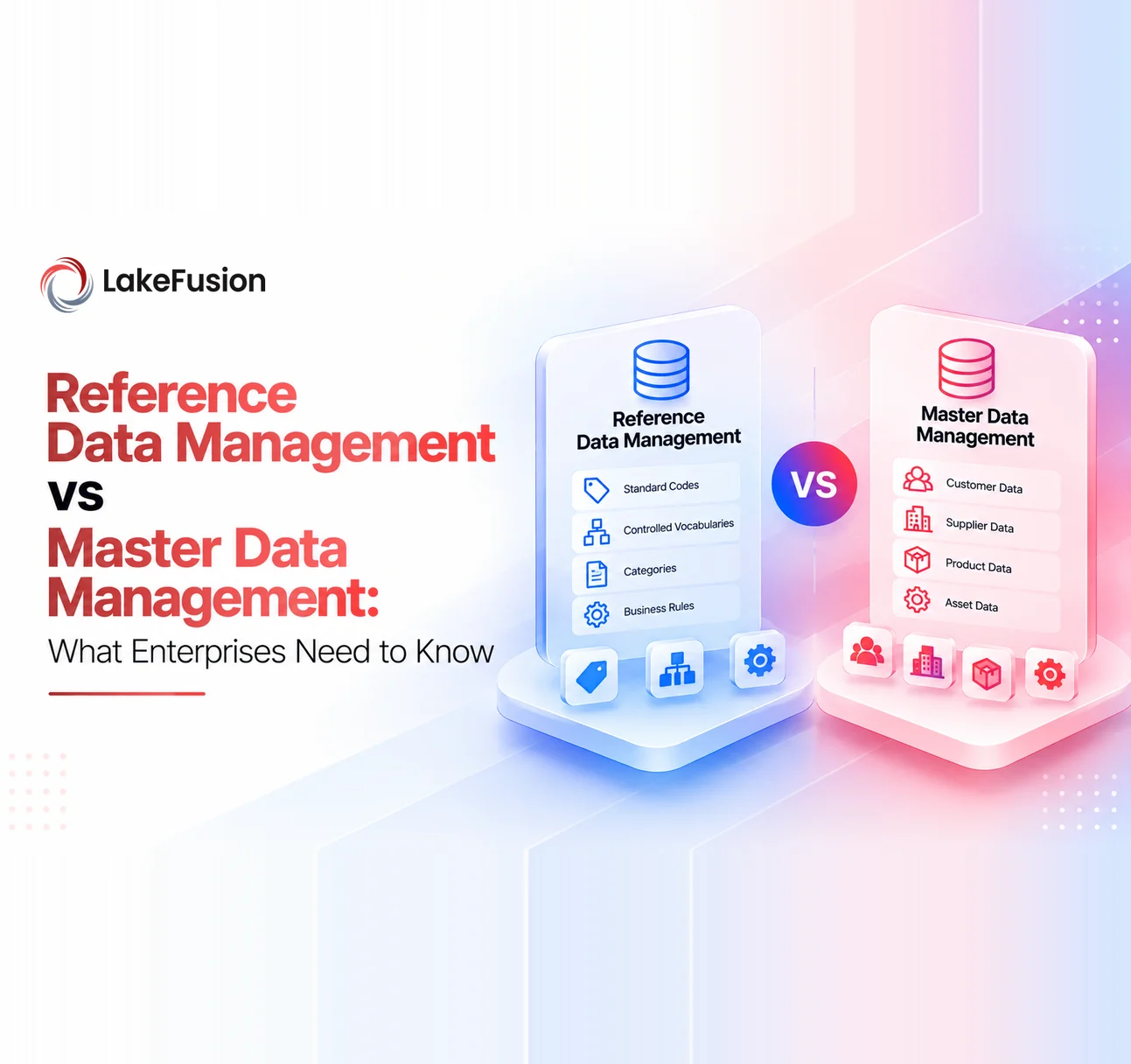
Master Data Management looks after the trusted versions of the main business things a company works with: customers, suppliers, companies, products, and locations. Reference Data Management manages the controlled lists of values that classify, describe, and maintain those things from one system to the next.
They address different problems but rely on each other. Good MDM requires consistent reference values to work properly, and reference data is more effective when shared with trusted master records across the enterprise.
Clarifying RDM vs MDM helps any enterprise build a database that stays consistent and reliable.
What Is Reference Data Management?
Reference data management means building, governing, sharing, and maintaining the standard lists of values that every business application and dataset uses. Those lists usually consist of codes, classifications, or allowed values that don't change often.
Examples include:
- Country and Region Codes
- Currencies
- Language Codes
- Customer Status Values
- Supplier Categories
- Payment Terms
- Business-Unit Codes
- Product Classifications
- Risk Categories
- Industry Codes
Take the United States. One system might write it as:
- US
- USA
- United States
- United States of America
When systems store the same thing differently, analytics and system links get messy fast. Reference Data Management picks one governed version and decides how every other system should line up with it.
Reference Data Defines Shared Business Meaning
Reference data is almost never the customer or supplier itself. It simply supplies the values that describe that entity. A customer golden record might hold:
- Customer Name: Acme Corporation
- Country: US
- Customer Type: Enterprise
- Status: Active
"Acme Corporation" counts as master data. "US," "Enterprise," and "Active" are the governed reference values. That difference sits at the heart of reference data management vs master data management.
What Is Master Data Management?
Master Data Management builds the trusted picture of the core business entities a company actually runs on.
The usual master-data domains cover:
- Customers,
- Suppliers,
- Companies,
- Products,
- Employees,
- Locations,
- Assets.
The hard part is that those same entities live in lots of different systems. One customer may appear in CRM, ERP, billing, support, and marketing systems with name and address, ID and/or contact information that wouldn't exactly match their other data.
An MDM software platform determines which of these records refer to the same real-world entity and creates one governed version for the whole organization to use.
Typical MDM capabilities include:
- Entity Resolution
- Matching and merging,
- Survivorship,
- Golden Record creation,
- Hierarchy management,
- Lineage,
- Data Stewardship,
- Governance workflows.
RDM locks down the allowed values. MDM decides which real-world entity the company is actually dealing with.
Reference Data Management vs Master Data Management
The simplest way to tell RDM vs. MDM apart is to look at what each controls.
| Area | Reference Data Management | Master Data Management |
|---|---|---|
| Primary focus | Codes, categories, classifications, allowable values | Core business entities |
| Examples | Country codes, currencies, status values, industry codes | Customers, suppliers, products, companies |
| Main problem | Inconsistent meaning across systems | Duplicate and fragmented entities |
| Typical activity | Standardization and mapping | Matching, merging and survivorship |
| Output | Governed reference values | Trusted golden records |
| Human governance | Reference-data owners and stewards | Domain stewards and MDM owners |
| Change frequency | Often relatively stable | Continuously changes with business activity |
They remain separate disciplines, yet they still depend on each other.
Simple Example of RDM vs MDM
Picture a company that keeps supplier records in three different systems.
System A holds: ABC Industrial Ltd. - Country: USA - Status: A
System B holds: ABC Industrial - Country: United States - Status: Active
System C holds: ABC Industries LLC - Country: US - Status: 1
Two separate problems show up.
Reference Data Problem
USA, the United States, and the US can all stand for the same country. A, Active, and 1 can all stand for the same supplier status. Reference data management lines those values up under one standard.
Master Data Problem
The company still has to figure out whether:
- ABC Industrial Ltd.
- ABC Industrial
- ABC Industries LLC
These are actually the same supplier. That job needs MDM and Entity Resolution. Once the identities get sorted, survivorship rules decide which details belong in the trusted supplier record.
This is why cleaning up reference data never replaces MDM. Tidy codes do not automatically fix duplicate entities.
Why Reference Data Matters to MDM
Reference data can make a big difference to how well a master data management setup works.
It Makes Matching More Consistent
Matching runs smoother when the same kinds of values carry the same meaning. If one source says "USA," another says "US," and a third uses the number "840," those differences need to be cleaned up before or during matching. Governed reference values reduce needless variation.
It Improves Golden Record Consistency
A Golden Record should do more than just get the entity identity right. Its attributes need to follow the company's standards too. If mastered supplier records still show five different ways of writing the same country or status, the consistency problem remains.
It Supports Analytics
Reports fall apart when the same business idea gets written differently from system to system. Governed reference values make company-wide analytics more solid because every category and classification shares the same definition.
It Helps Downstream AI
AI tools need clear, consistent context. If an agent treats "A," "Active," and "1" as three different statuses, it can reach the wrong conclusion even when it has mastered the supplier identity correctly.
Trusted master data and standardized reference data work side by side to give AI the data it can trust.
What Is Reference Data Governance?
Reference data governance defines who owns reference values, who can update them, how mappings stay in sync, and how changes propagate across systems. Without that governance, reference lists start popping up in every department.
- Finance builds one list.
- Sales builds another.
- Procurement keeps its own.
- Then the analytics teams end up manually mapping between them all.
Define Ownership
Every important reference-data domain needs a clear owner. That owner decides:
- approved values,
- definitions,
- mappings,
- deprecation rules,
- change processes.
Maintain Controlled Values
Treat reference values as properly governed business assets, not random spreadsheets sitting around. Teams need to know:
- Which values are still active
- Which ones have been retired
- Which newer values replaced the older codes
- How external codes line up with the internal standards
Track Changes
Even reference data that looks stable does change over time. Countries, classifications, regulatory categories, company structures, and product categories all shift. Good reference data governance keeps the history and stops those shifts from quietly breaking systems further down the line.
How Master Data Governance Differs
Master data governance sets the rules for trusted business entities. It answers questions like:
- Which systems count as the source of truth?
- Which attributes are allowed to be mastered?
- How should duplicate records be handled?
- Who gets to approve a merge?
- How should survivorship work?
- Who owns the customer, supplier, or product data?
Reference data governance asks a different set of questions:
- What values are allowed?
- What does each value actually mean?
- Which code is the official one?
- How should outside codes map onto the internal values?
Both need solid governance, but they govern different things.
Where Data Stewardship Fits
Data stewardship backs up both RDM and MDM.
In MDM, stewards often look at:
- potential duplicates,
- unclear matches,
- survivorship clashes,
- hierarchy changes,
- golden-record exceptions.
In RDM, stewards often look at:
- requests for new codes,
- mapping clashes,
- duplicate classifications,
- retired reference values,
- taxonomy changes.
Strong stewardship stops the governance rules from staying just theory. It turns them into a real process that handles exceptions and keeps both reference and master data trustworthy.
Do Enterprises Need Both RDM and MDM?
For most companies, the answer is yes. The real question is rarely whether to replace one with the other. It is how the two should work together.
Use RDM When the Problem Is Inconsistent Values
Reference data management fits when systems can't agree on categories, codes, classifications, or standard values.
Examples:
- Different country codes,
- Inconsistent customer-status values,
- Multiple supplier categories,
- Conflicting business classifications.
Use MDM When the Problem Is Fragmented Entities
MDM fits when the company can't reliably tell which records point to the same customer, supplier, product, or company.
Examples:
- Duplicate customers,
- Supplier identities spread across ERP systems,
- Inconsistent product records,
- Fragmented legal entities.
Use Both When Identity and Meaning Are Inconsistent
This happens often in large companies. A firm might need to clean up duplicate suppliers while also standardizing supplier categories, country values, risk classifications, and status codes.
That job needs both MDM and reference-data governance.
How RDM and MDM Work Together
A practical setup often moves through these steps.
1. Standardize Reference Values
Take codes and classifications from source systems and map them to governed company values.
2. Profile Master Data
Look at missing attributes, duplicate patterns, source quality and any inconsistencies.
3. Resolve Entity Identities
Use deterministic, probabilistic or AI-assisted matching to find the records that point to the same entity.
4. Apply Survivorship
Decide which sources and attributes win when values clash.
5. Create Governed Golden Records
Build the trusted entities that carry lineage, mastered attributes, and standardized classifications.
6. Maintain Through Stewardship
Send the unclear records and governance exceptions to the business stewards. When these steps run together, they produce more reliable, governed master data.
Reference Data and Product Data
The same distinction shows up in product environments. A product master stands for one specific product that can be sold.
Reference values might define:
- Product category,
- Color family,
- Unit of measure,
- Market,
- Channel,
- Lifecycle status.
A product information management system can handle richer product details, taxonomies, specifications, enrichment, and channel-ready information.
RDM, MDM, and PIM therefore overlap in company product-data setups, yet each still does a different job.
- RDM locks down the shared values.
- MDM sets the trusted product identity.
- PIM looks after the detailed product information the business and commerce teams need.
RDM and MDM on Databricks
Newer companies are bringing operational and analytical data to Databricks, and both reference and master data must keep up with the rest of the governed data foundation.
An approach to master data management on Databricks enables matching, survivorship, golden record creation, and stewardship to run alongside the enterprise data that already lives in the lakehouse. That can reduce the need for separate MDM copies and additional sync layers.
Reference values can also ensure uniform classifications across the same environment, improving the information that underpins analytics, applications, and AI.
The end result is not just tidier tables. It is a governed foundation where the company identities and the values that describe them stay more consistent.
Conclusion
The real difference between reference data management vs master data management is simply what each one governs.
Reference Data Management governs the shared codes, categories, classifications, and allowed values. Master Data Management governs the core company entities: customers, suppliers, products, companies, and locations.
Most enterprises need both. Reference data gives everyone the same meaning. MDM gives everyone the trusted identity. Combine governance and stewardship, and you have the consistency required for good reporting, day-to-day analytics, and AI.
If your company is already on Databricks, LakeFusion helps you approach entity resolution, golden records, survivorship, stewardship, and multidomain mastering within the governed lakehouse foundation.
Learn the capabilities of LakeFusion Master Data Management for creating trusted and governed enterprise entities on Databricks.
Frequently Asked Questions
What is reference data management?
Reference data management (RDM) controls the standardized codes, categories, classifications, and allowed values that all enterprise systems use in the same way.
What is the difference between RDM and MDM?
RDM looks after standardized values such as country codes or status classifications. MDM manages core business entities such as customers, suppliers, products, and companies.
Is reference data part of master data?
Although reference values can sometimes be found within a master record, they are still a different type of data from master data.
Why is reference data governance important?
With reference data governance, shared values are well defined, clearly owned, mapped, approved, and controlled throughout their lifecycle across all systems.
Can an enterprise use MDM without RDM?
Yes, but messy reference values can weaken matching, golden records, analytics, and downstream workflows. Most mature data-management programs therefore govern both.

Accelerate your edge with LakeFusion insights
Get practical perspectives on master data, governance, and building scalable, AI-ready data foundations.