
.avif)
No single master-data issue affects most enterprises. They have multiple ones. Customer records are decentralized across CRM, billing, and support systems.
Suppliers appear with various names in a procurement/ERP system. Product data resides in manufacturing, commerce, and catalog systems. Operations, maintenance, and finance utilize their own separate asset tracking system.
Managing each domain individually can solve one problem and create another set of uncoordinated data.
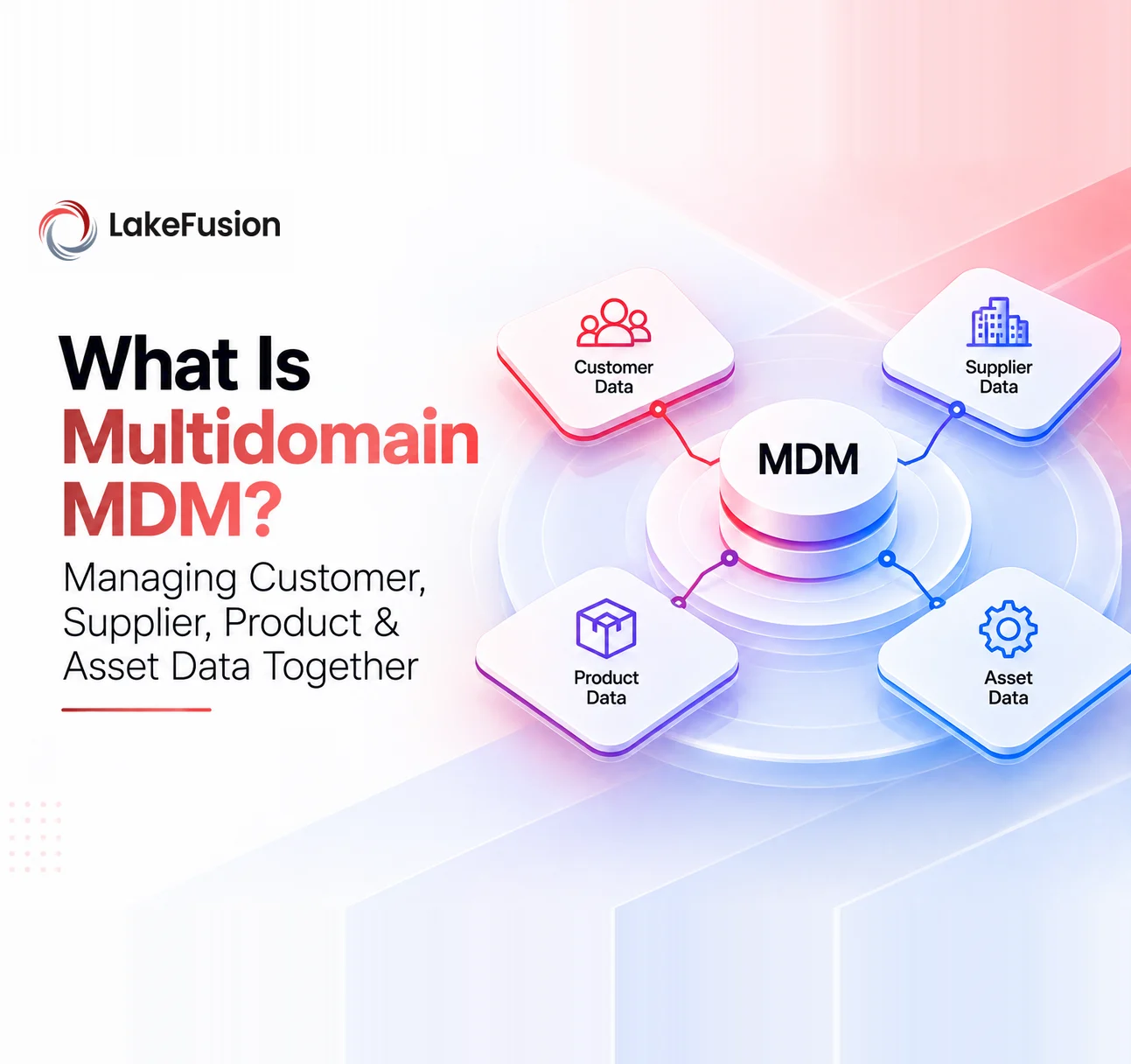
That is where multidomain MDM becomes valuable. Instead of building separate mastering programs for every business entity, multidomain master data management gives a common foundation for resolving, governing, and connecting customers, suppliers, products, companies, locations, assets, and other critical enterprise domains.
The result is not simply cleaner records. It is a unified platform of trusted data, which can power applications, analytics, governance, and AI throughout the company.
What Is Multidomain MDM?
Multidomain MDM is a master data management strategy that lets an organization track multiple domains of key business resources within the same data management system.
A domain stands for a major type of enterprise data, such as:
- Customers
- Suppliers
- Companies
- Products
- Assets
- Locations
- Employees
- Facilities
- Reference Data
Traditional MDM setups sometimes start with one domain, like customer data. That can fix an urgent need, but businesses almost never run on customers alone.
For example, a manufacturer might want to understand how a customer connects with the products purchased, the suppliers of the parts used to make the products, and the facilities where the products are manufactured.
Multidomain master data management solutions provide a means to establish trusted identities across all the domains while applying the same practices of governance, stewardship, matching, survivorship, and lineage.
Single-Domain MDM vs Multidomain MDM
Single Domain MDM is used to go deep into a single entity type. For example, Customer MDM can resolve duplicate customer records and create a customer golden record. Multidomain MDM extends trusted data concepts to more domains.
| Single-Domain MDM | Multidomain MDM |
|---|---|
| Focuses on one primary entity | Supports multiple enterprise entities |
| Often solves one departmental problem | Supports cross-functional data programs |
| Customer, supplier, or product in isolation | Customer, supplier, product, asset, location, company, and more |
| Separate governance may emerge by domain | Shared governance and stewardship framework |
| Limited cross-domain context | Greater relationship context across entities |
Why Enterprises Move Toward Multidomain Master Data Management
Organizations often start their MDM work with one pressing business problem. Marketing may want a single customer view. Procurement may need cleaner supplier details. Commerce teams may need consistent product data. Over time, these projects start to overlap.
A customer can also act as a supplier. A supplier can sit under a larger parent company. A product can rely on several suppliers and manufacturing assets. Locations can belong to companies, customers, or facilities.
When each domain is learned individually, an enterprise may recreate the silos it was designed to eliminate.
Shared Governance Across Business Domains
A master data management software platform can deliver the same governance rules across domains instead of creating separate processes for each data type.
Common capabilities may include:
- Matching,
- Entity Resolution
- Survivorship
- Golden-Record Creation
- Data Stewardship
- Lineage
- Hierarchy Management,
- Role-Based Controls.
This makes it simpler to roll out company-wide data standards while still letting domain-specific business rules stay in place.
Common Trusted-Data Foundation
Multidomain MDM also helps companies define more clearly what counts as trusted. The same rules used to pick the authoritative customer record can stretch to suppliers, products, organizations, and assets.
Instead of every team choosing its own source of truth, enterprises can implement governed mastering processes across the organization.
Better Context Across Entities
The real gain shows up when those domains have to work side by side. A trusted customer helps. A trusted customer linked to the right company, the products they bought, the service locations, the contracts, the suppliers, and the assets gives far richer business context.
This is where multidomain MDM can become a foundation for stronger analytics and relationship insight.
Customer MDM: Creating Trusted Customer Identities
Customer MDM often becomes the first multidomain use case companies take on because customer data is usually highly scattered.
One customer can show up in:
- CRM,
- Billing,
- Marketing,
- Support,
- E-Commerce,
- Erp,
- Partner Systems.
The same individual/company may show up in different names, addresses, emails, and/or IDs.
Resolve Fragmented Customer Records
MDM narrows the search to records that represent the same physical customer through entity resolution. Matching can match names, addresses, emails, phone numbers, identifiers, and more attributes.
Create a Customer Golden Record
Once matching records appear, survivorship rules decide which values become the official ones. The outcome is a governed Golden Record that keeps the customer looking the same across the enterprise. That mastered identity can then feed Customer 360, analytics, service work, personalization, reporting, and AI projects.
Preserve Stewardship and Lineage
Not every match should run fully automatically. If records are unclear, they can run through Data Stewardship processes where teams can review, resolve issues, and maintain a transparent history of decisions. This keeps customer mastery in check as source data continuously evolves.
Supplier MDM: Building a Trusted View of Vendors
Supplier data brings many of the same headaches as customer data. A vendor may appear in procurement under one name, in finance under another, and in ERP under a third.
Supplier data is particularly difficult to manage with mergers, subsidiaries, local offices, alternate legal names, and mixed identifiers. Supplier MDM transforms these disparate supplier records into governed enterprise identities.
Improve Supplier Visibility
A trusted supplier master can help companies see:
- which vendors are actually the same company,
- which suppliers sit under a common parent,
- which business units buy from the same vendor,
- where duplicate supplier records sit,
- which systems hold conflicting supplier details.
Strengthen Procurement and Risk Analysis
A consistent supplier identity supports spend analysis, sourcing, supplier risk, compliance and procurement reporting.
Supplier Master Data Management serves as the foundation for companies to view supplier relationships the same way each time, when they have hundreds or thousands of vendors.
Product MDM and Product Information Management
Products bring a different kind of mastering challenge. While a product may have a basic enterprise identity, a product may also have hundreds of attributes for description, technical, commercial and channel-specific. This implies that Product MDM and Product Information Management often operate side by side.
Product MDM Establishes Product Identity
Product MDM answers questions such as:
- Which records stand for the same product?
- What is the authoritative product identifier?
- Which source values should survive?
- How should product hierarchies get governed?
This creates a trusted product master.
PIM Enriches the Product Record
PIM goes past the mastered identity.
It handles information such as:
- Product Descriptions,
- Attributes,
- Specifications,
- Taxonomies,
- Categories,
- Localization,
- Enrichment,
- Catalogs,
- Channel-Ready Content.
In practical terms: Product MDM sets what the product is.
PIM manages the information the business needs about that product. Together, they give companies a stronger foundation for commerce, analytics, product operations, manufacturing, and downstream channels.
Asset Data as Part of Multidomain MDM
Even though companies try to include assets in their MDM programs, they don't always prioritize them; however, assets are critical in asset-heavy industries such as manufacturing, utilities, transportation, healthcare, and more.
An asset can be:
- a machine,
- production equipment,
- a vehicle,
- a medical device,
- infrastructure,
- a facility component,
- another operational resource.
Asset details can end up scattered across maintenance systems, ERP platforms, finance systems, operational databases, and IoT environments.
Establish Consistent Asset Identity
Multidomain MDM can identify which records point to the same physical or logical asset and assign a trusted identity. This matters most when serial numbers, internal IDs, equipment names, and location references differ across systems.
Connect Assets to Other Domains
The real payoff arrives when asset records link with other mastered entities.
For example:
Supplier → Component → Product → Asset → Facility
or:
Customer → Location → Installed Asset → Service Contract
These links give teams far more context than asset records sitting alone.
How Multidomain MDM Works
Although every enterprise architecture looks different, a multidomain mastering process usually follows a familiar pattern.
1. Define Priority Domains
Most companies should not try to master every domain at the same time. They start with domains tied to clear business results, such as customer, supplier, company, or product data. More domains can then join using the same mastering base.
2. Profile and Standardize Source Data
Source systems get checked for completeness, duplicates, format differences, and data-quality problems. Standardization cleans up attributes before matching starts.
3. Resolve Identities
Matching decides which records stand for the same real-world entity. Different domains can need different matching approaches. Customer identity may lean hard on names, emails, and addresses, while products may rest on SKUs, identifiers, specifications, and hierarchy details.
4. Apply Match, Merge, and Survivorship
Related records are grouped, and the most trusted values are selected based on set business rules. This creates governed master entities without throwing away the useful lineage of the source records.
5. Manage Stewardship and Governance
Possible matches, exceptions, and conflicting attributes can move through stewardship workflows for review. Governance sets ownership, access, and accountability across domains.
6. Connect Relationships Across Domains
Once entities become trusted, companies can start linking them. This is where capabilities such as Graph Analytics on Databricks become valuable. Instead of looking only at isolated golden records, teams can explore links between customers, suppliers, companies, products, facilities, and assets.
Multidomain MDM on Databricks
Modern companies increasingly keep operational and analytical data inside Databricks. Bringing in an outside MDM environment can add extra data movement, sync processes, and governance complexity. A Databricks-native approach changes that setup.
LakeFusion lets companies run MDM right next to the governed data already sitting in their Databricks environment. That means multidomain MDM can work across customer, supplier, company, product, and other enterprise data without building another disconnected master-data stack.
Govern Master Data Alongside the Lakehouse
When mastering runs around governed lakehouse data, companies can line up entity resolution, golden records, lineage, stewardship, and downstream use more tightly with the architecture they already have.
Support Analytics and AI from the Same Foundation
Trusted multidomain data can then feed:
- enterprise reporting,
- Customer 360,
- supplier analytics,
- product intelligence,
- operational applications,
- machine learning,
- AI agents.
The aim is not simply to create golden records. It is to make trusted enterprise data usable.
Multidomain MDM and Graph Intelligence
Multidomain MDM gains extra strength when the links matter as much as the entities themselves. Think about a company trying to understand supplier exposure. Knowing the supplier's trusted identity is only the first step.
The company may also need to know:
- Which products depend on that supplier
- Which facilities use those products
- Which subsidiary owns the supplier
- Which customers get hit,
- Which alternate suppliers exist.
MDM sets the trusted entities. Graph intelligence links those entities into a network.
Together, they let companies move from:
"What is the correct record?"
to:
"How is this trusted entity connected to the rest of the business?"
That relationship context grows more valuable for analytics, day-to-day decisions, and AI.
When Does an Enterprise Need Multidomain MDM?
A single-domain program can work when a company faces one clear, isolated data challenge. A multidomain approach becomes more useful when:
- Multiple master-data projects are starting up
- customer and supplier data overlap,
- Products need to link with suppliers and assets
- Company hierarchies stretch across multiple domains
- Analytics needs cross-domain context,
- AI needs governed data from several entity types
- Separate MDM setups are creating duplicated work.
The goal is not to master every dataset.
The goal is to build a scalable framework for the business entities that matter most.
Build a Connected Trusted-Data Foundation with LakeFusion
For businesses, multidomain MDM helps break the cycle of disjointed customer, supplier, product, and asset projects and build a common foundation of trusted entities across the enterprise.
By uniting Master Data Management, Product Information Management, and Graph Intelligence on Databricks, LakeFusion helps companies address information silos, build governed golden records, enhance product data, and visualize connections between key business entities.
To avoid creating another isolated master-data layer, companies can develop trusted multidomain data that aligns more closely with the lakehouse environment they already use.
Looking to integrate customer, supplier, product, and enterprise data on a single platform of trust? Check out LakeFusion or schedule a demo.
Frequently Asked Questions
What is multidomain MDM?
Multidomain MDM is a type of Master Data Management (MDM) that uses a common mastering and governance framework to manage multiple enterprise domains, like customers, suppliers, products, companies, assets, and locations.
How is multidomain MDM different from customer MDM?
Customer MDM focuses on developing trusted customer identities. Multidomain MDM uses the same matching, survivorship, stewardship, and governance procedures for all entity types.
Does multidomain MDM include product data?
Yes. Product data can be managed as a master-data domain. Product MDM establishes trusted product identity, while PIM typically manages richer attributes, taxonomies, enrichment, catalogs, localization, and channel information.
Why are relationships important in multidomain master data management?
Business entities rarely exist independently. Customers belong to companies, products depend on suppliers, assets operate at facilities, and organizations have parent-child structures. Connecting these relationships provides more useful enterprise context.
Can multidomain MDM support AI?
Yes. AI systems benefit from consistent identities, governed attributes, lineage, and relationship context. Multidomain MDM can provide a stronger trusted-data foundation for models, agents, analytics, and automated workflows.

Accelerate your edge with LakeFusion insights
Get practical perspectives on master data, governance, and building scalable, AI-ready data foundations.